How to Get More Chiropractic Patients (2026 Guide)
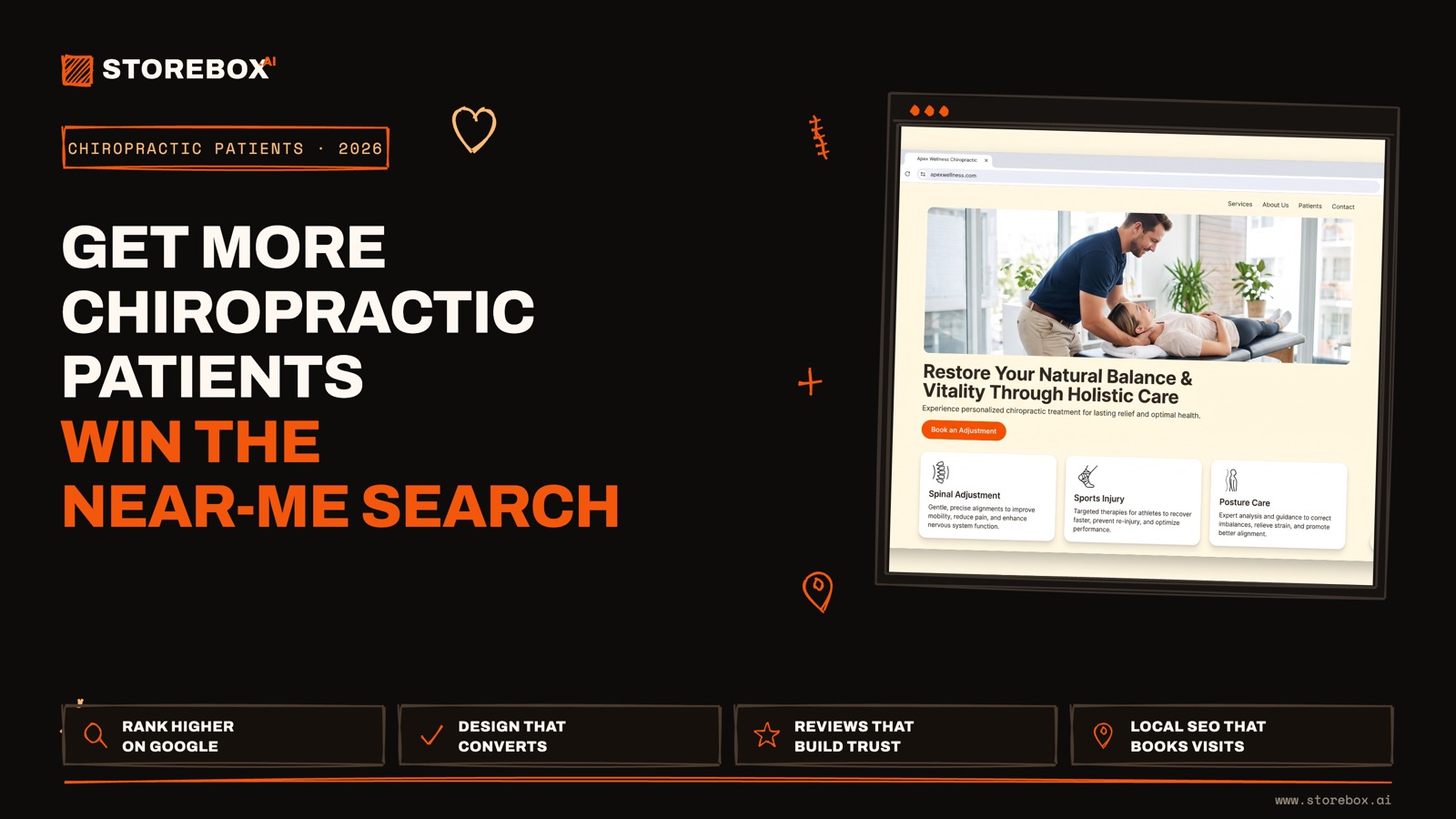
For years, a good adjustment and a happy patient were your whole marketing department. Word-of-mouth filled the books. But the patient who used to ask a friend for a recommendation now pulls out their phone and types "chiropractor near me" — and whoever shows up first wins the appointment, referral or not. So the real question of how to get more chiropractic patients in 2026 has quietly become a search problem: not "am I good enough," but "do I show up when a stranger in pain goes looking." The good news is you can fix that without a marketing degree. Below is exactly why the new patients are going elsewhere and the playbook to win them back.
Key insights▼
Why has word-of-mouth stopped filling your schedule?
It usually isn't your care, and it definitely isn't your results. You're losing new patients because the moment of decision moved online — and a referral from a friend now ends with that friend's name plus a Google search to "check them out" before anyone books.
Why does a referred patient still Google you before booking?
Because trust now gets verified on a screen. A friend's recommendation gets a new patient interested, but it almost never closes the appointment on its own anymore. They look you up. And what they find decides whether they call you or the clinic two blocks over.
The numbers are blunt. 72% of consumers read online ratings and reviews before booking with a new healthcare provider, and the same share said they prefer to choose a provider rated four out of five stars or higher (Reputation/YouGov, 2022 Healthcare Trends Report). It goes deeper than that for doctor-type decisions: in a Software Advice survey, 71% of patients used online reviews as the very first step to finding a new doctor, and 90% used reviews to evaluate physicians at all (Software Advice). The referral didn't disappear. It just stopped being the last step.
So the patient your happy regular told about you may never reach your front desk — not because they doubted the recommendation, but because your online presence didn't back it up, and the competitor's did.
Why does the bigger clinic outrank you even when you're better?
Two reasons, and they compound. First, they treat search like a budget line and you treat it like an afterthought. A multi-location group or a clinic with a marketing retainer runs ads on "chiropractor near me," keeps a stacked, active Google Business Profile, and asks every patient for a review. You rely on the work to speak for itself. It does — to the people already in your chair. It says nothing to the stranger searching at 9 p.m. with a stiff neck.
Second, the search itself rewards presence over quality. Google can't feel your adjustment. It ranks the clinic with the complete profile, the steady recent reviews, and the site that actually answers the searcher's question. 43% of patients said they'd even go outside their insurance network for a provider with favorable reviews (Software Advice) — so this isn't a small tiebreaker. Being the better chiropractor and being the findable one are two different jobs, and right now you're only doing the first.
Be the chiropractor they find first. When someone searches "chiropractor near me" at 9 p.m. with back pain, they should land on you — not the clinic across town. Get a website that ranks for $10 →
What's ranking now for "how to get more chiropractic patients" — and why you can still beat it?
Here's the honest read. We pulled the search results for this term, and the first page is wall-to-wall practice-management software and marketing agencies — ChiroTouch, Zocdoc, Zanda, ChiroUp, Noterro, and a dozen "we'll get you patients" agency pages. They're well-written, but they're all written to sell their tool or their retainer, and they answer the question in the abstract: "do local SEO," "get more reviews," "run ads." None of them is the page a working chiropractor can read and act on this week without buying anything.
That's the gap. The generic "marketing tips" angle is saturated and we're not going to out-shout a software company on its own keyword — so this guide does the harder, more useful thing: it's the specific playbook for the independent, single-location clinic who has no agency, no retainer, and needs the next ten new patients to come from a search they can actually win. The agencies own the keyword. They don't own the answer.
Skip the retainer. You don't need a $2,000/month agency to win "chiropractor near me" — you need three things set up right, once. Claim your $10 site →
How do you get more chiropractic patients from local search?
Stop thinking of marketing as advertising and start thinking of it as being findable at the moment of pain. Winning the "chiropractor near me" search comes down to three things working together: a Google Business Profile that lands you in the map, a wall of recent reviews that closes the click, and a website that turns a curious searcher into a booked first visit. Get these three right and you stop depending on word-of-mouth alone.
How do you win the Google "chiropractor near me" local pack?
The local pack — the three clinics shown with the little map at the top of a "chiropractor near me" search — is where the new-patient decision happens. It's worth fighting for: the map pack captures roughly 42% of all clicks on a local search, and the businesses inside it get about 126% more traffic and 93% more actions — calls, clicks, direction requests — than those ranked 4 through 10 (Search Engine Land). To get in:
- Claim and fully complete your Google Business Profile. Set the primary category to "Chiropractor," fill every field — services, hours, service area, insurance accepted — and add real photos of your office and team. A complete, active profile is the single biggest lever on whether you show in the 3-pack.
- Keep it alive. Post updates, answer questions, respond to every review. Google rewards profiles that look like a real, attended business — which a part-time competitor's neglected listing is not.
- Make your name, address, and phone identical everywhere. Your site, your profile, your directory listings should match to the character. Inconsistent info quietly kills your ranking.
This is exactly where most independents lose — not because they're hidden, but because their profile and their website don't reinforce each other. A platform like StoreBox builds your site and structures your Google Business Profile together so they point at the same searches and lift each other in the local pack — see the local SEO checklist every chiropractor needs ↗ for the full setup. You don't need a developer, and you don't need to babysit it.
How do you get more patient reviews — and why do they decide the click?
Ranking in the map gets you seen. Reviews get you chosen. When two clinics sit side by side in the local pack, the patient picks the one with more recent, higher-rated reviews — full stop. Remember, 72% won't even consider a provider rated below four stars (Reputation/YouGov), and 75% of consumers regularly read reviews before choosing a local business, with 81% reading them on Google (BrightLocal, 2024). So:
- Ask every satisfied patient, every time, while they're still in the office. The end of a visit where someone feels relief is the highest-yield moment you have. A simple "would you mind leaving us a quick Google review?" with a card or a texted link does more than any ad.
- Make it one tap. A QR code at the front desk and a follow-up text with a direct link to your Google review page removes the friction that kills most review requests.
- Respond to all of them — good and bad. 50% of consumers now trust reviews as much as a personal recommendation from a friend (BrightLocal), and a calm, professional reply to a rare negative review reassures the ten people reading it far more than a perfect-but-silent profile.
A steady review habit is the one thing the big clinic can't buy faster than you can earn it — every patient you already treat is a review you haven't asked for yet.
Turn happy patients into your best ad. A wall of recent five-star Google reviews wins the click before you say a word. Put it on a site built to show them off. Build your chiropractic site for $10 →
Which chiropractic website pages turn a searcher into a first visit?
Most independent clinic sites are a logo, an address, and a "request an appointment" form nobody fills out. That doesn't convert a stranger in pain who's comparing you to three other tabs. At minimum you need:
| Page | Job it does |
|---|---|
| "Chiropractor in [your city]" location page | Ranks for the exact "near me / in [city]" search a new patient runs |
| Condition pages (back pain, neck pain, sciatica, headaches) | Catches the patient searching the symptom, not the profession |
| Online booking page | Captures the lead at 9 p.m. when your phone goes unanswered |
| New-patient / what-to-expect page | Calms the nervous first-timer who's never been adjusted |
| Reviews + insurance + credentials | Answers "is this legit and will it be covered?" in one place |
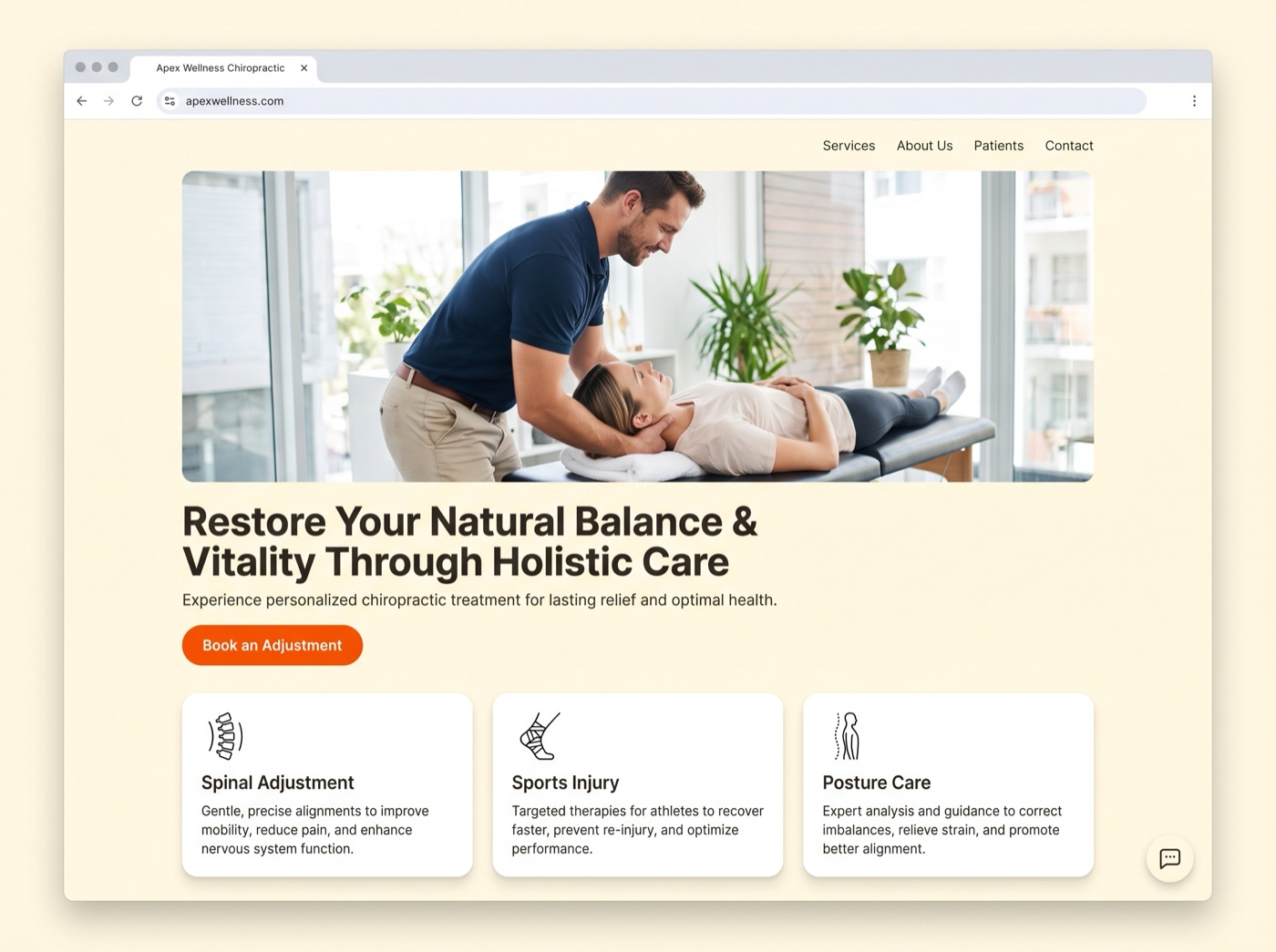
The patient searching "lower back pain relief [your city]" isn't looking for a chiropractor yet — they're looking for an answer. A condition page that gives it, then offers a booking, turns that searcher into your patient before they ever type "chiropractor." This is the whole point of a platform like StoreBox: it ships these pages as a structured template you fill with your own city, services, and conditions, so they're built to rank and built to book. (Want to know what to avoid first? See the 9 website mistakes that cost small businesses leads ↗.)
A site that books while you sleep. Online scheduling, condition pages, and your reviews — live this week, no developer. Build your chiropractic site for $10 →
How do you compete with a bigger clinic's marketing budget without one?
You don't outspend them. You out-focus them. The chiropractic market is huge and, more importantly, fractured: it's a roughly $21.9 billion industry made up of about 66,000 practices in the U.S., so fragmented that no single company holds even a 5% share (IBISWorld). That means there's no dominant brand to beat — just the clinic down the road, and you can beat them on the things money can't shortcut: a complete profile, genuinely local reviews, and pages built around the exact conditions and neighborhoods you serve.
A multi-location group spreads its marketing thin across a dozen cities. You only have to win one. Concede the obvious — yes, they can outspend you on ads. But ads stop the day the budget does, while a profile you completed, reviews you earned, and city-and-condition pages that rank keep working every night for free. Focused beats funded when the focus is this narrow.
Beat the budget with focus. One city, your conditions, your reviews — set up to rank long after a competitor's ad budget runs dry. Launch your site for $10 →
Frequently asked questions
How much does it cost to get more chiropractic patients?+
Is chiropractic marketing worth it for a small independent practice?+
How do chiropractic patients choose a clinic these days?+
How important are Google reviews for chiropractors specifically?+
How do I find a good chiropractor near me?+
Stop letting the next clinic win the patients you've earned
When a new patient goes looking — even one a happy regular sent your way — they reach for their phone before they reach for the door. If they can't find you in the map pack, see recent reviews, and book in two taps, your reputation never gets a say, and the clinic with the slicker setup wins by default. StoreBox builds the chiropractic website that ranks for "chiropractor near me," shows off your reviews, and turns a searcher in pain into a booked first visit — so the patients you've earned actually reach your front desk.
Build your StoreBox site — $10Sources
- Software Advice — How Patients Use Online Reviews (71% use reviews as first step; 90% use reviews to evaluate physicians; 43% would go out-of-network for good reviews) — https://www.softwareadvice.com/resources/how-patients-use-online-reviews/
- TechTarget / Reputation–YouGov — 2022 Healthcare Trends Report (72% read reviews before booking a new provider; 72% prefer 4+ stars) — https://www.techtarget.com/patientengagement/news/366584933/72-of-Patients-View-Online-Reviews-When-Selecting-a-New-Provider
- BrightLocal — Local Consumer Review Survey 2024 (75% regularly read reviews; 81% read them on Google; 50% trust reviews as much as a personal recommendation) — https://www.brightlocal.com/research/local-consumer-review-survey-2024/
- Search Engine Land — What Is the Google Local Pack? (3-pack ≈ 42% of clicks; 126% more traffic, 93% more actions) — https://searchengineland.com/guide/google-local-pack
- IBISWorld — Chiropractors in the US — Market Size (≈$21.9B; ≈66,000 businesses; no company >5% share) — https://www.ibisworld.com/united-states/market-size/chiropractors/1559/