How to Get More Construction Leads (Data-Backed)
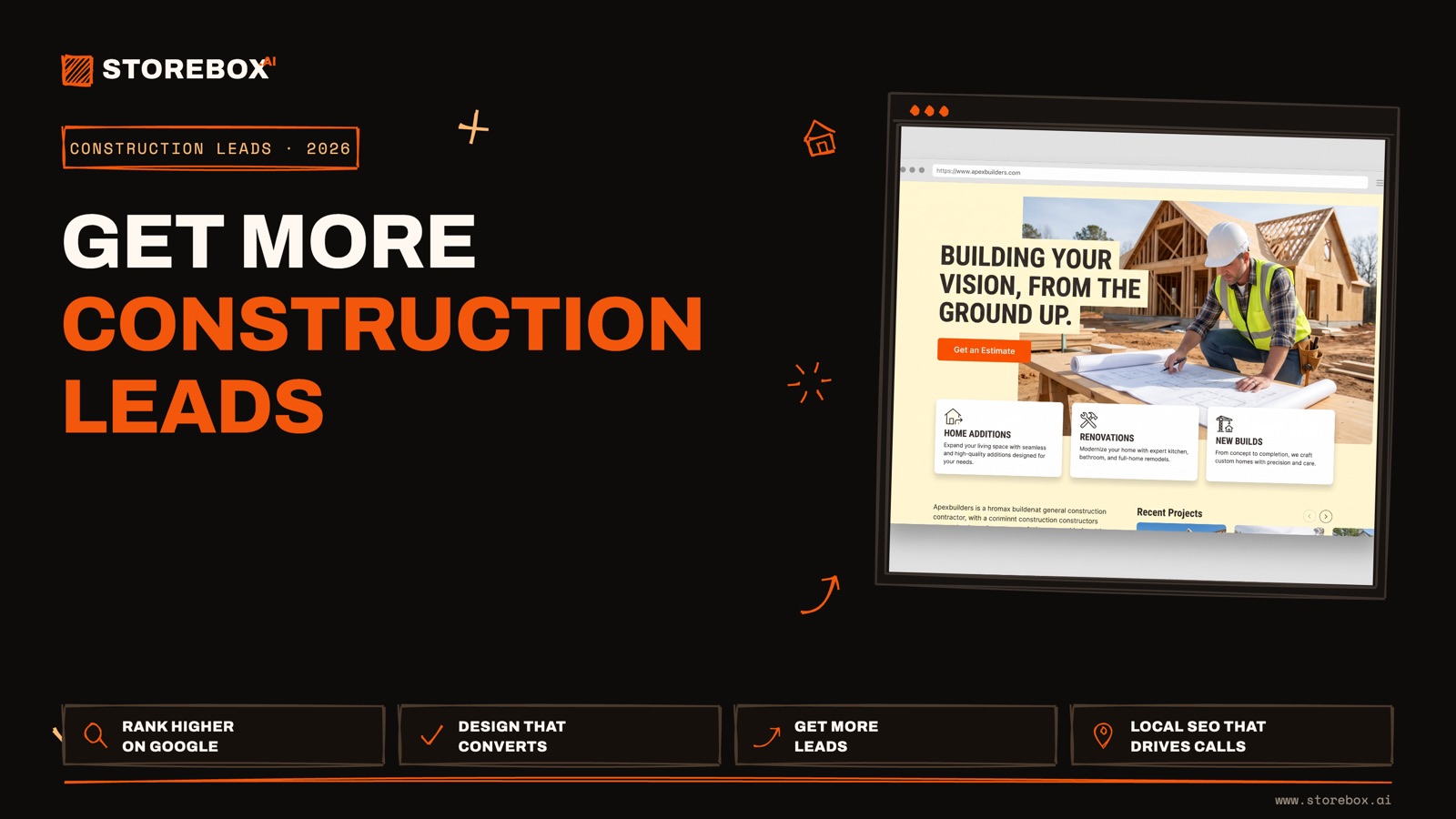
If you're a general contractor, the hard part of the job isn't the building — it's keeping a steady pipeline so the crew never sits idle. Most advice on how to get more construction leads sends you straight back to the same shared-lead platforms you're trying to escape: buy the lead, race four other contractors to the phone, lose to whoever lowballs hardest. So we went looking for what actually decides whether a GC gets the call — not what a marketing agency wants to sell you. Below is what we found, and the playbook to act on it.
Key insights▼
What do general contractors actually struggle with when getting work?
We didn't guess. StoreBox analyzed 136 real general-contractor discussions across online communities — owners talking to each other, not to a salesperson. The dominant themes were remarkably consistent. Reviews and reputation / referrals came up in about 23% of discussions — by far the loudest theme. Then, well behind it: finding steady leads and customers (~9%), scheduling and slow response to inquiries (~7%), and turning quotes and bids into signed jobs (~7%).
Read that order again, because it reframes the problem. The thing GCs talk about most isn't "I need more leads" — it's reputation, reviews, and referrals: the machine that produces leads on its own. The leads, the slow follow-up, and the bid-to-close gap are symptoms downstream of it. Fix the reputation engine and tighten the follow-up, and the lead problem largely takes care of itself.
This is directional — the share of discussions raising each theme, not a controlled survey — but the signal is strong and lines up with everything the outside research says about how homeowners choose a contractor. The rest of this guide goes deep on each of those four, in the order money flows.
Stop renting your reputation from Angi. When a homeowner searches your name and your trade, they should land on your site and your reviews — not a directory listing five competitors alongside you. Get a website that ranks for $10 →
How big is the opportunity, really — and why aren't you getting your share?
Construction is not a small pond. The U.S. construction sector is a roughly $3.7 trillion market, spread across more than 3.8 million businesses as of 2026 (IBISWorld). That fragmentation is the story: there's no dominant national brand homeowners default to. The job almost always goes to a local contractor — and which one wins is decided online, before a single conversation happens.
That's where most GCs leak. You're a great builder with a weak digital footprint, so the homeowner with a $60k renovation never finds you. They find the three contractors who show up on Google, read their reviews, and call them instead. The market size isn't your problem — your share of the search result is.
Why does so much of this come down to reviews and reputation?
Because that's how the buying decision gets made now. About 75% of consumers "always" or "regularly" read online reviews for local businesses, and only 3% never do (BrightLocal, 2024). For a project where someone hands a stranger their keys and a five-figure check, that's effectively everyone. And 81% of them read those reviews on Google (BrightLocal, 2024) — not on Angi, not on a directory. Your Google presence is doing the selling whether you manage it or not.
That's why "reviews and reputation" was the loudest theme in our analysis. The job goes to whoever the homeowner trusts, and trust is now public and searchable. The contractors winning aren't necessarily better builders — they're the ones whose reputation is visible at the moment of decision.
How to get more construction leads without buying them?
You build a system that turns your reputation into inbound calls — so you stop paying for shared leads and start owning the demand. Based on what GCs told us mattered most, that system has four parts, in order: a reputation that's visible online, a site that captures the searchers, follow-up fast enough to win, and a bid process that closes. Work them in that sequence.
How do you turn your reputation into leads instead of just hoping for referrals?
Word of mouth is real — 92% of consumers trust recommendations from friends and family over any other form of advertising (Nielsen, via RenoLeadz). But a referral isn't a closed loop anymore. Over 60% of homeowners who get a word-of-mouth referral still research online before deciding (RenoLeadz). Your buddy recommends you, the homeowner Googles your name — and if there's nothing there, or a half-built profile with two reviews, the referral dies on the results page.
So make your reputation searchable and undeniable:
- Ask for the review every time, by name and on Google. Recent, local, named reviews are both the trust signal and a ranking signal. Make it a standard step at job close, not an afterthought.
- Put your wins where searchers land. A real before/after gallery of jobs in their area, your license and insurance shown plainly, a clear list of what you do and don't take on. The referral that turns into a call is the one that gets confirmed the second they look you up.
- Own a page for your name and trade. When someone searches "[your company]" or "general contractor [your city]," your own site should be the top result — not a directory that surrounds you with competitors.
A platform like StoreBox builds this reputation hub for you — a site structured to rank for your name and service area, with the review, gallery, and trust sections already laid out so you just fill them with your work. See the 9 website mistakes that cost small businesses leads ↗ for the full list of what to fix.
Turn every finished job into your next lead. A site that shows your reviews and your work where homeowners actually look. Claim your $10 contractor site →
What does construction lead generation look like when you own the search instead of renting it?
Real construction lead generation is about being the contractor Google shows when someone in your area searches for the work — so the lead comes to you free, instead of bought five-ways-shared. The leverage point is local search, and the prize is the local map pack: the three businesses shown with the map above the regular results.
The map pack captures roughly 40–50% of all clicks on a local search, and businesses inside it earn about 126% more traffic and 93% more actions — calls, clicks, direction requests — than those ranked below it (Search Engine Land). To get there:
- Complete and work your Google Business Profile. Set the category correctly ("General contractor"), fill every field, and feed it real job photos. A complete, active profile is the single biggest lever on whether you appear in the 3-pack.
- Build a page for every city and service you offer. "Kitchen remodel in [city]," "home addition in [city]," "general contractor in [suburb]." A page matching the exact search beats a generic "services" page — and it's how a homeowner one town over finds you at all.
- Keep the reviews flowing with the city named. Recent local reviews rank you and reassure the searcher. A wall of "[your town]" reviews is something no out-of-area competitor and no directory can fake.
StoreBox builds your site, your city pages, and your Google Business Profile structure together so they reinforce each other and you actually land in the 3-pack — the full approach is in local SEO for contractors ↗.
Own the map instead of buying the lead. Website, city pages, and Google Business Profile, set up to rank so the calls come to you. Get your $10 contractor site →
Why are slow responses costing you jobs you already won?
Because the homeowner who fills out your form is also filling out three others, and the first contractor to call back usually wins. This is the most fixable leak in the funnel, and the data is brutal: a business that responds to a new lead within 5 minutes is about 100x more likely to make contact and 21x more likely to qualify it than one that waits 30 minutes (MIT / Oldroyd lead-response study, via CaseyResponse). Worse, 78% of customers buy from the first business that responds (CaseyResponse). The classic Harvard Business Review audit found the average company took over 42 hours to respond, and 23% never responded at all (CaseyResponse) — exactly the gap a fast GC walks through.
"Slow response" was its own theme in our analysis for a reason: you're on a roof all day, the inquiry sits, and by the time you see it the homeowner has booked someone. The fix isn't answering your phone mid-framing — it's capturing the lead cleanly and getting a fast acknowledgment out even when you're hands-deep in a job:
- Make the inquiry form dead simple. Name, project, location, photos. Every extra field is a homeowner who bounces.
- Auto-respond instantly. A site that texts or emails the moment a form comes in buys you the "first to respond" edge before you've put down the nail gun.
- Route it where you'll see it. The lead should hit your phone, not an inbox you check on Sundays.
A site built for this — instant capture, instant acknowledgment, the project details already organized — is part of what StoreBox sets up, so you stop losing won jobs to a slow callback.
Be the first callback, not the third. A site that captures the lead and pings you instantly — so you win the one who responds first. Build your $10 site →
How do you turn more quotes and bids into signed jobs?
Closing isn't about being cheapest — it's about being the contractor the homeowner already trusts by the time the number lands. "Quotes to closing the job" was a top theme in our analysis because too many GCs treat the bid as a price tag instead of the last step of a trust-building process. By the time you send the number, the decision is half-made on everything that came before: the reviews they read, the gallery they saw, how fast you got back to them.
So stack the deck before the price:
- Send the quote into a relationship, not a void. The homeowner who's already seen your reviews, your work, and gotten a fast, professional response reads your number very differently than one comparing three anonymous PDFs.
- Make the proposal itself credible. A clean, branded quote with scope, timeline, and what's included beats a number scrawled on a notepad — and signals you'll run the project the same way.
- Compete on accountability, not price. Your warranty, your license, your local reviews, your finished jobs in their neighborhood. That's what justifies not being the lowball bid — and it's the honest case, because the lowball bid is usually the one that goes sideways.
When your whole online presence does the trust-building up front, the quote stops being a coin flip. (Want to know what a site like that costs first? See what a small business website actually costs ↗.)
Win the bid before you send the price. Let your reviews and your work close the homeowner, so the number isn't the whole conversation. Launch your contractor site for $10 →
Frequently asked questions
How do I get more construction leads without paying for Angi or Thumbtack?+
How long does it take to rank locally and see leads from my own site?+
Why do I lose bids even when my work is better?+
How fast do I really need to respond to a new lead?+
How do I find a good general contractor near me?+
Stop buying shared leads and start owning your pipeline
The thing general contractors talk about most isn't leads — it's reputation. Get your reviews, your work, and your service area visible where homeowners actually search, respond before your competitors do, and the leads come to you for free. StoreBox builds the contractor website that ranks for "[your trade] in [your city]," shows off your reviews and finished jobs, and captures every inquiry the moment it comes in — so the pipeline stays full and the work stays yours.
Build your StoreBox site — $10Sources
- IBISWorld — Construction in the US — Market Size (~$3.7 trillion; 3.8M+ businesses, 2026) — https://www.ibisworld.com/united-states/market-size/construction/164/
- BrightLocal — Local Consumer Review Survey 2024 (75% regularly read reviews; 81% read them on Google) — https://www.brightlocal.com/research/local-consumer-review-survey-2024/
- Search Engine Land — What Is the Google Local Pack? (3-pack ≈ 40–50% of clicks; 126% more traffic, 93% more actions) — https://searchengineland.com/guide/google-local-pack
- CaseyResponse — Lead Response Time Statistics (2026): The 5-Minute Rule (5-min = 100x contact / 21x qualify; 78% buy from first responder; HBR 42-hr avg, 23% never respond) — https://caseyresponse.com/blog/lead-response-time-statistics
- RenoLeadz — How to Get More Word-of-Mouth Referrals (92% trust friends/family recommendations — Nielsen; 60%+ still research online after a referral) — https://renoleadz.com/blog/how-to-get-more-word-of-mouth-referrals-as-a-home-improvement-contractor/