How to Get More Physical Therapy Patients
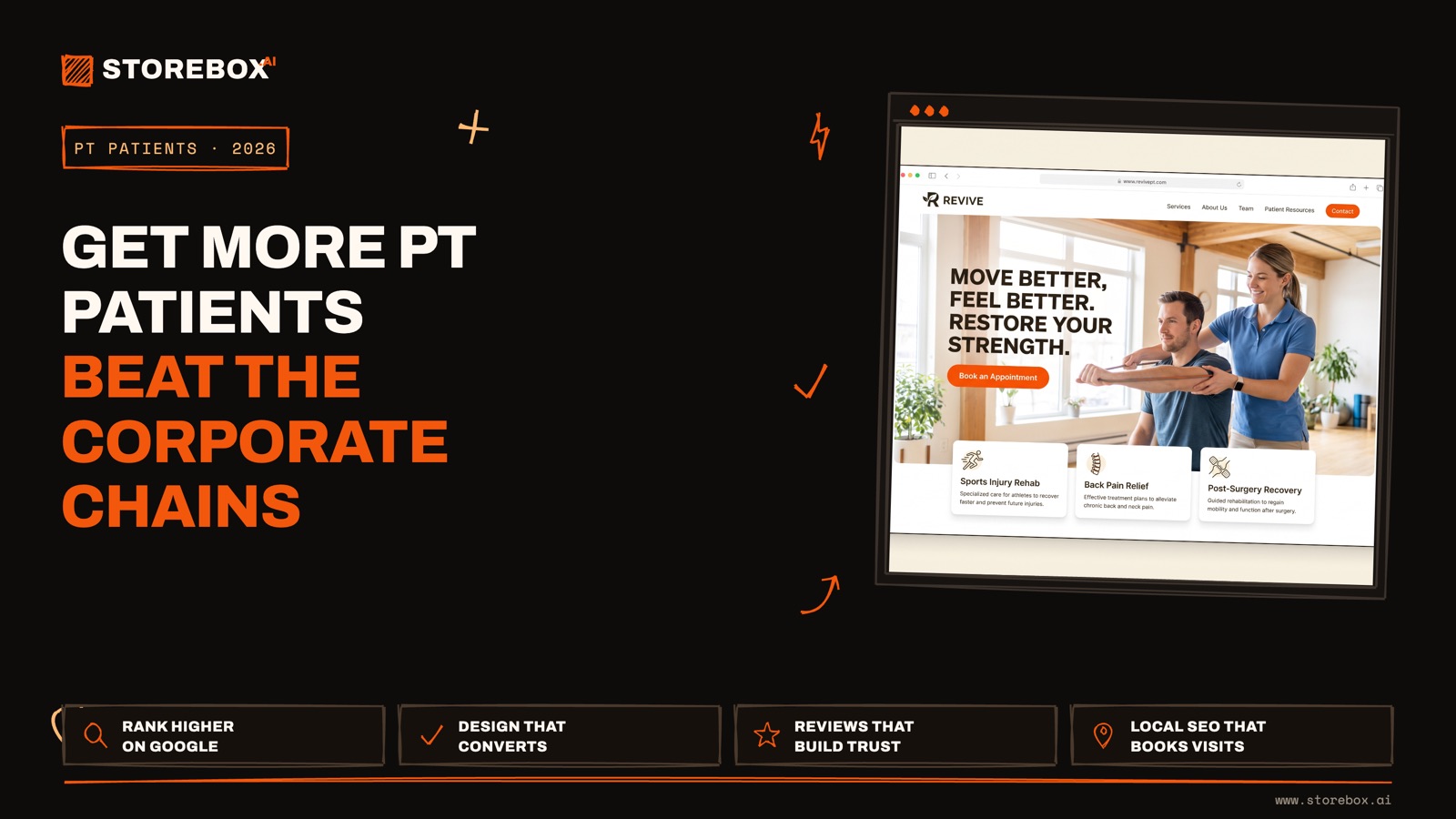
You didn't open your own clinic to fight a marketing war. You opened it so you could spend a real hour with a patient instead of stacking three on top of each other every fifteen minutes. But the patient down the street doesn't know that yet — they just type "physical therapy near me," click whatever shows up first, and that's usually the hospital outpatient center or the corporate chain with the bigger ad budget. So how to get more physical therapy patients as an independent comes down to one thing the chains can't out-spend you on: being the clinic your town actually finds and trusts online. Here's why you lose patients you should be winning, and the exact playbook to take them back.
Key insights▼
Why are independent PT clinics losing patients to hospital and corporate chains?
It usually isn't the quality of your care, and it's almost never your outcomes. You lose because the chain got found first — on Google, in the map results, and in the reviews — at the exact moment a person in pain decides who to call. By the time they'd have discovered that you offer a better, more personal hour of treatment, they've already booked somewhere else.
Is the physical therapy industry really consolidating around the big players?
Yes, and the numbers are blunt about it. The U.S. physical therapy clinic industry is worth about $53 billion and includes roughly 50,883 clinics — and it's a prime consolidation target precisely because it's still fragmented (Research and Markets via GlobeNewswire, 2025). The 50 largest companies — public operators and private-equity-backed roll-ups — already control about 29% of the market, and just six big chains (Select Medical, ATI, U.S. Physical Therapy, PT Solutions, Athletico, and one more) run 4,949 clinics, or 9.7% of every PT clinic in the country (WebPT).
Here's the part that matters for you: more than two-thirds of the market is still independent clinics like yours. Consolidation isn't a wall — it's a marketing-budget advantage that the chains are using while the SEO ground is still wide open. The patients are there. The chains are just easier to find right now.
Why does the chain get found before you do?
Two reasons, and they feed each other.
First, the decision happens online, before anyone makes a call. Over 60% of consumers run an online search before scheduling an appointment with a physical therapist — a higher share than for most other healthcare visits (Invoca / LSA, 2026). If your clinic doesn't show up for "physical therapy near me" or "PT for [their problem] in [their city]," you weren't even a candidate. The corporate chain with a polished site and a maintained Google profile was.
Second, reviews decide it once they do find you. A staggering 94% of healthcare patients use online reviews to evaluate providers (Invoca / Software Advice), and 84% check reviews before choosing a new provider — with more than half reading at least six before they decide (RepuGen). A thin or stale review profile loses to a chain's wall of recent ones, even when your actual care is better. The patient never gets to find that out.
Be the first clinic they find. When someone searches "physical therapy near me," they should land on you — not the chain three blocks over. Get a website that ranks for $10 →
What's ranking now for "how to get more physical therapy patients" — and why you can beat it?
Here's the opening. We pulled the search results for this query, and almost everything ranking is a generic listicle published by a software vendor — EMR companies, scheduling tools, and review apps (WebPT, Raintree, PTEverywhere, Empower EMR, Weave, Kinvent) running "10 ways to get more patients" posts. They're fine as far as they go, but they're written to sell their software to any clinic, so they stay vague: "build referral relationships," "improve your online presence," "ask for reviews." Useful in theory, but nobody's site got built or ranked from reading them.
What's almost entirely missing is the page written for your specific situation — the independent or cash-pay clinic that has to win direct-access patients and cash-pay patients on local search because it can't out-spend a hospital system or a PE-backed chain. The generic "physical therapy marketing" angle is crowded with vendors. The "independent clinic vs. the chains, and how you actually win the local search" angle is open. That's the gap you walk into — and because the competing pages are vendor content rather than purpose-built local pages, an independent clinic with a focused, well-structured site can outrank them in its own town without much trouble.
Stop reading tips. Start ranking. The vendors' listicles won't build your site. A page that targets your city and your specialties will. Claim your $10 site →
How do you get more physical therapy patients as an independent clinic?
The fix is to stop being the clinic that relies on a thinning trickle of physician referrals and start being the one your town already finds the moment someone's in pain. That means three things working together: a site that ranks for the searches patients actually run, a local presence the chains can't fake, and a review wall that makes you the obvious choice. Direct access is what makes this possible — in all 50 states, plus D.C. and the U.S. Virgin Islands, patients can now start care with a PT without a physician referral first; 21 states allow fully unrestricted direct access and the rest allow it provisionally (APTA, 2025). That legal shift means a patient can find you and book directly — but only if they can find you at all.
How do you build a PT website that ranks for the searches patients actually run?
Most patients don't search "physical therapy clinic." They search their problem. So build pages around the problems, not around your org chart:
- Make a page per condition, per city. "Physical therapy for low back pain in [your city]," "rotator cuff rehab in [your city]," "post-surgical knee PT in [your city]," "running injury PT in [your city]." A page targeting the exact search a person in pain runs will beat a generic "our services" page every time — and it's exactly where the chains are weakest, because their cookie-cutter sites rarely build out local condition pages.
- Answer the questions they're actually typing. Do I need a referral to see a PT? Will my insurance cover it, or what does cash-pay cost? How many visits will I need? Putting those answers on the page makes you the trusted expert before anyone walks in — and it's what direct access made possible, so say so plainly.
- Spell out the cash-pay option clearly. The patients you most want — direct-access, cash-pay people who'll do the full plan of care — are searching for transparent pricing and a real hour of one-on-one time. The chain's high-volume model can't promise that. Your page can.
This is exactly the gap a purpose-built site closes. A platform like StoreBox spins up condition-and-city pages structured to rank for the searches that matter, so an independent clinic can stand up a full local-SEO footprint without a developer — see the 9 website mistakes that cost small businesses leads ↗ for the full list of what to fix. You build it once and it keeps working while you're treating patients.
Which PT website pages turn a searcher in pain into a booked evaluation?
Most independent clinic sites are a logo, a phone number, and a stock photo of a stretch band. That doesn't convert against a chain's polished funnel. At minimum you need:
| Page | Job it does |
|---|---|
| Condition pages (per problem, per city) | Rank for the search the patient makes first — their specific pain |
| Direct-access / "no referral needed" page | Answers the #1 question and captures the patient physicians used to gate |
| Cash-pay pricing & insurance page | Converts the high-value patient the chains can't serve well |
| Online booking / request-an-eval page | Captures the lead before they bounce to the next result |
| Trust stack (credentials, specialties, real reviews, real photos) | Answers "is this place legit?" — where a personal clinic beats a faceless chain |
You don't need to build these by hand — that's the whole point of a platform like StoreBox, which ships these as a structured template you fill with your own specialties, pricing, and service area. (Want to know what a site like that costs first? See what a small business website actually costs ↗.)
All your patient-getting pages, no developer. Condition pages, a cash-pay page, online booking — ready to fill and go live this week. Build your PT clinic site for $10 →
How does an independent PT clinic win Google's local map results?
Ranking the pages only works if people see you. The local map results — the three businesses shown with the map — are where the "physical therapy near me" patient gets won, and they're a real weak spot for the chains, because a single local clinic with a complete profile and a year of genuine local reviews often outperforms a corporate location running on autopilot.
The map pack captures roughly 44% of all clicks on a local search, and the businesses inside it get about 126% more traffic and 93% more actions — calls, clicks, direction requests — than those ranked 4 through 10 (Search Engine Land). To get there:
- Fix and complete your Google Business Profile. Set the category to "Physical therapy clinic," fill every field — service area, hours, specialties, insurance/cash-pay info — and feed it a steady stream of real clinic and treatment photos. A complete, active profile is the single biggest lever on whether you show in the 3-pack.
- Earn reviews relentlessly, with the city and condition in them. Recent, local reviews are both a ranking signal and the thing that reassures a nervous patient — and 75% of consumers always or regularly read reviews, with 81% reading them on Google (BrightLocal, 2024). Reviews mentioning "my back pain" or your town do double duty.
- Build a page for every city and suburb you serve. A patient one town over won't find you if your site only names your home base. One service-area page per city turns "[that city] physical therapy" into a search you can win.
StoreBox builds your site, your city and condition pages, and your Google Business Profile structure together so they reinforce each other and you actually land in the 3-pack — the full approach is in local SEO for physical therapy clinics ↗.
Own the map, not just the referral. Website, city pages, and Google Business Profile, set up together so you rank when it counts. Get your $10 PT clinic site →
How do you stop depending on physician referrals to fill the schedule?
You can't out-network a hospital system that owns the orthopedic group upstairs and routes its own referrals downstairs. You don't have to. Direct access changed the rules — and the evidence is firmly on your side. APTA's 2025 review found direct access is safe, improves outcomes, and saves roughly $1,500–$1,800 per patient versus the physician-first pathway, with no adverse-event pattern across tens of thousands of direct-access visits (APTA, 2025).
So make direct access your front door. The patient who can find you, book without a referral, and read fifty reviews from people in their own town doesn't need a doctor to send them — and reviews are decisive here: 40% of patients say a review caused them to cancel or change a care decision (rater8, 2025). Concede the obvious — yes, the chain has the bigger ad budget and the hospital has the captive referral pipeline. But you have the thing they can't manufacture: a real local clinic, real reviews from real neighbors, and a full hour of care the high-volume model can't match. Put that in front of the searcher and you win the patient the chain was counting on getting by default.
Make direct access your front door. No referral needed — just a site patients can find and a review wall they trust. Launch yours for $10 →
Frequently asked questions
How do I get more physical therapy patients without relying on physician referrals?+
What's the best physical therapy marketing strategy for an independent or cash-pay clinic?+
Do patients need a referral to see a physical therapist?+
How do I find a good physical therapist near me?+
How much does it cost to get a new physical therapy patient, and is it worth it?+
Stop handing your patients to the chains
When someone in your town pulls a muscle or comes out of surgery, they reach for their phone before they reach for a referral. If they can't find you in that moment, your better care and your full treatment hour never get a say — the chain with the maintained profile and the wall of reviews wins by default. StoreBox builds the local physical therapy website that ranks for "[your city] physical therapy," captures direct-access and cash-pay patients, and turns the searcher in pain into your booked evaluation — so the patients stay independent, with you.
Build your StoreBox site — $10Sources
- Research and Markets via GlobeNewswire — U.S. Physical Therapy Clinics Market Analysis 2025 ($53B industry; 50,883 clinics; top 50 firms ≈ 29% share) — https://www.globenewswire.com/news-release/2025/05/02/3073073/28124/en/U-S-Physical-Therapy-Clinics-Market-Analysis-2025-53-Billion-Industry-Primed-for-Consolidation-M-A-Activity-Surges-in-Fragmented-Therapy-Sector.html
- WebPT — Is Consolidation Making the Independent PT Private Practice Go Extinct? (6 chains = 4,949 clinics, 9.7% of the industry) — https://www.webpt.com/blog/is-consolidation-making-the-independent-pt-private-practice-go-extinct
- APTA — State of Direct Access to Physical Therapist Services (2025) (all 50 states + D.C. + USVI; 21 unrestricted; saves ≈ $1,500–$1,800/patient) — https://www.apta.org/apta-and-you/news-publications/reports/2025/state-of-direct-access-to-physical-therapist-services
- Invoca — Healthcare Marketing Statistics (>60% search before booking a PT visit; 94% use online reviews to evaluate providers — LSA & Software Advice) — https://www.invoca.com/blog/healthcare-marketing-statistics
- RepuGen — Statistics on Patient Reviews for Healthcare Professionals (84% check reviews before choosing a provider; 51% read ≥6) — https://www.repugen.com/blog/statistics-on-patient-reviews-for-healthcare-professionals
- rater8 — How Patients Choose Their Doctors (2025 Report) (40% changed a care decision because of a review) — https://rater8.com/how-patients-choose-their-doctors-2025-report/
- BrightLocal — Local Consumer Review Survey 2024 (75% regularly read reviews; 81% read them on Google) — https://www.brightlocal.com/research/local-consumer-review-survey-2024/
- Search Engine Land — What Is the Google Local Pack? (map pack ≈ 44% of clicks; 3-pack: 126% more traffic, 93% more actions) — https://searchengineland.com/guide/google-local-pack
- WebPT — Key Metrics for Marketing & Sales for Physical Therapy Practices (LTV should be ≥ 3× acquisition cost) — https://www.webpt.com/blog/measuring-matters-key-metrics-marketing-and-sales-physical-therapy-practices