How to Get More Roofing Reviews (Win More Jobs)
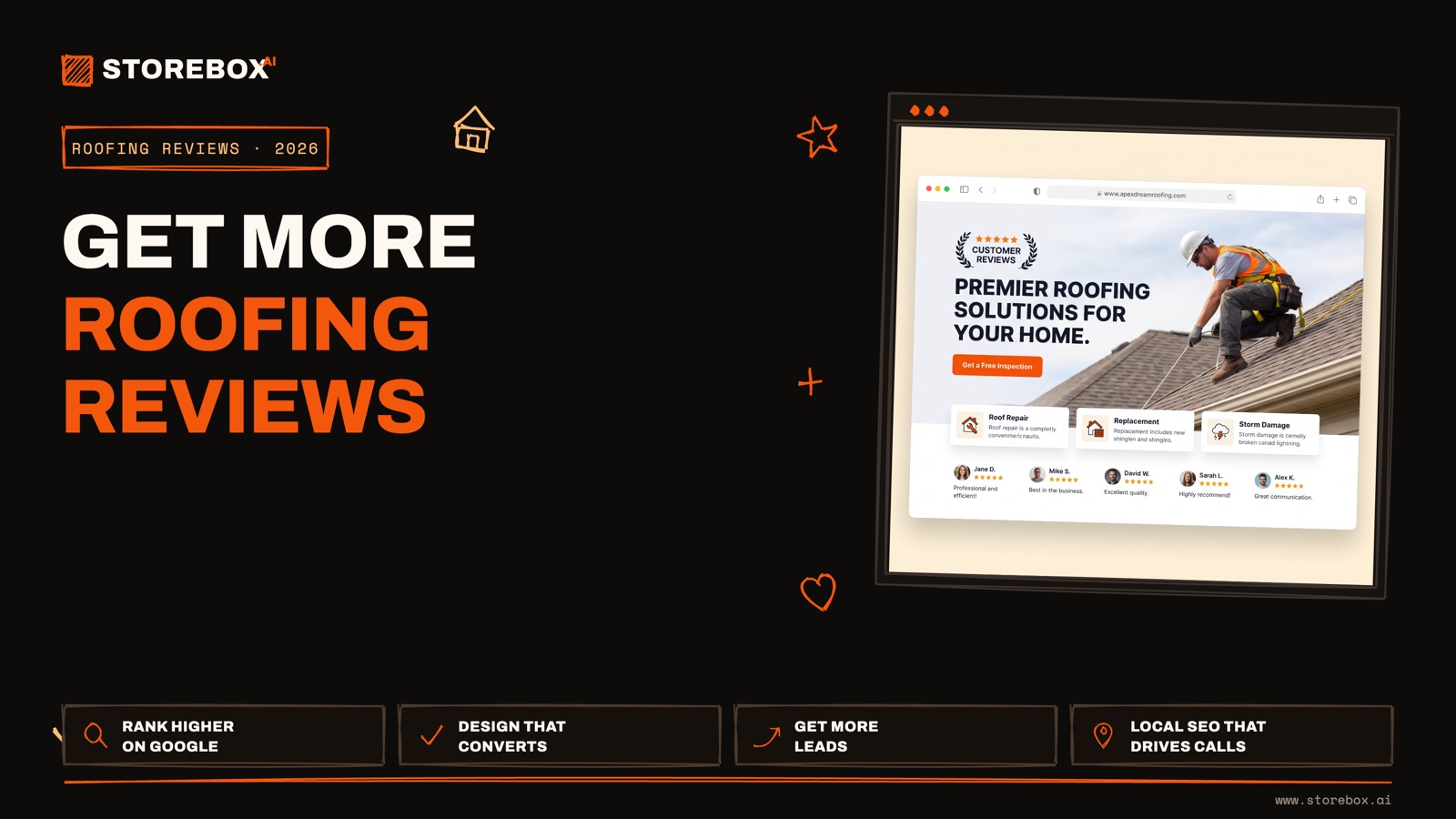
You already know the feeling. You give a sharp quote, the homeowner says they're "getting a couple more numbers," and then they go quiet — and a week later you find out they went with a shop whose work you wouldn't put on your own house. It usually isn't price, and it definitely isn't your craftsmanship. It's that the other contractor looked safer before either of you ever picked up the phone. Figuring out how to get more roofing reviews — and putting that reputation where homeowners actually look — is how you stop losing those jobs. It's a marketing problem you can fix without climbing a single ladder.
Key insights▼
What do roofers actually struggle with most?
Before getting to reviews, it's worth knowing this isn't a hunch. StoreBox analyzed 400 real roofing discussions across online communities — the places contractors and homeowners actually talk, not a marketing survey. Three themes dominated almost equally: turning quotes into signed jobs (about 20% of the conversation), getting a steady flow of leads (about 17%), and reviews and reputation (about 17%) — homeowners constantly asking some version of "did they do it right?" and "is this contractor trustworthy?"
Read those three together and a strategy falls out. Everyone obsesses over the middle one — leads. But the first and third are the same problem wearing two hats: trust. The homeowner asking "did they do it right?" before they sign is the same homeowner deciding whether your quote becomes a job. Reviews and reputation aren't a nice-to-have sitting next to lead generation — they're the lever that decides whether the leads you already pay for ever turn into work. This post is about pulling that lever.
Why do reviews decide which roofer gets hired?
Because the homeowner makes up their mind before they ever talk to you. Roofing is a high-stakes, infrequent, expensive purchase — most people hire a roofer once a decade, can't judge the work themselves, and are terrified of getting burned. So they outsource the judgment to people who already hired you. That's what a review is.
The numbers are blunt. Roughly 75% of consumers "always" or "regularly" read online reviews for local businesses, and 81% of them read those reviews on Google (BrightLocal, 2024). It gets stricter from there: 71% of consumers won't even consider a business with an average rating below three stars (BrightLocal, 2024). For a purchase as nervous-making as a roof, your star rating is a filter that decides whether you make the shortlist at all — before craftsmanship, before price, before your quote gets read.
And reviews don't just get you considered; they get you chosen. The Spiegel Research Center at Northwestern found that a product with just five reviews is 270% more likely to be purchased than one with none, and that displaying reviews lifted conversion rates as much as 380% for higher-priced items (Spiegel Research Center). A roof is about as higher-priced as a home purchase gets. The contractor with a wall of recent reviews isn't winning because they're better — they're winning because they removed the homeowner's fear first.
Stop losing jobs you already earned. A homeowner who can see twenty recent five-star reviews picks up the phone. Get a site that shows them off for $10 →
How to get more roofing reviews — what's the actual system?
The honest answer is that there's no trick, just a system the agencies bury under buzzwords. Most roofers get reviews by accident — the rare delighted customer who goes out of their way. The contractors with hundreds of reviews simply made asking a fixed step in every job, the same as cleanup or final invoice. Here's how to build that without paying for software you don't need.
When is the right moment to ask for a roofing review?
At the peak of the customer's happiness, which is almost always the moment the job is done and they're standing in the driveway looking at a clean roof and an empty dumpster. Not a week later in an email they'll ignore. The crew lead or the owner asks, in person, while the goodwill is fresh: "If you're happy with how this came out, the single biggest thing you could do for us is leave a quick Google review — it's how other neighbors find us."
A few rules that move the needle:
- Ask every customer, not just the big jobs. A small repair customer leaves a review just as easily as a full-replacement customer — and volume of recent reviews is what builds the wall. Don't ration the ask to your $20k jobs.
- Make it one tap. Hand them a card or a text with the direct Google review link (you can copy it straight from your Google Business Profile). Every extra step — searching your name, finding the profile, scrolling to the button — is a place you lose them.
- Ask in person first, follow up by text. The verbal ask gets the commitment; the text gives them the link while they still remember saying yes.
The bottleneck is almost never willingness — happy customers want to help. It's friction and forgetting. Kill both and the reviews come.
How do you make the review ask happen on every single job?
By taking it off the crew's memory and building it into the workflow. A review system isn't expensive software — it's a trigger and a consistent follow-up. The trigger is job completion. Every finished job, regardless of size, fires the same short sequence: in-person ask, same-day thank-you text with the review link, and one polite reminder a few days later if no review came in.
This is where most roofers leak reviews — the intention is there, but it lives in someone's head and dies under the next emergency callout. The fix is to attach the ask to something that already happens every time: the final invoice, the warranty hand-off, the closeout text. A platform like StoreBox sets up your site and Google Business Profile to work together so the review link is always one tap away and your incoming reviews actually land where homeowners see them — see the roofing website and SEO guide ↗ for how the pieces fit. You build the habit once; the reputation compounds on its own.
Make the ask automatic. The roofer with 200 reviews didn't get lucky — they made asking a step in every job. Set yours up for $10 →
What is roofing reputation management beyond just collecting reviews?
Collecting reviews is half the job. Roofing reputation management is the other half: responding to what comes in, putting reviews where buyers look, and handling the occasional bad one without panicking. Reviews you never respond to or never display are reviews working at a fraction of their power.
Why does responding to every review matter?
Because the homeowner is reading your responses as closely as the reviews themselves — and Google is watching too. 89% of consumers expect business owners to respond to reviews, 80% say they're more likely to use a business that responds to all of them, and 42% say they're unlikely to use a business that ignores its reviews entirely (BrightLocal). Responding is also a confirmed local-ranking input, with both the timeliness of the response and replying to positive and negative reviews playing a role.
So reply to all of them. Thank the five-star reviewers by name and mention the job ("Glad the new architectural shingles are holding up on Maple St."). For a critical review, stay calm, take it offline, and answer publicly in a way that shows you stand behind the work — because the next ten prospects are reading how you handle a problem, not whether you ever had one. A measured response to a bad review often sells better than a perfect record, which homeowners quietly find suspicious.
Where should your roofing reviews actually show up?
In the three places a homeowner looks before they call: your Google Business Profile, the local map results, and your own website. Most roofers earn reviews and then let them sit on a single profile. The contractors who win pipe them everywhere a nervous buyer might land.
The map results — the three businesses shown with the map — are the biggest prize, and reviews are the main thing that gets you in. The local pack captures roughly 44% of all clicks on a local search, and the businesses inside it earn about 126% more traffic and 93% more actions — calls, clicks, direction requests — than those ranked 4 through 10 (Search Engine Land). The #1 spot alone takes about 17.8% of clicks (Backlinko via OnTheMap). A steady flow of recent, local, keyword-rich reviews ("they did our roof in [your city]") is both a ranking signal that helps you land in that pack and the social proof that makes someone click you once you're there.
Then carry that proof onto your own site — a dedicated reviews page, star ratings on your service pages, and named testimonials next to the relevant job photos. StoreBox builds your site, your reviews page, and your Google Business Profile structure together so they reinforce each other and your reputation shows up in all three places at once — the full approach is in local SEO for roofing contractors ↗. Reviews trapped on one platform are reviews doing one-third of their job.
Put your reviews where they look. Google, the map, and your own site — your reputation should greet every homeowner who searches. Build it for $10 →
How do you handle a bad roofing review without losing future jobs?
You answer it like the professional you are and let the response do the selling. One bad review on a wall of good ones barely registers — what costs you jobs is silence or a defensive rant. Acknowledge the customer's experience, state plainly what you did or offered to do to make it right, and invite them to continue the conversation directly. You're not writing for the angry reviewer; you're writing for every future prospect who scrolls down and decides whether you're a contractor who owns problems or hides from them. Handled well, a single negative review surrounded by calm, accountable responses can make you look more trustworthy than a suspiciously spotless record.
One bad review won't sink you — ignoring it will. Show prospects you stand behind your work, on a site that puts your reputation front and center. Get yours for $10 →
How do reviews turn into a durable competitive edge?
Because in a market this big and this crowded, reputation is the one moat a competitor can't buy overnight. There are roughly 101,679 roofing contractor businesses in the U.S. generating about $92.5 billion a year (IBISWorld), which means in any given town a homeowner has a dozen names to choose from and almost no way to tell them apart — except by reviews. A long, recent, well-managed review history is the one asset a new competitor or an out-of-town crew can't fake or fast-track. They can match your price and copy your website; they can't manufacture three years of real neighbors vouching for you.
That's the whole reason to treat reviews as a system instead of an accident. Every job you finish without asking is a brick you didn't lay in a wall that, once built, quietly wins you work for years. The contractor who started a review habit two years ago is the one ranking in the map pack and closing quotes today. The best time to start was then; the second-best is the next job you wrap up.
Frequently asked questions
How many Google reviews does a roofing company need?+
Can I offer a discount or gift card for a review?+
What's the fastest way to get Google reviews for roofers?+
Do reviews actually help my roofing business rank on Google?+
How do I check if a roofer is trustworthy and find a good one near me?+
Build the reputation that books your jobs
When a homeowner searches for a roofer, they pick the one who already looks safe — and "safe" is spelled out in stars, recent reviews, and a site that puts them front and center. The work you do is already good enough to earn them; the only question is whether you're collecting that proof and showing it where buyers look. StoreBox builds the roofing website, reviews page, and Google Business Profile structure that turn your reputation into ranking and booked jobs — so the trust you've earned actually wins you the work.
Build your StoreBox site — $10Sources
- BrightLocal — Local Consumer Review Survey 2024 (75% always/regularly read reviews; 81% read on Google; 71% won't consider <3 stars) — https://www.brightlocal.com/research/local-consumer-review-survey-2024/
- BrightLocal — Responding to Online Reviews: Why & How (89% expect responses; 80% more likely to use a business that responds to all; 42% unlikely to use one that ignores reviews) — https://www.brightlocal.com/learn/responding-to-online-reviews/
- Spiegel Research Center, Northwestern University — How Online Reviews Influence Sales (5 reviews = 270% more likely to be purchased; up to 380% conversion lift on higher-priced items) — https://spiegel.medill.northwestern.edu/how-online-reviews-influence-sales/
- Search Engine Land — What Is the Google Local Pack? (3-pack: 126% more traffic, 93% more actions; ~44% of clicks) — https://searchengineland.com/guide/google-local-pack
- Backlinko via OnTheMap — Local SEO Statistics (map pack ≈ 44% of clicks; #1 spot ≈ 17.8%) — https://www.onthemap.com/blog/local-seo-stats/
- IBISWorld — Roofing Contractors in the US — Market Size (~$92.5B; ~101,679 businesses) — https://www.ibisworld.com/united-states/market-size/roofing-contractors/198/