Get More Therapy Clients in Private Practice
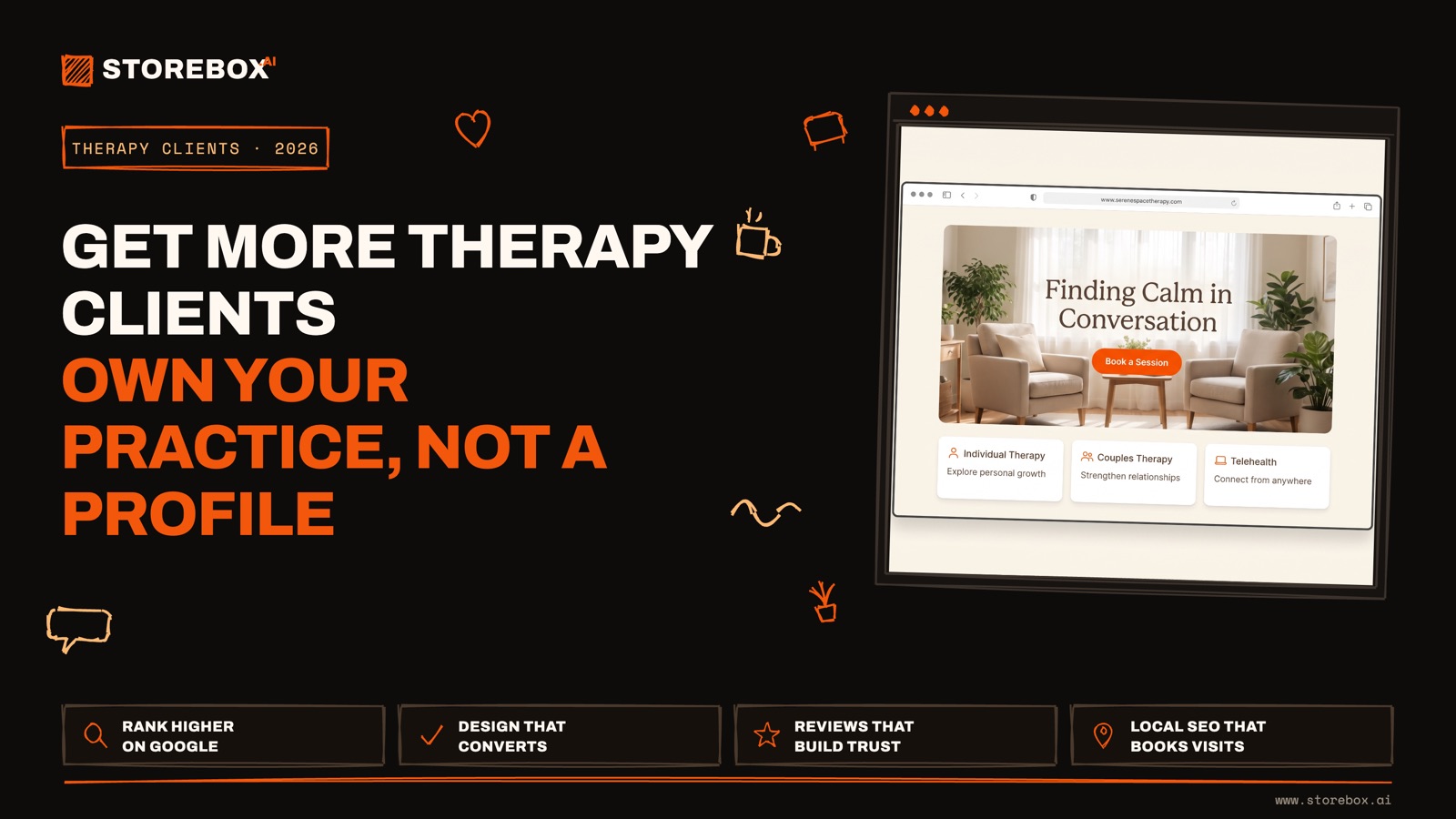
You went into private practice to do the work, not to fight an algorithm for it. But here's the bind every solo clinician runs into: the people who need a therapist near them are searching online, and what they find first is a VC-backed app or a directory page where you're listing #47 of 300. Figuring out how to get more therapy clients without handing a cut to BetterHelp or paying monthly rent to a directory is, underneath it all, a visibility problem — and it's one you can fix without taking a single extra evening intake. Below is exactly why you're invisible to local clients right now, and the playbook to put yourself back in front of them.
Key insights▼
Why can't local clients find you when the apps and directories can?
It usually isn't your clinical skill, and it definitely isn't your fees. You're hard to find because the moment a person in your town decides to look for therapy, the first results they see are built and funded to be found — and your practice, more often than not, has no real home of its own on the internet for them to land on.
Why are the teletherapy platforms outspending you for attention?
Because there's enormous money pushing them to the top of the page. The U.S. online therapy market sat at about $4.39 billion in 2025 and is projected to hit $14.10 billion by 2034 (GlobeNewswire / Towards Healthcare, 2025). Inside that market, the consumer apps are giants: BetterHelp alone has served more than 5 million people through a network of roughly 35,000 therapists (Towards Healthcare, 2025), and Calm, Talkspace, and BetterHelp together created a mental-health app segment worth about $2 billion (ResearchAndMarkets via BusinessWire, 2026).
That kind of capital buys the top of Google for the broad searches. You can't outbid it, and you shouldn't try. The good news is that their model has a built-in weakness you can exploit — they sell any therapist, anywhere. You can own the search they can't: the person who specifically wants someone local, in person, and theirs.
Why does a Psychology Today listing keep you stuck in a crowd?
Because a directory profile is a rented room in someone else's house, and you're sharing it with everyone else in your zip code. Psychology Today is the default that therapy-seekers see — by the company's own account, its directory appears as the top Google result for people searching for a therapist 96.2% of the time (Psychology Today). That sounds like a reason to be on it, and you probably should be. But think about what it actually does: it sends the searcher to a page of dozens of therapists, where you compete on a thumbnail and a paragraph, the directory keeps the ranking power, and the moment you stop paying, you disappear.
A directory profile makes you a result. Your own website makes you the result. Those are not the same thing, and only one of them compounds in your favor over time.
Stop renting your visibility. A directory profile vanishes the month you stop paying. Your own site keeps working. Get a website that ranks for $10 →
What's ranking now for "how to get more therapy clients" — and why you can beat it?
Here's the opening. We pulled the search results for this exact query, and almost everything ranking is a generic listicle published by a software company or a directory: Zencare, SimplePractice, Headway, BrighterVision, and a handful of practice-marketing agencies. The articles are fine as far as they go — "define your niche," "set up a profile," "post on social media" — but notice who wrote them. They're funnels. The directory's "11 ways to get clients" exists to sell you a directory listing; the EHR's version exists to sell you software.
What's almost entirely missing is the honest version written for the solo clinician: how to build a presence you actually own, so local private-pay clients find you directly instead of through a platform that takes a cut or a profile you rent forever. The "sign up for our thing" angle is crowded. The "own your own corner of local search" angle — tied to your city, your specialty, and your license — is wide open.
We're keeping the topic but sharpening the frame: this isn't another listicle of twelve tactics. It's the case for owning your visibility, and the three pieces that make it work.
Own the search, don't rent it. The therapist who shows up on their own site for "[your city] therapist" keeps every client they earn. Claim your $10 site →
How do you fill a private-pay caseload that's actually yours?
The fix is to stop being the therapist a platform occasionally surfaces and start being the one your town already finds directly. That means three things working together: a real website that ranks for local searches, a complete local presence the apps can't fake, and a wall of reviews that makes you the obvious safe choice. This is the heart of any serious private practice marketing plan, and it's where most clinicians never go because they think it requires a web developer. It doesn't.
Which website pages turn a local searcher into a booked consult?
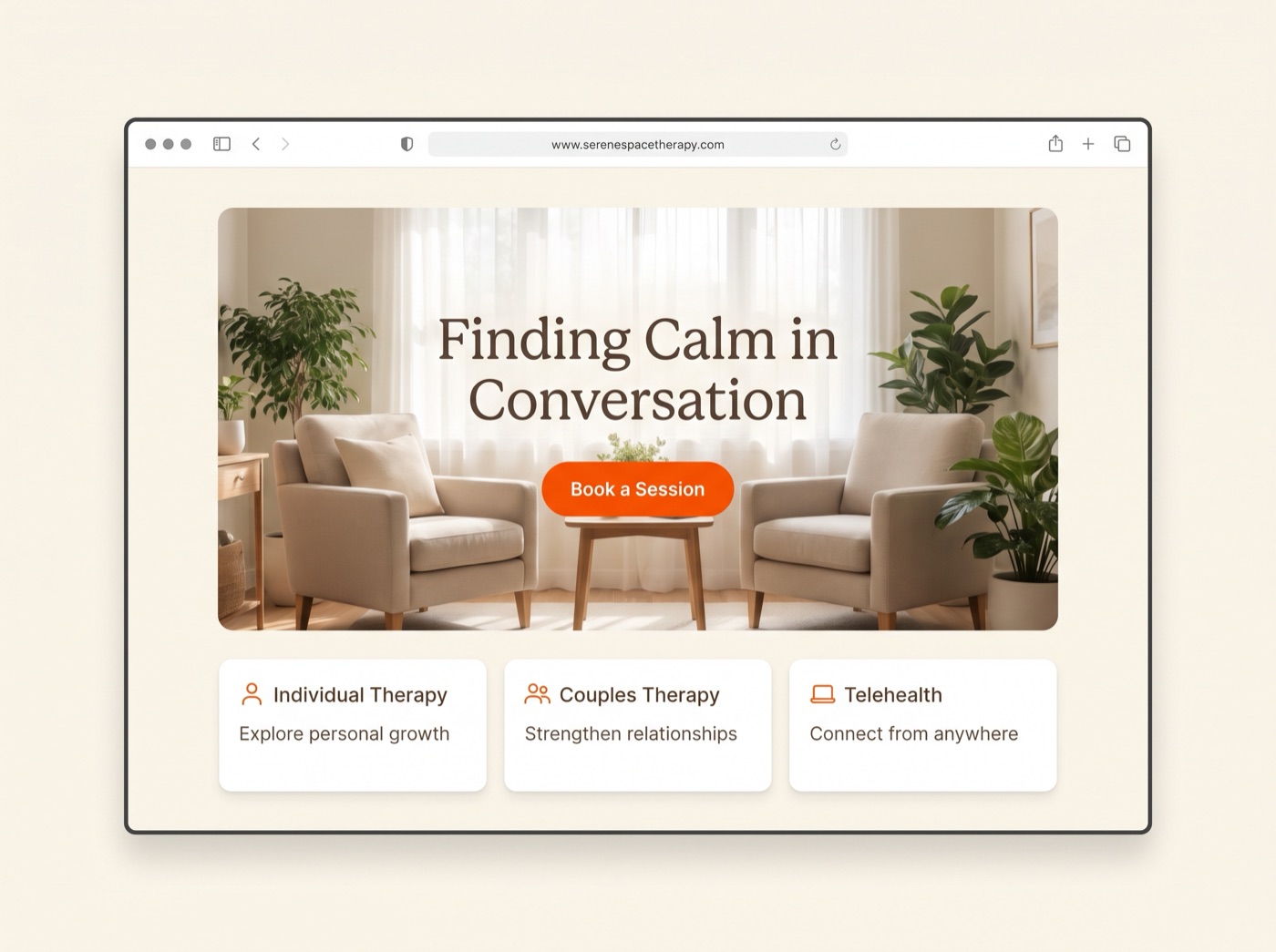
A profile photo and a phone number won't do it. The teletherapy apps win the broad search precisely because they answer the visitor's real questions on a purpose-built page. You can beat them locally by doing the same thing, focused on your community. At minimum you need:
| Page | Job it does |
|---|---|
| Home page naming your city + specialty | Ranks for "[your city] anxiety therapist" — the search the app can't target |
| A page per specialty you treat (anxiety, couples, trauma) | Matches the exact problem the searcher typed, not a generic "therapy" page |
| Fees & insurance / private-pay page | Answers the question that filters out the wrong-fit caller before they book |
| "What to expect in your first session" page | Calms the nervous first-timer the way a platform's slick onboarding does |
| About page with your license, training, and a real photo | Answers "is this person real and qualified?" — the directory thumbnail can't |
You don't need to build these by hand — that's the whole point of a platform like StoreBox, which ships these as a structured template you fill with your own specialties and your own city. (Want to know what to avoid first? See the 9 website mistakes that cost small businesses leads ↗.)
All your practice pages, no web developer. Specialty pages, fees, first-session — ready to fill and go live this week. Build your therapy site for $10 →
How do you get found for "therapist near me" instead of the big platforms?
This is where the apps are weakest and you are strongest. Roughly 46% of all Google searches have local intent, and 76% of people who run a "near me" search visit a business within a day (Google / Think with Google, via BiziQ). A national app can't be "near" anyone — but a real practice with a real address and a year of local signals can own that search. To get there:
- Claim and complete your Google Business Profile. Set the category to "Mental health service" or "Counselor," fill every field — service area, hours, the specialties you treat — and keep it active. A complete, current profile is the single biggest lever on whether you show up in the local map results, and it's free.
- Build a page for each city or neighborhood you serve. A client one town over won't find you if your site only names your home office. One service-area page per location turns "[that town] couples counselor" into a search you can actually win — exactly the kind of long-tail term the platforms ignore because there's no national volume in it.
- Keep your name, address, and phone identical everywhere. Your website, your Google profile, your directory listings — same details, character for character. Inconsistency is the most common reason a legitimate local practice never shows up on the map.
The private-pay angle matters here too. Clients are not as captured by the apps as the headlines suggest — in a 2024 study, 52.5% of clients preferred face-to-face therapy versus 24.1% who preferred teletherapy (client-satisfaction study, NCBI/PMC). The person who wants to sit in a room with you is the person searching locally — and the person you can actually charge a private-pay rate. Own that search and you own a caseload the platforms can't touch.
StoreBox builds your site, your city pages, and your Google Business Profile structure together so they reinforce each other and you actually land in the local results — the full approach is in local SEO for therapists and counselors ↗.
Be the "therapist near me" they find. Website, city pages, and Google profile, set up together so you rank when it counts. Get your $10 therapy site →
How do reviews and trust pages convince a nervous client to choose you?
Choosing a therapist is one of the most cautious purchases a person makes, and they vet you before they ever call. About 72% of patients read online reviews when selecting a new healthcare provider, and most prefer a provider rated four stars or higher (Reputation / YouGov Healthcare Trends Report). Reviews aren't just persuasion, either — they're a ranking signal. Roughly 75% of consumers regularly read online reviews for local businesses, and 81% read them on Google (BrightLocal, 2024).
Therapy has an ethics wrinkle most local trades don't — soliciting testimonials from current or former clients is restricted under most licensing boards' rules. So you build trust the compliant way: invite Google reviews from non-clients who can speak to you professionally (supervisees, colleagues, referral partners, workshop attendees), and put the rest of the trust stack on your own site where you control it — your license number, your training, your areas of focus, a clear photo, and a plain explanation of your approach. That combination answers the searcher's quiet question — "is this person qualified, and is this going to be okay?" — which a thumbnail in a directory never can.
Make trust the thing they find first. Your license, your approach, your reviews — on a site that ranks, not a profile you rent. Launch yours for $10 →
Frequently asked questions
Why am I not getting clients even though I'm a good therapist?+
Is it worth paying for a Psychology Today profile, or should I build my own website?+
How do I get more private-pay clients instead of insurance-rate or platform clients?+
How do I find a therapist near me?+
Do I really need a website if I'm already on the directories?+
Stop sending your local clients to a national app
When someone in your town decides they need a therapist, they reach for their phone first. If they can't find you in that moment, the VC-backed app and the crowded directory win by default — and you keep wondering why a good clinician has open slots. StoreBox builds the therapy practice website that ranks for "[your city] therapist," tells your full story, and turns the local searcher into your booked consult — so the clients down the street find you, not a platform that takes a cut.
Build your StoreBox site — $10Sources
- GlobeNewswire / Towards Healthcare — Online Therapy Services Market to Grow from USD 4.39 Billion in 2025 to USD 14.10 Billion by 2034 — https://www.globenewswire.com/news-release/2025/12/08/3201720/0/en/Online-Therapy-Services-Market-to-Grow-from-USD-4-39-Billion-in-2025-to-USD-14-10-Billion-by-2034.html
- Towards Healthcare — Online Therapy Services Market Sizing (BetterHelp: 5M+ people served, ~35,000 therapists) — https://www.towardshealthcare.com/insights/online-therapy-services-market-sizing
- ResearchAndMarkets via BusinessWire — U.S. Mental Health Treatment Market Report 2026 (Calm, Talkspace, BetterHelp = ~$2B app segment) — https://www.businesswire.com/news/home/20260113967219/en/U.S.-Mental-Health-Treatment-Market-Report-and-Directory-2026-Outpatient-Inpatient-Facilities-Apps-Therapists---Calm-Talkspace-and-BetterHelp-Created-a-$2-Billion-Market-Segment---ResearchAndMarkets.com
- Psychology Today — Join Psychology Today (directory = top Google result for therapy-seekers 96.2% of the time) — https://join.psychologytoday.com/us/signup
- Google / Think with Google, via BiziQ — Local Search Statistics (46% of searches have local intent; 76% of "near me" searchers visit within a day) — https://biziq.com/blog/local-search-statistics/
- NCBI / PMC — Assessing therapeutic alliance and client satisfaction across teletherapy, in-person, and hybrid modalities (52.5% preferred face-to-face vs 24.1% teletherapy, 2024) — https://www.ncbi.nlm.nih.gov/pmc/articles/PMC12794107/
- Reputation / YouGov — Healthcare Trends Report (72% of patients read online reviews when selecting a new provider) — https://www.techtarget.com/patientengagement/news/366584933/72-of-Patients-View-Online-Reviews-When-Selecting-a-New-Provider
- BrightLocal — Local Consumer Review Survey 2024 (75% regularly read reviews; 81% read them on Google) — https://www.brightlocal.com/research/local-consumer-review-survey-2024/