How to Get Real Estate Photography Clients in 2026
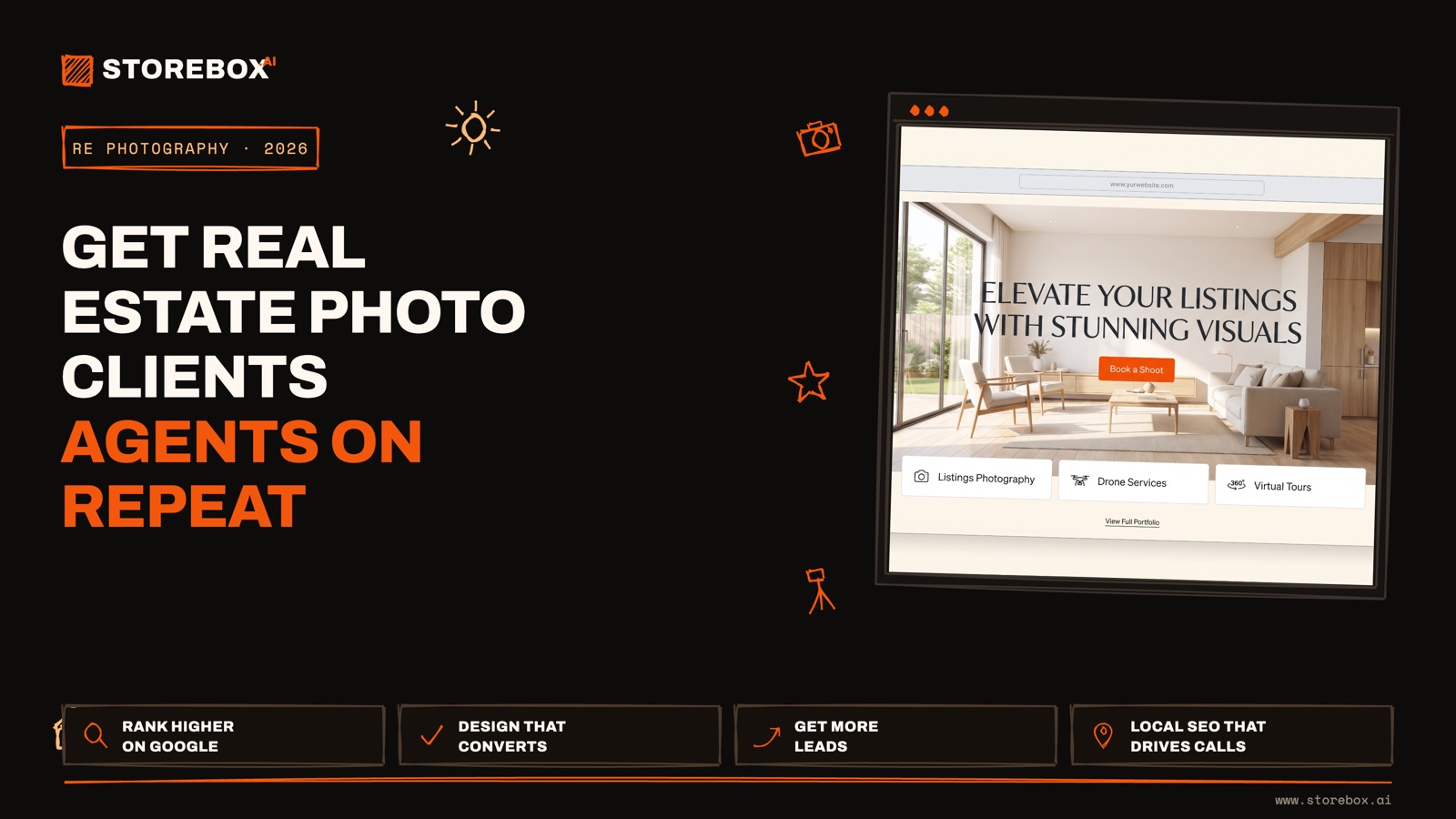
You know the grind. You win a shoot off a Facebook group or an undercut quote, you deliver gorgeous photos, the agent says "these are amazing" — and then you never hear from them again. So you go back to bidding against three other photographers on the next listing, shaving your rate to win it. Figuring out how to get real estate photography clients isn't really the hard part; the hard part is getting the same agents to call you back without a price fight every time. That's a marketing and visibility problem, not a camera problem — and below is exactly why one-off shoots stay one-off, plus the playbook to turn them into a roster of agents who rebook you on sight.
Key insights▼
- Why do your real estate photography clients only book you once?
- What's ranking now for "how to get real estate photography clients" — and why you can beat it?
- How do you get more real estate photography clients who rebook?
- How do you compete with cheaper photographers without dropping your rate?
- Frequently asked questions
Why do your real estate photography clients only book you once?
It usually isn't your photos, and it definitely isn't your turnaround. You lose the repeat business because nothing about your setup makes you the default — the photographer an agent reflexively books for their next listing without shopping around. You delivered files to an inbox and then disappeared. When the next listing comes up, you're one of several names, and the cheapest name wins.
Why is competing on price a trap for real estate photographers?
Because the photography market is huge, fragmented, and full of people willing to go lower than you. The U.S. photography industry runs about $15.8 billion a year across roughly 255,000 businesses, most of them solo (IBISWorld, 2025). You're competing against a sea of one-person shops, and the ones who win on price alone train agents to treat the work as a commodity.
The agents who only care about the lowest rate are exactly the ones who never refer you and never upgrade to a bigger package. Every shoot starts from zero. The way out isn't to be cheaper — it's to be the photographer an agent trusts enough to stop comparing, which is a reputation and visibility game, not a discounting game.
Why does an agent forget you the moment the shoot is over?
Two reasons, and they compound.
First, you're invisible between shoots. You sent a Dropbox link and went quiet. The agent has no portfolio to revisit, no website to bookmark, no easy way to forward "my photographer" to the agent at the next desk. You exist in their memory for about a week, then you're gone.
Second, the next agent who needs a photographer searches before they ask around. When an agent in your city googles "real estate photographer near me," whatever ranks — a competitor's clean portfolio site, a directory listing, a Google profile stacked with reviews — is who they call. If you have no findable presence, you weren't even in the running. Repeat business and referral business both leak out of the same hole: agents can't find you again when they're ready to rebook.
Be the photographer they can actually find again. When an agent needs a photographer next week, your portfolio should be the page they land on — not a competitor's. Get a portfolio site that ranks for $10 →
What's ranking now for "how to get real estate photography clients" — and why you can beat it?
Here's the opening. We pulled the search results for this exact query, and almost everything ranking is a generic listicle: "5 tips to get clients," "build a portfolio, post on Instagram, cold email agents." The pages come from photography-software blogs and stock-photo sites (Zenfolio, CubiCasa, Aryeo) plus a Facebook group thread. Useful as starter advice — but every one of them stops at "get your first client" and treats acquisition as the whole game.
What's almost entirely missing is the page that does the harder job: the playbook for turning a one-time shoot into a repeat, referring agent — the flywheel of a findable portfolio, a wall of reviews, and local visibility that makes rebooking automatic. The "how do I land my first gig" angle is crowded. The "how do I stop starting from zero on every listing" angle — the one that grows a photography business past the hustle phase — is wide open. That's the gap you walk into, so we're keeping the keyword but sharpening the angle: not just getting clients, but building the system that makes them stay.
Stop landing clients and start keeping them. The photographer who gets rebooked has a setup the one-off hustler doesn't. Claim your $10 portfolio site →
How do you get more real estate photography clients who rebook?
The fix is to stop being the photographer who delivers files and vanishes, and start being the one agents already find and already trust when the next listing hits. That means three things working together: a portfolio site that ranks and sells your work, a review wall that makes you the safe default, and local visibility so agents discover you before they ask a colleague.
How does a portfolio website turn one-off shoots into repeat realtor clients?
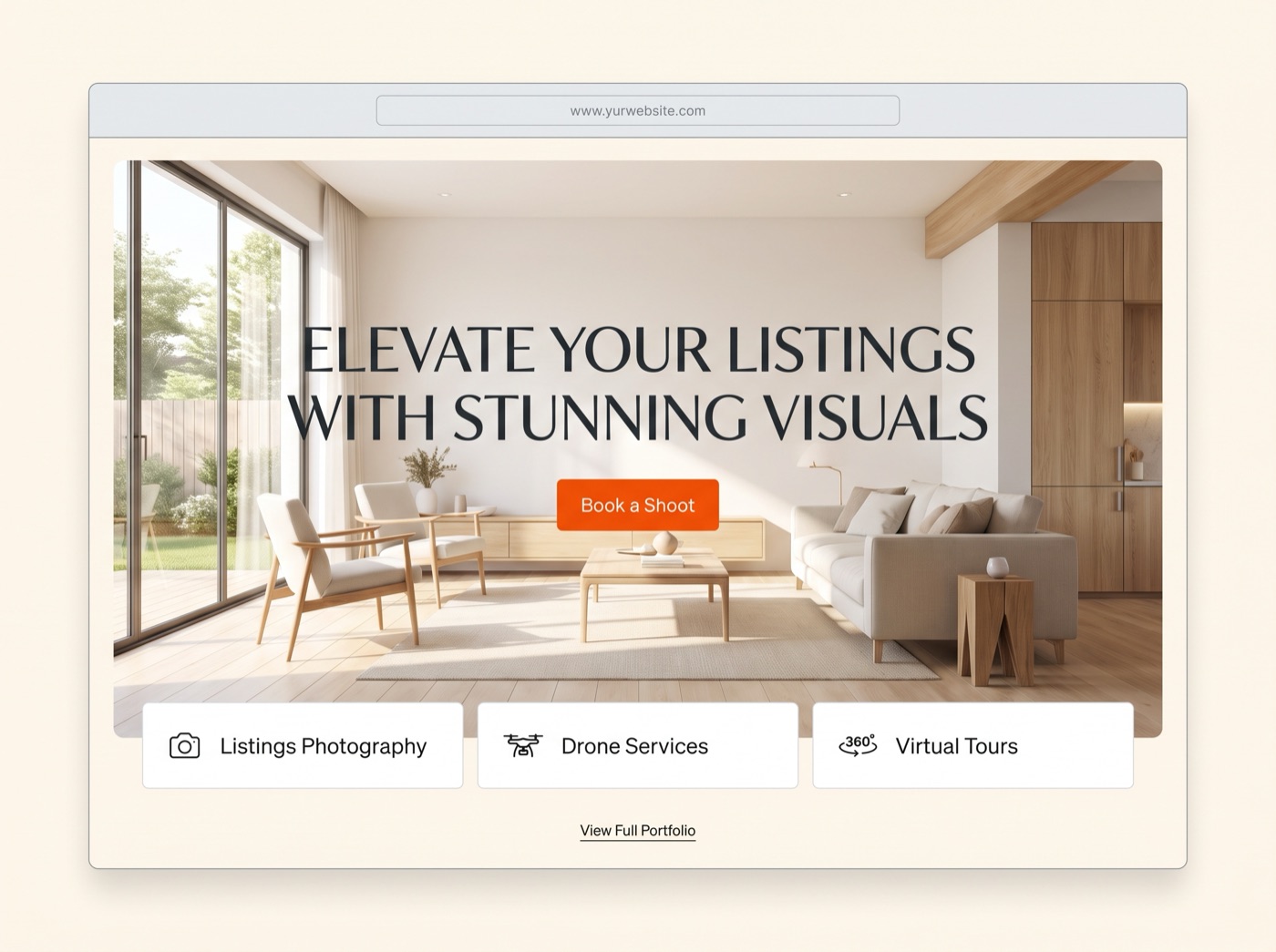
A Dropbox link is not a business. A portfolio website is the difference between "that photographer I used once" and "my photographer." Build one that does three jobs:
- Show the work an agent is actually buying. Agents don't hire photographers; they hire faster sales at higher prices. Lead your portfolio with the homes you've shot, organized by the thing they care about — bright, wide, listing-ready galleries — not your art project. Photos are the single most useful website feature to home buyers, ahead of property details and floor plans (NAR, 2024), and agents know it. Your portfolio should make that connection obvious.
- Make it dead simple to rebook and refer. A clear "book a shoot" button, your packages and turnaround times, your service area, and a one-click way to forward your page to another agent. The whole point is that the agent never has to go searching again.
- Be the thing they can bookmark and send. When an agent tells a colleague "use my photographer," they need a link to send. A real site is forwardable; a Dropbox folder is not.
This is exactly the gap a purpose-built site closes. A platform like StoreBox spins up a real estate photographer's portfolio site structured to rank and convert — galleries, packages, a booking page, and your service area — without a developer and without you touching code. See the 9 website mistakes that cost small businesses leads ↗ for the full list of what to fix; you fill it with your own work once and it sells for you between shoots.
Turn "that photographer I used once" into "my photographer." A portfolio agents can bookmark, rebook from, and forward — live this week. Build your photography site for $10 →
Which real estate photography website pages convince an agent to book you?
Most photographer sites are a logo, an Instagram feed, and a contact form. That doesn't close an agent who's deciding between you and two others. At minimum you need:
| Page | Job it does |
|---|---|
| Portfolio galleries (by property type) | Proves the work matches the listings the agent sells |
| Packages & pricing page | Answers "what does it cost and what do I get" before they email a competitor |
| Online booking / scheduling page | Captures the job before they call someone faster |
| Reviews & agent testimonials | Answers "will this go smoothly?" — your edge over the cheap unknown |
| Service-area pages (per city/suburb) | Ranks for "[city] real estate photographer" so new agents find you |
You don't need to build these by hand — that's the whole point of a platform like StoreBox, which ships these as a structured template you fill with your own galleries and your own service area. (Want to know what a site like that costs first? See what a small business website actually costs ↗.)
Everything an agent needs to say yes, on one site. Galleries, packages, booking, and reviews — no developer, ready to go live. Launch your portfolio for $10 →
How do reviews and referrals get you repeat real estate photography clients?
Here's the leverage most photographers ignore: agents are the most referral-driven buyers you'll ever work with. 66% of recent home sellers used an agent who was referred to them or one they'd worked with before, and 88% of buyers would use their agent again or recommend them (NAR, 2024). Agents live and die on repeat-and-refer — so they instinctively respect a service provider who runs the same way.
Reviews are how you prove it before you've even met. Roughly 75% of consumers always or regularly read online reviews, and 81% read them on Google (BrightLocal, 2024). An agent vetting a new photographer does exactly the same thing. So build the engine:
- Ask for a review at the moment of delight. The second you deliver photos the agent loves is when you ask — every single time. A standing request after every shoot is the difference between photographers who get steady referrals and those who don't.
- Put agent testimonials on the site, with names and brokerages. "Closed in 6 days, buyers said the photos sold them" from a named local agent beats any adjective you could write about yourself.
- Make referrals frictionless. A simple "know an agent who needs photos?" line and a forwardable link turns one happy agent into three.
StoreBox builds the review prompts and testimonial display into your site so the proof compounds with every shoot, instead of evaporating into a Dropbox link. The full approach is in the complete local SEO guide for small businesses ↗.
Let your last shoot sell your next one. A wall of named-agent reviews makes rebooking the obvious, safe choice. Get your $10 photographer site →
How does local visibility get agents to find you before they ask around?
A great portfolio only works if agents see it. When an agent needs a photographer and searches "real estate photographer [your city]," the names that show up — in Google's local map results and the organic listings under it — are the ones that get the call. That's where new agents enter your roster, and it's where you stop relying on Facebook-group scraps.
Buyers and agents alike start online: 52% of buyers found the home they purchased on the internet, every buyer uses the internet to search, and 70% search on a phone (NAR, 2025). The agents serving them are just as online — and they search for vendors the same way. To get found:
- Claim and complete your Google Business Profile. Set the category to "Photographer," fill every field — service area, hours, services — and feed it real listing photos. A complete, active profile is the single biggest lever on whether you show up in the local map results when an agent searches.
- Build a service-area page for every city you cover. An agent one town over won't find you if your site only names your home base. One page per city turns "[that city] real estate photographer" into a search you can actually win.
- Keep earning local Google reviews. Recent, local reviews are both a ranking signal and the thing that reassures a new agent you're the safe pick over the unknown low bidder.
StoreBox builds your portfolio, your city pages, and your Google Business Profile structure together so they reinforce each other and you actually surface when agents search — the full approach is in local SEO for photographers ↗.
Get found before they ask a colleague. Portfolio, city pages, and Google profile set up together so you rank when an agent needs you. Get your $10 photographer site →
How do you compete with cheaper photographers without dropping your rate?
You can't out-cheap a hobbyist with a kit lens, and you shouldn't try. The agent's real fear isn't your price — it's a shoot that goes sideways: missed light, a no-show, slow delivery, photos that don't move the listing. That fear is your whole pitch, and the data backs the value of getting it right.
Professional photos aren't a luxury for the agent — they're revenue. 85% of home buyers consider photos the most critical factor when evaluating a property online, and listings with professional photos get about 61% more views (NAR, via PhotoUp). And it shows up at the closing table: in Redfin's analysis, homes priced $200,000 to $1 million sold for $3,400 to $11,200 more relative to list price with professional DSLR photos, and homes around $400,000 sold roughly three weeks faster (Redfin). Frame your rate against an extra $10,000 on a sale and a faster close and you're not the expensive option — you're the obvious investment. Put that math, your reviews, and your turnaround on a site that ranks, and the low bidder stops being your competition.
Sell the outcome, not the hourly rate. Faster closes and higher prices are what agents actually buy — show it on a site that ranks. Launch yours for $10 →
Frequently asked questions
How do I get my first real estate photography clients with no portfolio?+
How do I get more real estate photography clients to rebook me instead of shopping around?+
How much should I charge for real estate photography?+
Is a website worth it for a real estate photographer, or is Instagram enough?+
How do I find a good real estate photographer near me?+
Stop chasing the next gig and start building a roster
When an agent needs photos, they reach for the photographer they can find, trust, and rebook in one click. If you're a Dropbox link and a memory, your best work never gets a second booking — the next low bidder wins by default. StoreBox builds the real estate photographer's portfolio site that ranks for "[your city] real estate photographer," displays your reviews, and makes rebooking effortless — so one shoot turns into a referring, repeat agent instead of another one-off.
Build your StoreBox site — $10Sources
- IBISWorld — Photography in the US — Industry Analysis (~$15.8B; ~255,000 businesses; ~1.1 employees/business) — https://www.ibisworld.com/united-states/industry/photography/1443/
- National Association of Realtors — Highlights From the Profile of Home Buyers and Sellers (photos most useful website feature at 41%; 66% of sellers used a referred/repeat agent; 88% of buyers would use their agent again) — https://www.bnar.org/about/news/nar-profile-of-home-buyers-and-home-sellers/
- National Association of Realtors, 2025 Profile (via summary) — (52% of buyers found their home online; every buyer used the internet; 70% searched on mobile) — https://www.bnar.org/about/news/nar-profile-of-home-buyers-and-home-sellers/
- PhotoUp (citing NAR) — Key Real Estate Photography Statistics (85% of buyers say photos are the most critical factor; pro photos = ~61% more views) — https://www.photoup.net/learn/key-real-estate-photography-statistics
- Redfin — Professional Real Estate Photos Sell Homes for More (DSLR photos: $200k–$1M homes sold $3,400–$11,200 more vs. list; ~$400k homes sold ~3 weeks faster) — https://www.redfin.com/blog/professional-real-estate-photos-sell-homes-for-more/
- BrightLocal — Local Consumer Review Survey 2024 (75% always/regularly read reviews; 81% read them on Google) — https://www.brightlocal.com/research/local-consumer-review-survey-2024/