How to Sell HVAC Maintenance Agreements (Data)
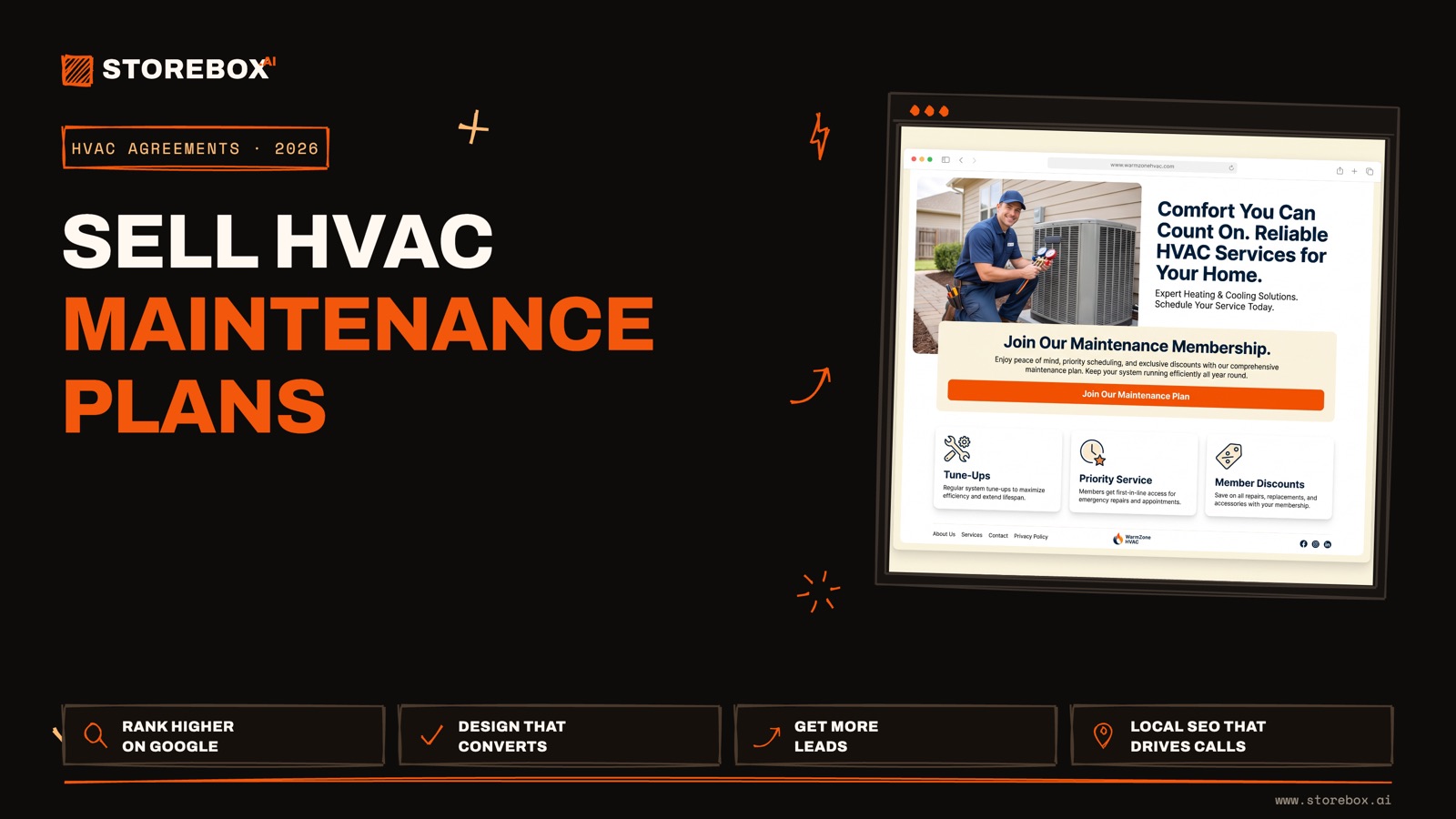
Most advice on how to sell HVAC maintenance agreements reads like a script handed down by a software vendor who has never lost a job to the guy across town. So instead of guessing, we went and listened. StoreBox analyzed 577 real HVAC discussions across online communities — the actual conversations homeowners and owners have when no sales coach is in the room. One theme towered over everything else: reviews and trust in the company showed up in roughly 25% of discussions — homeowners terrified of being upsold, telling stories where one tech says you need a whole new $24,000 unit and another fixes it for $400. Next came quote sticker-shock (~15%) and finding a steady stream of customers (~12%). This is a directional read of real talk, not a formal survey — but the pattern is unmistakable, and it points straight at the fix: the deepest pain in HVAC is trust, and the most powerful tool you have to win it is a transparent maintenance agreement.
Key insights▼
What do HVAC customers actually distrust most?
Not your wrench work. When you read 577 real discussions, the technical side of HVAC almost never comes up as the problem. What comes up — over and over, by a wide margin — is the company. Will they be honest with me? Are they selling me a repair I don't need? The single most dominant theme in our analysis was reviews and trust, at about a quarter of all discussions. The fear is specific and visceral: a homeowner gets two diagnoses on the same broken unit — "you need a new $24K system" versus "I can fix it for $400" — and has no way to know who's lying.
Here's the breakdown of what surfaced most often.
Look at the top three together and a single story emerges. The customer is scared of being upsold (trust), gets blindsided by a number (sticker-shock), and you, meanwhile, are scrambling to find the next one-time job (leads). All three are symptoms of the same disease: a relationship that begins and ends in a single, high-stakes, high-anxiety transaction. The maintenance agreement is the cure — it replaces that one tense moment with a standing relationship where you've already earned the trust before anything breaks.
Why does selling a maintenance agreement solve your trust problem?
Because it flips the entire dynamic. A one-time service call is adversarial by design: the customer assumes you have an incentive to find expensive problems, and the data says they're right to be wary. The fear is so dominant that 60% of consumers consider honesty and trustworthiness the single most important factor when choosing an HVAC contractor — ahead of price (FIELDBOSS 2025 HVAC Survey). And the same 1,000-homeowner survey found the top frustration isn't cost at all — about 38% named a communication or procedural problem (lateness, no updates, pressure sales) versus 21% who named price.
A maintenance plan answers that fear structurally. The member already knows you, has seen you do small honest work, and has a written agreement that says exactly what they pay and what they get — no surprises, no "trust me." You stop being a stranger they're scared to let in the house and become their HVAC company.
And the demand is already there: a 2025 survey found that 51% of homeowners now expect a membership or service plan from their home-service provider (Housecall Pro). Half your customers are waiting to be asked. Most owners just never ask.
Win the trust before anything breaks. A homeowner who already knows you won't fear the quote. Put your honest reputation where they search first. Get a website that ranks for $10 →
What's ranking now for "how to sell HVAC maintenance agreements" — and why can you beat it?
We pulled the live search results, and the first page is wall-to-wall field-service software vendors — ServiceTitan, BuildOps, FieldEdge, ServiceFusion, Sera — plus a marketing agency or two. They're competent, but they all read the same: a "5 tips" or "8 ways" listicle written by a content team that surveyed nobody, built to sell you their dispatch software at the bottom.
That's the gap. Those pages compete on volume and polish; they can't compete on evidence, and not one of them leads with what the customer is actually afraid of. This post is built on a first-hand read of 577 real discussions — the kind of original, experience-based signal Google's helpful-content guidance rewards and the software farm can't fake. So we sharpened the angle: instead of another generic checklist of "perks to bundle," this is a plan built around the one thing the data says actually sells the agreement — trust — and the recurring revenue that follows once you've earned it.
How do you sell HVAC maintenance agreements? Build the trust system
The plan follows the data. Win the trust, make the agreement easy to say yes to, prove it online so strangers convert too, and then let the recurring revenue compound. Here's each piece in order.
How do you design an HVAC maintenance plan customers actually trust?
Trust is designed into the plan, not pitched on top of it. The agreements that sell are the ones that remove the customer's fear of the unknown, so build yours around transparency:
- Spell out exactly what's included and what it costs — in writing. Two visits a year, a filter, a full inspection, a flat monthly or annual price. The whole point is that there are no surprises; that's what the sticker-shocked customer is buying.
- Lead with priority and protection, not the discount. Members get to the front of the line in a July heat wave and a written promise you won't recommend a replacement you wouldn't put in your own home. That peace of mind is worth more than 10% off a repair.
- Price it as a relationship, not a transaction. Residential agreements commonly run $300–$800 a year depending on scope (Coach Ellie Marshall). The number matters less than the framing: a small, predictable amount that makes the scary big repair far less likely.
The membership only works if a prospect can find the terms and believe them before they ever call. This is where a purpose-built site earns its keep — a platform like StoreBox spins up a clear maintenance-plan page that lays out your tiers, pricing, and the honesty promise in plain language, so the trust-building starts before the phone rings. See the full HVAC lead generation guide ↗ for the full checklist.
How do you actually sell the agreement at the kitchen table?
The best moment to sell a maintenance plan is the moment you've just earned trust — right after you've done honest work and not tried to upsell them. Selling to that warm customer is a different game entirely: across industries, the probability of selling to an existing customer is 60–70%, versus just 5–20% for a brand-new prospect (Marketing Metrics, Farris et al.). You're not cold-pitching; you're offering to keep doing the thing you just did.
To make the ask land:
- Frame it as protecting the investment they already made. "Your system's got good life left — here's how we keep it that way and avoid the $8,000 surprise." You're on their side against the breakdown, not selling against their wallet.
- Show the math honestly. A filter change and tune-up on a scheduled visit costs a fraction of an emergency replacement. Real numbers beat pressure every time — and pressure is exactly what the data says customers hate most.
- Make signing up frictionless. A simple online enrollment link they can use that night, after they've thought it over, closes more plans than a clipboard you shove across the counter.
It's also far cheaper to grow this way: it costs 5 to 25% less to keep an existing customer than to win a new one (Housecall Pro). Every agreement you sell is a customer you stop having to re-acquire every season. (Want to see what a plan page that converts looks like first? See the 9 website mistakes that cost small businesses leads ↗.)
Sell on the back of trust, not pressure. The warm customer is up to 14x more likely to say yes. Give them an honest reason and an easy yes. Launch yours for $10 →
How do you prove your trustworthiness online so strangers sign up too?
Your members trust you because they've met you. Everyone else is judging you from the search results — and that's where most of the trust problem lives, because the scared homeowner checks you out online before they ever let you in the door. 75% of consumers regularly read online reviews before choosing a local business, and 81% read them on Google (BrightLocal, 2024). A thin or stale profile reads as "this might be the company that upsells you," no matter how honest you actually are.
So make your reputation do the trust-building while you're on a call:
- Ask every member for a review, every time. The customer who just had a calm, no-pressure tune-up is your best reviewer. Recent, local reviews are both a trust signal to the next homeowner and a ranking signal that helps you show up at all.
- Put the honesty promise on the page. "We'll never recommend a replacement we wouldn't put in our own home" — backed by your license, your warranty, and real reviews — answers the exact fear that dominated our analysis.
- Show up on the map. The local map pack captures roughly 44% of all clicks on a local search, and the businesses inside it get about 126% more traffic and 93% more actions than those ranked below (Search Engine Land). That's where the trust-checking homeowner looks first.
StoreBox sets up your site, your maintenance-plan page, and your Google Business Profile together so your honest reputation actually shows up — and bakes the review request into the job flow so it goes out on its own. The full approach is in local SEO for HVAC contractors ↗.
Let strangers see what your members already know. Reviews, license, and an honesty promise where they search — that's how a stranger becomes a member. Get your $10 HVAC site →
Why do maintenance agreements build the recurring revenue (and business value) you want?
Because they turn a feast-or-famine seasonal business into a predictable one. This is the part the sticker-shock and lead-flow pains were really about: you're tired of starting from zero. Service-agreement customers fix that twice over. They generate roughly 25% higher customer lifetime value than one-time customers, because they call you — and only you — when it's time for the big replacement (Coach Ellie Marshall).
And the recurring book is the single most valuable asset you can build. When owners sell their companies, top maintenance-agreement books trade at 2 to 3 times their annual recurring revenue — buyers pay a premium for predictable, contracted income they know will renew (Main Street Wealth, 2026). Every plan you sell isn't just this month's $40; it's an asset that compounds and that someone will one day pay a multiple for.
In a market of roughly 120,461 HVAC contracting businesses generating about $158.4 billion a year (IBISWorld), most of your competitors are still living job-to-job, chasing the same scared one-time strangers you are. You don't have to out-hustle all of them. You have to be the one shop in your zip code that earned the trust, signed the agreement, and never has to start from zero again.
Stop starting from zero every season. A book of members is recurring revenue today and a premium-priced asset tomorrow. Build the site that grows it. Build your HVAC site →
Frequently asked questions
What is the easiest way to sell more HVAC maintenance agreements?+
How much should an HVAC maintenance plan cost?+
How do HVAC service agreements actually build recurring revenue?+
Why won't my customers sign up for a maintenance plan?+
Is an HVAC maintenance plan worth it?+
Stop chasing scared strangers one job at a time
The deepest pain in HVAC isn't pricing and it isn't the work — it's trust, and our analysis of 577 real discussions made that unmistakable. The maintenance agreement is how you answer it: it turns the one-time stranger who's afraid of being upsold into a member who already knows you, and it turns your feast-or-famine season into recurring revenue. StoreBox builds the HVAC website and maintenance-plan page that earn that trust where homeowners search, automate your reviews, and make signing up a one-tap yes — so you stop starting from zero every season.
Build your StoreBox site — $10Sources
- StoreBox — Analysis of 577 real HVAC discussions across online communities (directional read; reviews/trust ~25%, quote sticker-shock ~15%, leads/customers ~12%, website ~5%) — original StoreBox research
- IBISWorld — Heating & Air-Conditioning Contractors in the US — Market Size (~$158.4B in 2025; ~120,461 businesses) — https://www.ibisworld.com/united-states/market-size/heating-air-conditioning-contractors/1945/
- FIELDBOSS — HVAC's Real Problem Isn't Price, It's Poor Communication (2025 Survey, 1,000 homeowners) (60% rank honesty as #1 factor; ~38% name communication vs 21% price as top frustration) — https://www.fieldboss.com/blog/hvacs-real-problem-isnt-price-its-poor-communication/
- Housecall Pro — Generate More Revenue With HVAC Maintenance Plans (51% of homeowners expect a membership/plan; 5–25% cheaper to retain than acquire) — https://www.housecallpro.com/resources/value-of-hvac-maintenance-contracts/
- Marketing Metrics (Farris et al.) — Probability of Selling to Existing vs. New Customers (60–70% existing vs 5–20% new prospect) — https://www.linkedin.com/pulse/60-70-probability-selling-existing-customers-d-john-carlson
- Coach Ellie Marshall — HVAC Maintenance Agreements and Customer Lifetime Value (~25% higher CLV; residential plans ~$300–$800/yr) — https://coachelliemarshall.com/blog/hvac-maintenance-agreements-customer-lifetime-value
- Main Street Wealth — How Private Equity Values HVAC Maintenance Contracts (2026) (top agreement books trade at 2–3x annual recurring revenue) — https://mainstreetwealth.ai/resources/how-pe-values-hvac-contracts
- BrightLocal — Local Consumer Review Survey 2024 (75% regularly read reviews; 81% read them on Google) — https://www.brightlocal.com/research/local-consumer-review-survey-2024/
- Search Engine Land — What Is the Google Local Pack? (map pack ≈ 44% of clicks; 126% more traffic, 93% more actions) — https://searchengineland.com/guide/google-local-pack