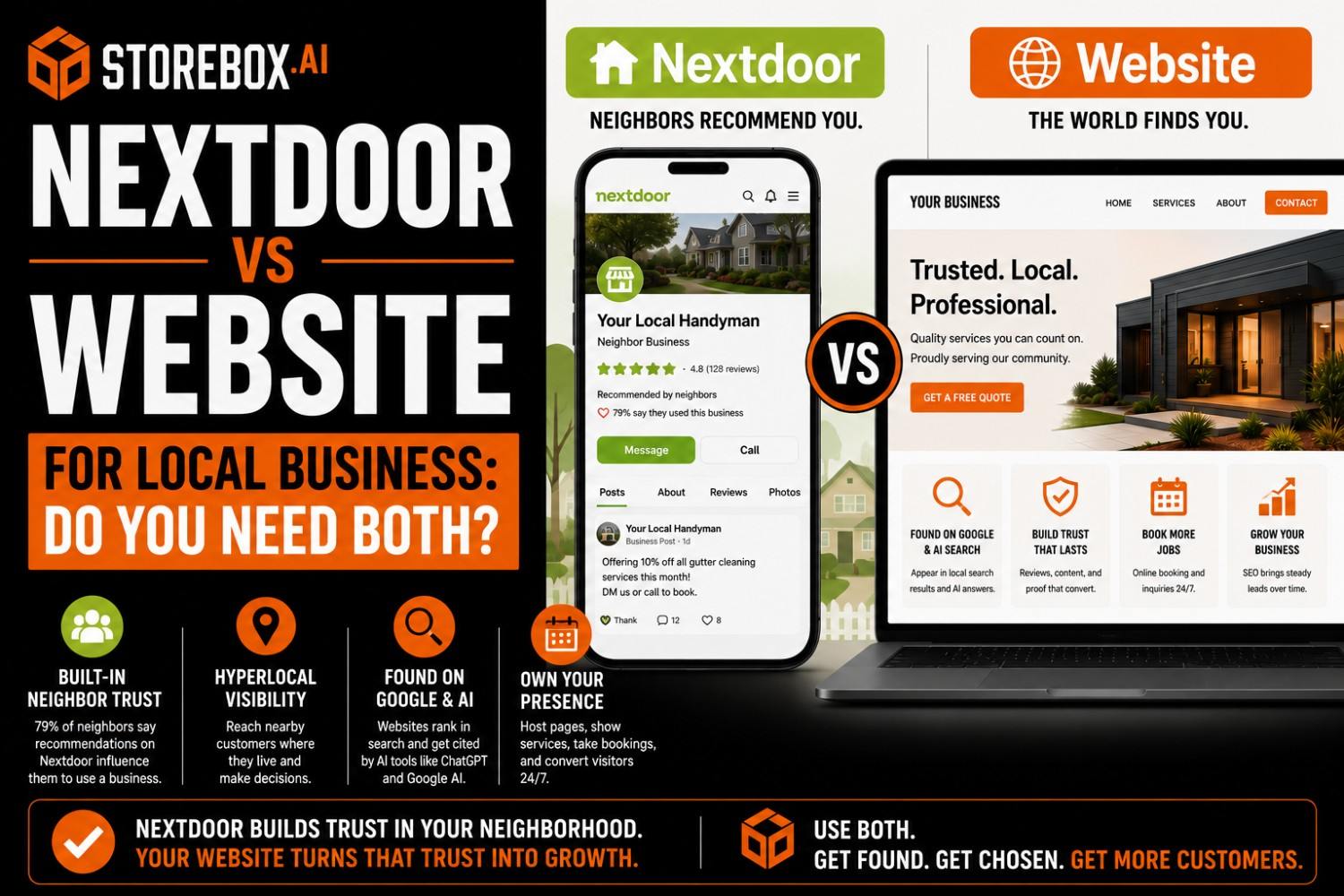
Key Takeaways
Nextdoor vs website for local business: what neighborhood trust does well, and what it structurally can't replace.
Expand key takeaways
- Claiming a Nextdoor business page is free and includes 2 free posts a month reaching neighbors nearby. Paid Local Deals and ads sit on top of that free tier and are optional.
- 79 percent of neighbors say a recommendation they saw on Nextdoor influenced them to visit a business or use a service, according to Nextdoor's own published data, making word of mouth the platform's real strength.
- Nextdoor business page cost stays at zero unless you run paid Local Deals, which typically average around $75 per deal, or self-serve ads billed per click.
- Nextdoor vs Google Business Profile isn't really a competition, since they solve different problems: Nextdoor builds neighborhood trust, GBP determines whether you show up on Google Maps at all.
- Do small businesses need a website if they have Nextdoor comes down to one fact: Nextdoor doesn't rank you on Google, doesn't get cited by AI tools, and can't host bookings, service pages, or SEO content the way an owned site does.
- Nextdoor is a strong channel for contractors and home service pros specifically, since "who does everyone use for X" is one of the most common post types on the platform.
Table of Contents
Nextdoor is a neighborhood-based social network built around verified addresses rather than public profiles anyone can follow. Residents use it to ask for recommendations, post local alerts, and talk about what's happening on their own street or in their own zip code, which is a very different setup than an open platform like Instagram or Facebook. For a small business, using Nextdoor usually means claiming a free business page, showing up when a neighbor asks "who does everyone use for X," and occasionally posting an update or an offer directly to nearby residents. That local, verified structure is exactly why Nextdoor vs website for local business deserves a real answer instead of a guess.
Do small businesses need a website if they have Nextdoor, or does neighborhood word of mouth cover what a website used to do. Nextdoor vs Google Business Profile is the comparison most owners get wrong, treating the two as interchangeable when they serve completely different purposes. Nextdoor business page vs website comes up constantly too, mostly from owners who've built a following on Nextdoor and are wondering if that following replaces a real site. How to advertise on Nextdoor for free is the most-searched version of this question, since most people don't realize there's a free tier at all before they start comparing costs. And once the free tier is understood, the follow-up question is nearly always the same one this article is built around: do small businesses need a website if they have Nextdoor already working for them, or does Nextdoor cover enough of the job on its own.
Nextdoor is unusually well trusted for a platform, since it's neighbors asking neighbors rather than an algorithm or an ad. That trust is real and worth taking seriously. It's also not a substitute for the things a website does, and the rest of this piece explains exactly why.
What Nextdoor Costs
Most owners never realize there's a free tier at all, which is exactly why how to advertise on Nextdoor for free is one of the most-searched phrases in this whole comparison.
The Free Tier
- A claimed Nextdoor Business Page costs nothing to set up or maintain
- Verified businesses get 2 free posts a month that reach neighbors in nearby areas
- Photos, a business description, and reply-to-recommendation features are included at no cost
- Completing the profile matters: pages with a logo and photo gallery get meaningfully more views than bare-bones listings
The Paid Tier
- Local Deals start as low as $1 to $3 per neighborhood, with an average cost of around $75 per deal
- Self-serve ads run on a cost-per-click model, typically $2.50 to $5.00 per click
- A solo operator testing a few neighborhoods usually budgets $100 to $300 a month
- An active local service business covering more ground often spends $500 to $1,500 a month
Nextdoor business page cost, in short, is zero until you choose to advertise, and from there it scales with how many neighborhoods you target and how competitive your category is locally.
Free tier or not, Nextdoor still can't rank you on Google.
A Storebox site handles the part neighborhood word of mouth structurally can't.
Do Small Businesses Need a Website if They Have Nextdoor?
Yes, and the reason is structural rather than a matter of Nextdoor being weak. Nextdoor is built entirely for discovery inside its own app. It has no mechanism for showing up in a Google search, no way to get cited when someone asks an AI assistant for a recommendation, and no built-in way to host service pages, a booking system, or long-term SEO content.
of neighbors say a recommendation they saw on Nextdoor influenced them to visit a business or use a service, per Nextdoor's own published data. That's real word of mouth, and it's exactly why the platform is worth using, just not as a replacement for the rest.
What Nextdoor Genuinely Does Well
- Builds trust fast, since recommendations come from real neighbors rather than strangers
- Surfaces "who does everyone use for X" conversations that are hard to replicate anywhere else
- Costs nothing to start, with a low-cost paid tier for extra reach
What Only a Website Does
- Ranks independently in Google search for the services and questions people search before they know your name
- Gets cited by AI tools like ChatGPT and Google's AI Overviews, which pull from structured websites, not neighborhood app posts
- Hosts detailed service pages, pricing, and booking flows that a Nextdoor page has no format for
- Builds SEO value that compounds over months instead of resetting with every new post
Nextdoor business page vs website isn't really a fair fight, since a Nextdoor page was never built to do the second list. It was built to do the first one, and it does that part well.
Nextdoor vs Google Business Profile: What Each One Does
These two get confused constantly, and the confusion is understandable since both show a business's name, photos, and reviews. The mechanics underneath are completely different.
| Platform | What it does | What it doesn't do |
|---|---|---|
| Nextdoor | Neighborhood word of mouth, recommendations, local trust | Doesn't rank you on Google, doesn't feed local SEO directly |
| Google Business Profile | Determines Google Maps and local pack visibility | Doesn't build the same personal, neighbor-to-neighbor trust |
| Website | Owned asset, ranks independently, cited by AI tools | Takes more upfront setup than either free listing |
Nextdoor vs Google Business Profile, put simply, is neighborhood trust versus map visibility. A Google Business Profile audit is worth doing regardless of how active you are on Nextdoor, since GBP is the one of the three that directly determines whether you show up when someone searches nearby on Google. Our comparison of Google Business Profile vs website covers that relationship in more depth if you want the fuller picture.
Get a free website draft in the middle of deciding where to focus? See what Storebox would build for your business before committing budget to any single platform.
Nextdoor for Contractors and Local Service Pros
This is where Nextdoor earns real depth rather than a passing mention, since it's one of the strongest channels for trades. "Who does everyone use for a good electrician" or "any recommendations for a reliable plumber" are some of the most common post types on the platform, and they convert well because the person asking is already close to hiring someone.
Why Nextdoor Works Especially Well for Trades
- Homeowners post specifically asking for recommendations, not browsing passively
- A single strong recommendation thread can generate several leads at once
- Trust transfers directly from a known neighbor to an unknown business
Why It Still Isn't Enough on Its Own
- Nextdoor recommendations aren't searchable the way a website's service pages are
- A contractor with no site has nowhere to send a Nextdoor lead to see pricing, past work, or booking availability
- The next homeowner searching Google for the same service won't find that same recommendation thread
If your trade is HVAC, plumbing, electrical work, or roofing, Nextdoor vs website for contractors resolves the same way every time: use Nextdoor for the trust it builds, but back it with a site that converts the traffic Nextdoor sends your way.
Nextdoor Reviews and Reputation
Nextdoor for business reviews works differently than Google reviews, and it's worth understanding the gap before assuming one covers the other.
Nextdoor recommendations build trust within the platform's own community
Does Nextdoor show up on Google: only in the narrow case where the platform's own domain ranks, not your specific business page
Nextdoor recommendations do not directly feed Google's local ranking algorithm the way Google reviews do
A consistent business listing across Nextdoor, Google, and other directories supports local SEO indirectly, through citation consistency, not through the recommendations themselves
Nextdoor vs Other Platforms
Nextdoor isn't the only local-trust platform worth comparing against a website, and the same core answer tends to repeat across all of them.
Nextdoor vs Yelp for business: Yelp leans on public star ratings and broader discovery; Nextdoor leans on private neighborhood trust. Neither replaces a website, as covered in our Yelp vs website comparison.
Nextdoor vs Facebook for local business: Facebook has wider reach but weaker local intent; Nextdoor's users are already thinking locally by design.
Website vs Nextdoor for small business, in every version of this comparison, comes down to the same gap: none of these platforms are owned, searchable the way a website is, or built to compound in value over time.
How Storebox Fits Into This Decision
Storebox builds websites for small businesses that want to keep their free Nextdoor presence while adding the one thing Nextdoor structurally can't provide: a site that ranks on its own, gets cited by AI tools, and gives every Nextdoor recommendation somewhere real to send people. The site can highlight your Nextdoor reputation and recommendations directly, so visitors see the same neighborhood trust without ever needing to leave your page.
%20(1).png)
Keep the free Nextdoor presence. Add the site that gives its recommendations somewhere real to land.
Highlights your Nextdoor reputation and recommendations directly on your own site
SEO and AEO plan gets your own domain found in Google search and referenced by tools like ChatGPT and Google's AI Overviews, both places a Nextdoor post simply doesn't reach
Our guide on answer engine optimization and how to show up in AI search results explain that gap in more detail
Our notes on affordable web design and common small business website mistakes are worth a look alongside this before you commit to a specific route
If you're weighing whether it's worth building a website alongside your Nextdoor page:
Do small businesses need a website if they have Nextdoor?
Is Nextdoor free for business, or do I need to pay for visibility?
Does Nextdoor help with local SEO or show up on Google?
Is Nextdoor worth it for a small business?
How does Nextdoor compare to Google Business Profile?
Can Nextdoor replace a website for my business?
Sources
Nextdoor already sends you neighbors who trust you. Give that trust somewhere real to land.
Start With a Free Website Draft →