Key Insights
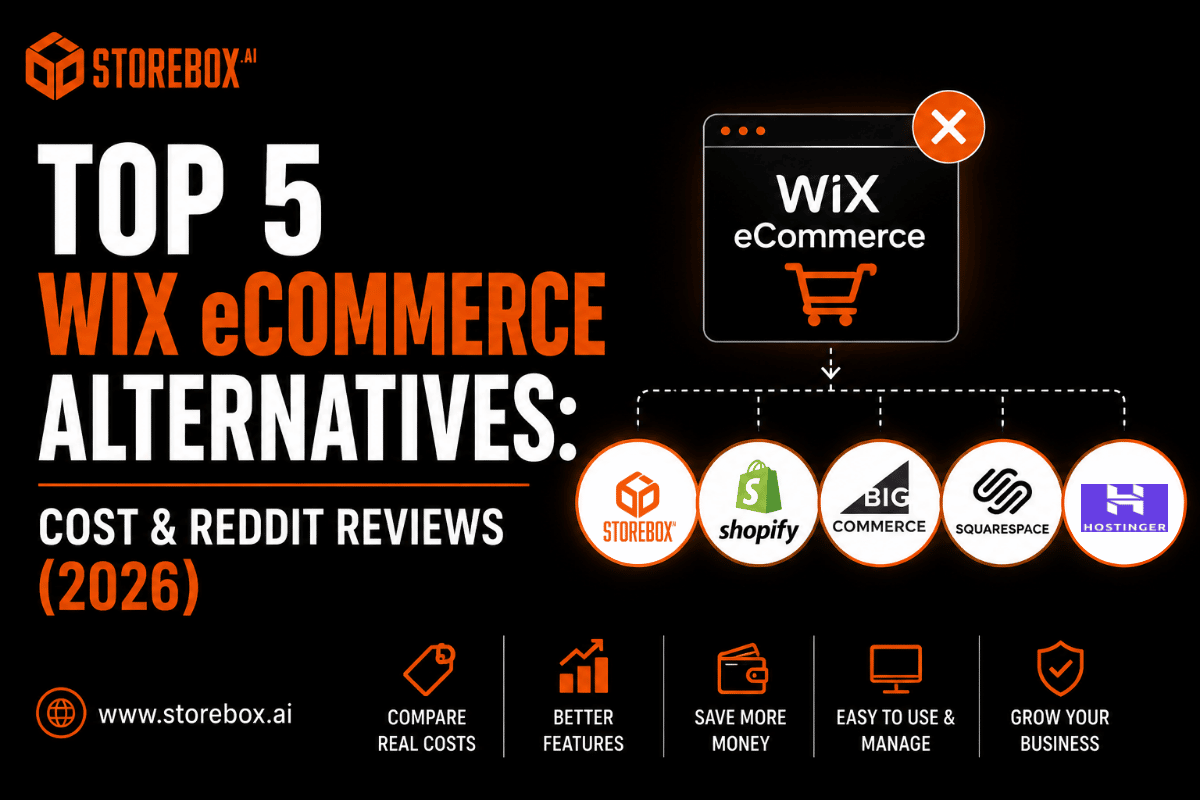
5 Wix ecommerce alternatives compared: real cost, Reddit reviews, and the builder ceiling most stores hit.
Expand key insights
- Wix ecommerce and Shopify solve the same problem from opposite starting points. Wix began as a website builder that added a store. Shopify began as a store platform that added website flexibility. That origin difference still shapes which one fits a given business better today.
- A common complaint from Wix store owners is that the builder feels slow and cluttered once a store grows past a handful of products. What works fine for a five-product hobby store becomes frustrating to manage as a catalog and promotion calendar expand.
- Wix's ecommerce plan pricing looks affordable until store owners add the apps needed for lead capture forms, advanced discounts, and inventory automation. Several of these are built into Wix's higher tiers only, or require third-party app subscriptions.
- Wix does not have a native integration with Shopify. Store owners wanting to run both simultaneously need a Shopify Buy Button or a third-party connector app, since the two platforms do not talk to each other directly.
- A done-for-you ecommerce website removes the ongoing builder management entirely, which is the specific gap most Wix alternatives still leave in place: nearly every option on this list still requires you to be the one building, updating, and maintaining the store yourself.
- Store owners switching away from Wix consistently cite two reasons: the site looking unpolished compared to competitors, and the builder becoming harder to use as the store grows. Both are structural issues with the DIY builder model, not something a new theme fixes.
Why People Look for Wix Ecommerce Alternatives
Wix ecommerce alternative searches spike for a consistent set of reasons, and real store owner complaints back this up directly.
▲
38
▼
r/ecommerce
• paraphrased, reflecting a common pattern
"I've had a few people tell me the website looks a bit cheap and feels clunky." The original poster was running a model kit store on Wix and specifically wanted something that kept Wix's easy on-the-fly product and pricing edits, just with a more professional look and feel.
💬 Reply
➦ Share
🏆 Award
⋯
That specific complaint, cheap-looking and clunky, comes up repeatedly from small store owners who started with Wix because it was quick to set up, then found the visual polish did not match competitors as their store matured.
▲
24
▼
r/WIX
• paraphrased, reflecting a common pattern
"It's becoming frustrating to make even simple changes, and on top of that, the pricing is getting pretty expensive for what I'm getting." The complaint points to the two most common reasons for researching Wix ecommerce competitors: the builder becomes harder to use as a catalog grows, and the cost climbs once you need functionality not included in the base tier.
💬 Reply
➦ Share
🏆 Award
⋯
Both of these are structural, not cosmetic. A new theme does not fix a builder that has become slow to navigate. A pricing tier upgrade does not fix a site that still looks like a template. This pattern is not unique to Wix. Any ecommerce website builder built around drag-and-drop editing faces the same trade-off eventually: what makes setup fast for a beginner becomes friction once a catalog, a promotion calendar, and multiple product variants are all being managed inside the same interface.
Any honest Wix ecommerce review has to weigh the platform's genuine strengths, fast setup, easy on-the-fly editing, no transaction fees on paid plans, against these specific and recurring complaints. These are the same structural issues covered in our guide on common small business website mistakes. The five alternatives below are compared against that same standard.
Outgrowing Wix? Skip the next builder.
Get a professional store built for you, live in 24–48 hours. No builder to manage, from $9.99/mo.
Wix Ecommerce Alternatives Compared: Quick Reference Table
| Platform |
Monthly cost |
Transaction fees |
Ongoing management |
Best for |
| Storebox |
From $9.99/mo flat |
None |
Minimal, managed for you |
Wanting Wix's ease without the ceiling |
| Shopify |
$39+ (often $89–$189 real cost with apps) |
None with Shopify Payments |
High, you manage apps and theme |
Growing catalogs needing ecommerce-specific tools |
| Squarespace Commerce |
$28–$52 |
None |
Moderate, still a self-managed builder |
Visual polish, service-and-product hybrids |
| BigCommerce |
$39–$105 |
None |
Moderate, fewer required apps than Shopify |
Multi-channel sellers |
| Hostinger Website Builder |
$5.99–$9.99 |
None |
Moderate, smaller app ecosystem |
Budget-conscious small stores |
5 Best Wix Ecommerce Alternatives: Features, Pros, Cons, and Best For
Best Overall Value

Done-for-you managed ecommerce store with product listings, categories, and checkout built for you. Built-in lead capture forms configured from the start, no third-party app required. SEO (schema markup, meta tags, sitemap) included by default. Product, pricing, and discount updates handled through simple requests rather than a self-managed editor.
Key Features
● Store built from your photos, price list, or a voice note, live in 24 hours
● Built-in lead capture forms, no third-party app or higher-tier plan needed
● Product, pricing, and discount updates via simple text requests, same-day turnaround
● 0% commission on every sale, card processing only
● SEO, email marketing, and review collection all included, zero paid apps
● Free migration from Wix in 24 to 48 hours, your domain stays with you
Pros
✓ Flat $9.99/mo with 0% commission
✓ No builder to manage as your catalog grows
✓ Professional design without needing to build it yourself
Cons
✗ Less granular hands-on design control than a self-built store
✗ Not built for enterprise-scale catalogs with thousands of SKUs
Best for: Wix store owners who want the on-the-fly product and pricing flexibility they liked about Wix, without the visual and usability ceiling that comes with managing the builder themselves as the store grows.
See What Your Store Could Look Like →

2
Shopify
ECOMMERCE PLATFORM
Dedicated ecommerce platform with a large app ecosystem, built-in abandoned cart recovery, multi-channel selling (social, marketplaces), and inventory tools built for larger catalogs than Wix supports comfortably. No native integration with Wix, but a mature standalone platform.
Key Features
● Thousands of apps in the Shopify App Store covering nearly any ecommerce feature
● Native multi-channel selling to Facebook, Instagram, TikTok Shop, and Amazon
● Built-in abandoned cart recovery
● Shopify Payments as a built-in processor, avoiding a separate gateway fee
● Inventory tools built for larger catalogs than Wix handles comfortably
● Infrastructure built to handle high-traffic spikes without going down
Pros
✓ Scales further than Wix for growing catalogs
✓ Largest app and developer ecosystem of any platform here
✓ Advanced discount, multi-channel, and inventory features Wix lacks natively
Cons
✗ Real monthly cost is $89 to $189+ once necessary apps are added
✗ Transaction fees apply unless using Shopify Payments exclusively
✗ You still manage the app stack and theme yourself
Best for: Wix store owners whose catalog has outgrown a builder-based platform and who need ecommerce-specific functionality (advanced discounts, multi-channel selling) that Wix does not natively support. For a deeper look, read our full Shopify alternatives comparison.

Design-forward website and store builder with integrated commerce, appointment scheduling, and content tools in one platform. Similar drag-and-drop model to Wix with a different visual design language.
Key Features
● Unified website and store design system with stronger visual templates than Wix
● Appointment scheduling and service booking built in
● Abandoned cart recovery on Commerce Advanced plan
● Native subscription and recurring order support
● No transaction fees on paid commerce plans
● Basic on-page SEO tools with auto-generated sitemap
Pros
✓ Directly addresses the "looks cheap" complaint common among Wix store owners
✓ Good for service-and-product hybrid businesses
✓ No transaction fees on paid plans
Cons
✗ Ecommerce catalog and inventory tools are less developed than ecommerce-first platforms
✗ Still a self-managed builder: same growing-catalog friction can resurface
Best for: Wix store owners whose primary complaint is visual polish rather than functionality, and who are comfortable managing another drag-and-drop builder. For a full breakdown, see our Wix vs Squarespace vs Storebox comparison.

4
BigCommerce
HOSTED PLATFORM
Hosted ecommerce platform with built-in SEO tools, multi-channel selling, and more native functionality than Wix or Shopify at the same tier, meaning fewer required apps for a comparable feature set.
Key Features
● Native multi-channel sync with Amazon, eBay, Walmart, Meta, and Google
● No transaction fees on any plan tier
● More built-in features out of the box than Wix or Shopify, reducing app costs
● Native product filtering and faceted search
● Headless commerce API for custom storefronts
● Auto-generated sitemap and customizable URLs for SEO
Pros
✓ No transaction fees on any plan
✓ More included features, less app-stacking than Wix or Shopify
✓ Strong for multi-channel selling across marketplaces
Cons
✗ Steeper learning curve for setup and customization than Wix
✗ Higher-tier plans get expensive fast as revenue thresholds are crossed
Best for: Wix store owners planning to sell across multiple channels (marketplaces, social commerce) who want more built-in functionality without assembling a large app stack.
5
Hostinger Website Builder
BUDGET BUILDER
AI-assisted website and store builder with ecommerce functionality, hosting bundled into the same plan, and a simpler interface aimed at budget-conscious small stores.
Key Features
● AI-assisted store setup reduces initial build time
● Hosting bundled into the plan, no separate hosting bill
● Entry price as low as $5.99/mo depending on billing term
● Product listings, payment processing, and basic inventory management
● Simpler interface than Wix, fewer features but less clutter
● Free domain and SSL included on paid plans
Pros
✓ Lower cost than Wix's paid ecommerce tiers in most cases
✓ Hosting included, not a separate line item
✓ AI-assisted setup reduces initial build time
Cons
✗ Smaller app ecosystem and fewer advanced ecommerce features
✗ Design flexibility is more limited past built-in templates
Best for: Very small or budget-constrained stores that want lower monthly cost than Wix without a significant increase in setup complexity.
Done comparing? See the difference.
We'll build a free store draft from your business name and product type. No signup. No card.
Wix vs Shopify vs Done-for-You: The Real Comparison
Wix ecommerce vs Shopify is the highest-intent comparison search in this space, and the honest answer depends entirely on what stage your store is at. It also leaves out a third path most comparisons never mention: not managing a builder at all.
Who builds it
You do, drag-and-drop
Scales to
Small catalogs only
Best for a small catalog and an owner who wants to make every edit themselves.
Monthly cost
$39+ ($89–$189 real cost)
Who builds it
You do, plus app stack
Scales to
Large, multi-channel
Best for a growing, multi-channel store that needs ecommerce-specific tools.
No builder at all
Monthly cost
From $9.99 flat
Who builds it
We do, end to end
Scales to
Small to multi-location
Best for owners who want Wix's easy edits without managing the builder themselves.
Does Wix connect to Shopify directly? No. There is no native integration between the two platforms. Store owners wanting to bridge them typically use a Shopify Buy Button embedded into a Wix site, or a third-party connector app, neither of which is a seamless solution.
Is Wix good for selling online? Yes, for the right business: a small catalog, a design-forward brand, and an owner comfortable making their own ongoing edits. Is Shopify better for a growing multi-channel store? Generally yes, because the app ecosystem and built-in ecommerce logic scale further than Wix's.
Cost is also part of this comparison and rarely gets addressed honestly in vendor-published material. Wix's paid ecommerce tiers start lower than Shopify's, which makes Wix look cheaper on the surface. Once a store needs the lead capture forms, advanced discount logic, or inventory automation that Shopify includes more natively, the gap narrows or reverses depending on which apps end up being necessary.
Neither answer accounts for the ongoing time cost of managing either platform yourself, which is the specific gap Storebox is built to close. If you are actively planning a switch, our dedicated Wix alternative page and our Squarespace alternative page both cover migration specifics in more depth. For a side-by-side look at three of the platforms discussed here, read our Wix vs Squarespace vs Storebox comparison.
What Reddit Says About Wix Ecommerce and Switching Away
Wix ecommerce Reddit searches and Wix ecommerce alternatives Reddit searches both point to the same underlying pattern: store owners researching a switch are looking for candid experiences, not vendor marketing pages.
Store owner discussions • Switching platforms
🔥 Hot
New
Top
▲
312
▼
Posted in r/ecommerce
The appearance complaint: "looks a bit cheap and feels clunky"
The most consistently repeated concern across Wix-related discussions. Store owners are not vaguely dissatisfied about this, they can point to the exact sensory impression that pushed them to start researching alternatives.
💬 84 Comments
➦ Share
▲
201
▼
Posted in r/WIX
The usability complaint: it gets harder to manage as the store grows
Frustration with making even simple changes as a catalog and promotion calendar expand, paired with rising cost for functionality that used to feel included.
💬 57 Comments
➦ Share
▲
96
▼
Posted in r/ecommerce
The recurring ask: built-in lead capture, not another app
A third pattern worth naming: store owners frequently ask specifically about built-in lead capture, since relying on third-party form integrations adds both cost and one more thing that can break.
💬 39 Comments
➦ Share
Simulated community summary. Patterns distilled from small business and ecommerce owner discussions, not a single verbatim thread.
What is notable across these discussions is how specific and consistent the complaints are. Store owners are not vaguely dissatisfied. They can point to the exact feature gap or the exact sensory impression that pushed them to start researching alternatives. That specificity is useful for anyone evaluating their own site: if a similar, specific frustration sounds familiar, it is a reasonable signal that a switch is worth evaluating rather than something to dismiss as a one-off complaint.
None of this means Wix is a poor platform. It means the businesses outgrowing it tend to describe the same two or three specific frustrations, which is useful information regardless of which of the five alternatives above ends up being the right fit. For the broader version of this decision, read our done-for-you vs DIY website guide.
Done-for-You Ecommerce Website: Why Storebox Leads This List
A DFY ecommerce website addresses the exact two complaints that show up most often from Wix store owners: the site looking unpolished, and the ongoing management becoming a burden as the store grows. Every other option on this list still requires you to build, customize, and maintain the store yourself. That is the structural difference that puts Storebox first.
This is the direct answer to the r/ecommerce poster's original question: keeping the ability to adjust products and pricing easily, without the "cheap and clunky" result that a self-managed builder can produce. For the full cost math behind this decision, read our guide on free vs affordable website builders.
Storebox builds a done-for-you ecommerce website with:
🎨
Professional store design without needing to build it yourself
No template selection, no drag-and-drop assembly. The design is handled for you and looks professional from day one, which directly addresses the "looks cheap" complaint that pushes Wix store owners to start searching for alternatives.
📋
Built-in lead capture forms configured from the start
No third-party app required. No higher-tier plan needed. Lead capture is part of the base build, which removes one of the most common feature gaps that Wix store owners mention in community discussions.
💬
Product, pricing, and discount management via simple requests
Not a drag-and-drop editor you manage yourself. Send a text or email with the change, and it goes live the same day. This keeps the on-the-fly flexibility Wix owners liked while removing the builder management they did not.
🔍
SEO built in, not sold as a separate app
Schema markup, meta tags, and sitemap configuration are part of every Storebox build. No SEO app to install, no separate subscription. This is the structural work that gets your store found on Google and recommended by AI tools.
🔄
Unlimited content updates with 24-hour turnaround
New products, seasonal promotions, pricing changes, banner updates. All included in the monthly price, handled for you, live within 24 hours. No per-edit fees, no freelancer invoices, no waiting on a queue.
%20(1).png)
What is included at every plan, no add-on apps required.
Store setup with product listings, categories, and checkout built for you
0% commission on every sale
Built-in lead capture forms, no third-party app
Built-in SEO: schema markup, meta tags, sitemap
Email marketing and review collection included
Unlimited content updates with 24-hour turnaround
Starter
$9.99/mo
Store, schema, SEO, unlimited 24-hour edits
Popular
Growth
$19.99/mo
Everything in Starter plus review automation, lead routing, growth optimization
Pro
$49.99/mo
Everything in Growth plus multi-location pages, advanced analytics
No contract. Free migration from Wix, Shopify, or any other platform in 24 to 48 hours. Your domain stays with you.
We build a free store draft from your business name and product type in under five minutes. No signup. No card.
Frequently Asked Questions
What are the best Wix ecommerce alternatives?
The best Wix ecommerce alternatives depend on why you are switching. Storebox is the top choice for store owners who want Wix's easy on-the-fly editing without managing a builder themselves, since it is done-for-you and includes built-in lead capture and SEO from the start at $9.99 a month. Shopify suits growing catalogs needing ecommerce-specific functionality. Squarespace Commerce addresses visual polish complaints directly. BigCommerce fits multi-channel sellers. Hostinger Website Builder suits budget-conscious small stores wanting a lower entry price than Wix. For agencies or freelancers managing this decision on behalf of clients,
Storebox agency resources cover the same comparison from a reseller perspective.
What are the main features of Wix ecommerce?
Wix Stores, the ecommerce layer within the Wix website builder, offers a drag-and-drop storefront editor, on-the-fly product and pricing edits, discount code creation, and payment processing with no transaction fees on paid plans. Built-in lead capture forms and advanced discount logic typically require a higher-tier plan or a third-party app. Wix ecommerce is best suited to small catalogs and visually driven brands rather than large, complex product ranges.
Is Wix good for selling online?
Yes, for a specific type of business. Wix ecommerce works well for small catalogs, design-forward brands, and owners who want to make their own ongoing edits without technical help. It becomes less suited to businesses needing advanced ecommerce functionality or catalogs large enough that the editor becomes slow to manage. A done-for-you ecommerce website like Storebox, starting at $9.99 a month, is worth considering if the ongoing management, not just the initial setup, is the concern.
What is the difference between Wix and Shopify for online stores?
Wix began as a website builder that added ecommerce functionality. Shopify began as an ecommerce platform that added website flexibility. In practice, Wix suits small catalogs and design-led brands better, while Shopify suits growing, multi-channel stores with more complex catalog and inventory needs. Neither has a native integration with the other. Store owners who want to run both use a Shopify Buy Button or a third-party connector, since there is no direct integration between the platforms.
Can I connect Wix and Shopify?
There is no official, native integration between Wix and Shopify. The most common workaround is embedding a Shopify Buy Button into a Wix site, which lets you sell Shopify-managed products on a Wix page. Third-party connector apps offer similar workarounds with varying reliability. Neither approach is a seamless combination of the two platforms, which is why most store owners choose one platform rather than trying to run both together over the long term.
What is a done-for-you ecommerce website?
A done-for-you ecommerce website is a managed service where a company builds, hosts, and maintains your online store for a flat monthly fee, rather than you selecting a builder and doing the ongoing work yourself. This includes store design, product setup, built-in lead capture, SEO configuration, and ongoing content updates. It directly addresses the two most common reasons store owners leave Wix: an unpolished result from self-managed design, and the growing time burden of managing a builder as the store scales. Storebox provides this starting at $9.99 a month with free migration from Wix included. Once your store is live, pairing it with
a local SEO strategy is the fastest way to start generating organic traffic.
See what your store could look like on Storebox.
Get a free draft in five minutes. No signup. No card.