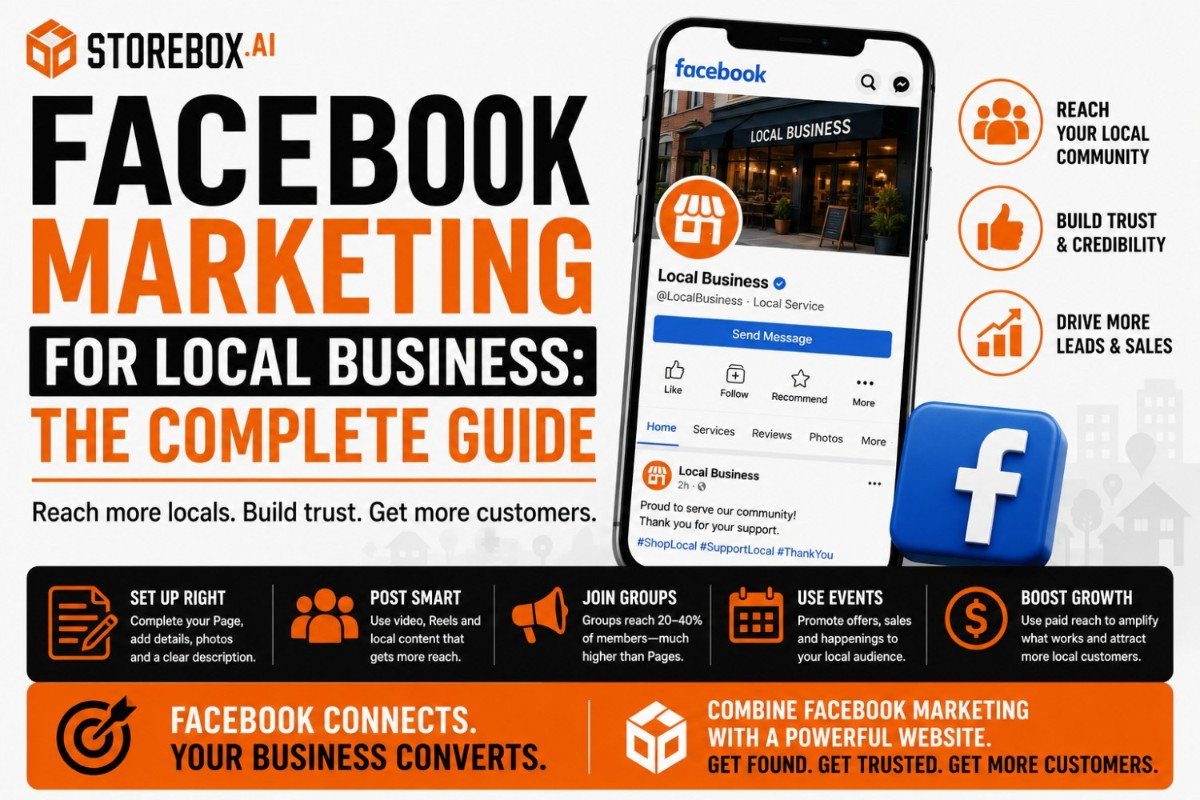
Key Takeaways
Facebook marketing for local business in 2026: what still earns reach, what to post, and whether a page is enough on its own.
Expand key takeaways
- Facebook Page organic reach now averages just 2 to 5 percent of followers, based on Socialinsider's 2026 analysis of 25 million posts across more than 130,000 business pages.
- Facebook Groups reach 20 to 40 percent of members per post, a dramatically higher rate than Pages, making group participation one of the few remaining free distribution channels on the platform.
- Local businesses get the best results from a mix of Page posts, Groups, and Facebook Events, not Page posts alone.
- The right social platform depends on the business: Facebook still wins for community-driven local audiences, while Instagram and TikTok pull ahead for visually driven or younger-skewing brands.
- Video and Reels content earns meaningfully more organic reach than photo or link posts, and link posts specifically perform worst of any format.
- Having a Facebook page doesn't remove the need for a website: Facebook helps with local discovery and trust, but it can't rank a business on Google or get cited by AI tools the way a real website does.
Table of Contents
- Setting Up Your Facebook Business Page Right
- How to Promote Your Business on Facebook
- Facebook Posts That Work for Local Business
- Facebook vs Other Social Platforms for Small Business
- Growing Your Facebook Following Locally
- Is a Facebook Page Enough, or Do You Need a Website Too?
- How Storebox Fits Into Your Facebook Marketing
- Frequently Asked Questions
Most small businesses figuring out where to spend their social media time start with Facebook, and for local businesses specifically, that instinct is usually right. This guide covers how to promote a business on Facebook the way it works in 2026: page setup, the tactics that still earn reach, what to post, and how Facebook stacks up against other platforms when you're deciding where the effort is best spent. It also covers the question most guides skip entirely: whether a Facebook page is enough on its own, or whether the business still needs a website behind it, since anyone digging into Facebook marketing seriously tends to run into that question eventually anyway.
Setting Up Your Facebook Business Page Right
Get the basics right before worrying about tactics, since a poorly set up page undercuts everything built on top of it.
Choose the correct business category, since it affects which searches and recommendations the page shows up in
Fill out hours, address, phone number, and website link completely, matching exactly what's listed everywhere else the business appears
Use a clear profile photo and a cover image that represents the business accurately, not a generic stock image
Add a short, specific business description that states what the business does and who it serves
How to Promote Your Business on Facebook
Once the page is set up, promotion is where most of the real work happens, and where most local businesses either compound their efforts or waste them.
Organic Tactics That Still Work
Post consistently rather than in bursts, since Facebook's algorithm favors pages with a steady posting rhythm over sporadic activity
Join and participate in local Facebook Groups relevant to your area or industry, since Groups reach 20 to 40 percent of members per post compared to a Page's 2 to 5 percent
Use Facebook Events for local promotions, sales, or in-person happenings, since Events get surfaced to people actively looking for things to do nearby
Respond quickly to comments and messages, since engagement speed factors into how much additional reach a post earns
Why Organic Alone Isn't Enough Anymore
Organic Reach: Facebook Pages vs Facebook Groups
Per member reached, per post.
Average Page organic reach has fallen to 2 to 5 percent of followers, down sharply from the 15 to 16 percent businesses saw a decade ago
A Page with 10,000 followers today reaches a few hundred people per post organically, not several thousand
Paid boosting fills the gap organic reach used to cover, but it's a recurring cost rather than a one-time investment
Reach that resets every algorithm update isn't reach you own.
A Storebox site keeps the same content and reviews working, without competing against a shrinking feed.
Facebook Posts That Work for Local Business
Not every post format performs the same way, and getting this wrong is one of the most common reasons local business pages plateau.

Video and Reels content earns noticeably more organic reach than static photo or link posts, and Reels was the only format to show a year-over-year engagement increase in early 2026
Behind-the-scenes content, especially footage of real work being done, performs well because it reads as authentic rather than promotional
Customer highlights and testimonials build the same kind of trust a Google or Yelp review does, just inside the feed
Local community involvement posts, sponsorships, events, partnerships with other nearby businesses, tend to outperform pure sales content
Link posts consistently earn the lowest organic reach of any format, since Facebook's algorithm favors content that keeps people on the platform
| Post type | Relative organic performance |
|---|---|
| Video / Reels | Highest, and the only format gaining reach year over year |
| Photos | Second highest, especially photo albums |
| Status / text updates | Moderate |
| Link posts | Lowest, avoid as the primary content type |
Social media business posts that mix these formats, rather than defaulting to one, tend to hold attention better over time than a feed that looks the same every week.
Facebook vs Other Social Platforms for Small Business
There isn't a single best social media platform for a small business, and a small business's social presence often ends up split across two or three platforms rather than one.
| Platform | Best fit |
|---|---|
| Community-driven local businesses, older demographics, Groups and Events | |
| Visually driven businesses, product-based brands, younger audiences | |
| TikTok | Discovery-first businesses willing to invest in short-form video |
Facebook still holds an advantage for local businesses because of Groups and Events, two features neither Instagram nor TikTok has an equivalent for. If you're weighing Instagram or TikTok specifically, our comparisons of Instagram vs website for business and TikTok vs website for business cover the same ownership question this guide raises for Facebook, applied to each platform.
Growing Your Facebook Following Locally
How to grow your business on Facebook, for a local audience specifically, looks different than growing a national or online-only brand.
Facebook marketing for local business works best as a compounding effort: each tactic reinforces the others, but none of them alone will offset the platform's declining organic reach. If Facebook marketing is eating more time than it's worth, it's also worth comparing that time cost against what a marketing agency charges to handle it instead.
Also Read
Local SEO ChecklistIs a Facebook Page Enough, or Do You Need a Website Too?
No, for most businesses, a Facebook page alone isn't enough, and the reason is structural rather than a matter of doing Facebook marketing well or poorly. Do small businesses need a website if they have Facebook comes down to what happens outside the Facebook app entirely. A Facebook page can't rank independently in a Google search, can't get cited when someone asks an AI assistant for a recommendation, and can't host detailed service pages or a booking flow the way a website can.
Facebook can be
One of several ways a customer discovers a business
A website is
The one place all of that discovery is supposed to lead, whether that's a booking, a call, or a purchase
Whether a Facebook page alone is enough for a business is worth answering plainly: Facebook is strong for community trust and local engagement, but it was never built to be found by someone who's never heard of the business and isn't scrolling Facebook when they search. Our comparison of Google Business Profile vs website covers the same gap from a different angle, since Facebook and GBP share the same core limitation against an owned site. Our notes on what a real website costs are worth reading if budget is the main thing that's kept this from happening already, and our comparison of done-for-you vs DIY websites covers the time side of that same decision.
How Storebox Fits Into Your Facebook Marketing
Storebox builds websites for small businesses that want to keep Facebook working for community engagement while adding the search visibility Facebook structurally can't provide. The site can pull in the same photos, reviews, and community content already being posted to Facebook, so nothing has to be built twice.
%20(1).png)
Keep Facebook working for community. Add the search visibility it structurally can't provide.
Pulls in the same photos, reviews, and community content already being posted to Facebook
SEO and AEO plan gets the business's own domain found in Google search and cited by AI tools like ChatGPT
Our complete local SEO guide covers what that visibility takes to build
Our answer engine optimization guide explains why this gap keeps widening as more people ask AI assistants for recommendations directly
If your Facebook marketing is working but you don't have a website behind it yet:
Our notes on small business website mistakes and affordable web design are both worth reading alongside this before you commit to a specific route.
How do I promote my business on Facebook for free?
What are the best Facebook posts for a local business?
Is a Facebook page enough for my business, or do I need a website too?
How often should a local business post on Facebook?
Does Facebook help with local SEO?
What's the best time to post on Facebook for a local business?
Sources
Ready to give your Facebook following somewhere to land beyond the feed?
Start With a Free Website Draft →