Key Takeaways
Instagram vs website for business: what the numbers actually say about ownership, reach, and discovery in 2026.
Expand key takeaways
- About 27 to 29 percent of small businesses in the US still operate without a website in 2026, down from roughly 36 percent in 2020, according to multiple industry surveys.
- 81 percent of consumers research a business online before buying from it or booking a service, which includes checking a site that isn't just a social profile.
- Instagram's organic reach for a typical feed post has fallen to somewhere between 3 and 8 percent of followers in 2026, down sharply from 10 to 15 percent just a few years ago.
- A website is something you own outright. An Instagram account is something you rent, and the terms of that rental can change without your input.
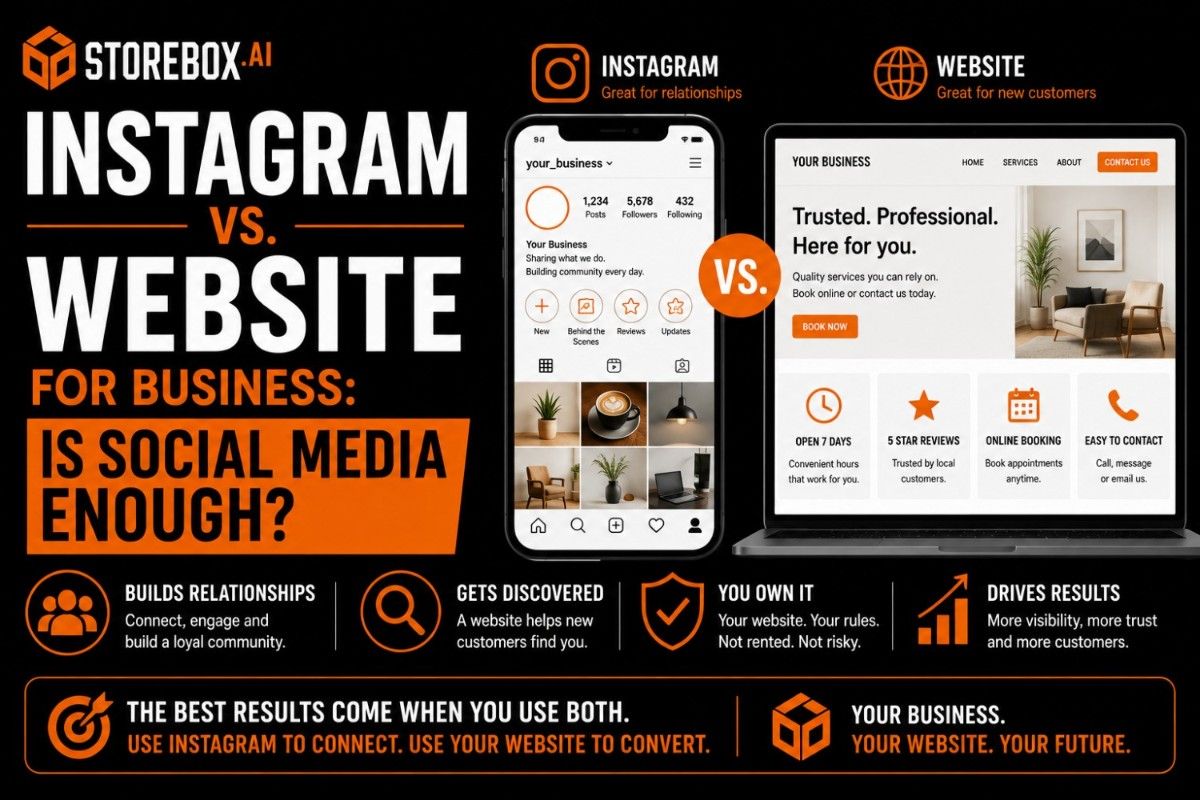
- Instagram is strong at building relationships and showing personality. A website is stronger at converting a stranger who has never heard of you before.
- Storebox's done-for-you websites are built to work alongside an existing Instagram presence rather than replace it, so you don't have to choose one over the other.
Table of Contents
Instagram vs website for business is really a question about ownership and discovery, and it comes up so often because the tradeoffs rarely get explained clearly. Do small businesses need a website when Instagram already reaches their existing followers for free, or is that reach doing less work than it used to. Do I need a website for my small business if most of my customers already find me through a Facebook or Instagram page, or is a profile page a different thing entirely from a real site built to convert someone who's never heard of the business before.
Instagram vs website for business isn't a question with one universal answer, since it depends on how a specific business gets found today and how it wants to get found next year, but it's a question worth answering with numbers instead of a shrug.
What Instagram Gives You That a Website Can't, and the Other Way Around
Instagram is built for relationships with people who already know you exist. It shows personality, behind-the-scenes content, and quick visual proof of what a business does, and it does all of that with no setup cost beyond your time. A website is built for the opposite job: convincing someone who has never heard of the business before that it's worth trusting, and doing it whether that person arrives at 2pm or 2am, from a search engine, an AI assistant, or a link someone else shared.

What Instagram Does Well
- Reaches existing followers with visual content
- Builds personality and behind-the-scenes trust
- Free to start, fast to post
- Good for repeat engagement
What a Website Does Well
- Converts strangers who find you through search
- Shows structured information: hours, pricing, booking
- Owned outright, not subject to algorithm changes
- Good for a first impression that leads to a sale
| What Instagram does well | What a website does well |
|---|---|
| Reaches existing followers with visual content | Converts strangers who find you through search |
| Builds personality and behind-the-scenes trust | Shows structured information: hours, pricing, booking |
| Free to start, fast to post | Owned outright, not subject to algorithm changes |
| Good for repeat engagement | Good for a first impression that leads to a sale |
Neither one replaces the other. They're built to do different jobs, and most businesses that grow past their first few customers end up needing both. A website that costs too little or too much for what it delivers is a separate problem worth understanding before you build one, since the price gap between a barebones site and a properly structured one is usually where businesses either overspend or end up with something that doesn't do the job.
Keep the Instagram. Add the part it can't do.
Storebox builds a website that works alongside your existing presence, not instead of it.
Can Instagram Replace a Website for Your Business?
Not fully, and the biggest reason is one most business owners don't think about until it happens to them. Every post, every follower, and every bit of reach on Instagram exists on Meta's terms, not yours. Accounts get suspended, algorithms change overnight, and a page that reached thousands of followers organically five years ago now reaches a fraction of that without paid promotion. A website doesn't have that problem. Once it's built, it belongs to the business, and no platform update can quietly cut its traffic in half.
What You're Actually Renting on Instagram
Accounts get suspended, sometimes without a clear reason or a fast path to appeal
Algorithms change overnight, and reach can drop without warning or explanation
A page that reached thousands organically five years ago now reaches a fraction of that without paid promotion
Do I need a website if I have Instagram largely comes down to how much of the business depends on being found by people who don't already follow the account. If most new customers arrive through referrals and existing followers, a strong Instagram presence can carry a lot of the load. If new customers need to find the business through a search engine or an AI assistant recommending it, an Instagram page alone won't show up there the way a real website can.
Where the AI Search Gap Shows Up
Our guide on how to show up in AI search results covers this gap in more detail, since AI tools pull from structured websites far more often than social profiles, and our broader piece on answer engine optimization explains why that gap is only getting wider as more people ask AI assistants for recommendations instead of searching Google directly.
Why Social Media Alone Isn't Enough for Most Businesses
Instagram's organic reach has been shrinking for years, and the numbers make the case better than an opinion could. Feed posts that once reached 10 to 15 percent of followers now typically reach somewhere between 3 and 8 percent, depending on the format and the account size, and that gap keeps widening as platforms push businesses toward paid promotion.
Instagram Organic Reach: Then vs Now
Share of followers a typical feed post reaches organically, without paid promotion.
Social media only, no website, means a business's visibility is entirely dependent on an algorithm it doesn't control and can't appeal to when it changes.
Where Social Media Still Fits
Social media alone still has a place in this picture, just not as the only front door a business relies on.
A Google Business Profile alone has the same limitation: useful as a supplement, but not a substitute for a site the business owns outright.
Many of the most common small business website mistakes start upstream of the website itself, in businesses that delayed building one for too long while betting everything on a platform they didn't control.
Do Small Businesses Need a Website?
The data leans firmly toward yes, even as website builders have made the barrier to entry lower than it's ever been. Roughly 27 to 29 percent of small businesses in the US still don't have one, and that number has been falling steadily, from about 36 percent in 2020 down to today's figure, as it becomes cheaper and faster to set one up.
Small Businesses With No Website
Consumers Who Research Online First
Meanwhile, 81 percent of consumers say they research a business online before using its services, which means the businesses without a site are relying on the remaining 19 percent, or hoping their Instagram page does the same job a website would.
Do small business owners need a website in 2026 specifically, given how far social platforms and AI tools have come? If anything, the case has gotten stronger, not weaker, since AI assistants like ChatGPT and Google's AI Overviews pull structured information from websites to answer questions and make recommendations, something a social media profile isn't built to provide. A local SEO checklist is a reasonable next step once the website exists, since a site with no local optimization behind it captures less of that 81 percent than it could.
Who Should Pick Instagram, a Website, or Both
| Business type | Verdict |
|---|---|
| Local service business (plumber, salon, clinic) | Needs a website. Customers search by intent, not by following an account first |
| E-commerce or product business | Needs a website. Instagram can drive traffic, but checkout and trust need a real site |
| Influencer or personal brand | Instagram can carry the relationship, but a website adds credibility for brand deals and bookings |
| Very early-stage or pre-revenue business | Instagram alone can work short term, but plan to add a site before scaling |
A Special Case: Influencers
Do influencers need a website is a slightly different question than the others, since an influencer's business often is their social presence. Even then, a simple site for media kits, brand partnerships, and direct bookings tends to convert better than routing everything through direct messages, and it gives partners a place to verify who they're working with.

A media kit page that's always up to date, instead of a PDF that goes stale
A booking or contact form that doesn't rely on someone checking DMs
A place for brand partners to verify who they're working with before signing anything
This is also where the done-for-you versus DIY website decision matters most, since an influencer or small business owner rarely has the spare time to build and maintain a site alongside everything else on their plate.
Also Read
Wix vs Squarespace vs StoreboxHow Storebox Fits Into This Decision
Storebox builds websites specifically for small businesses that already have an Instagram presence and don't want to abandon it, just add to it. The approach pulls content and photos you're already posting into a real website, so the site doesn't compete with your social presence, it backs it up with something you own. Storebox's SEO and AEO plan then works to get that website found in Google search and cited by AI tools, the exact visibility gap a social media profile can't close on its own.
%20(1).png)
Built for businesses that already have Instagram working. Not a replacement, a backup that you own.
Pulls content and photos you're already posting into a real, owned website
SEO and AEO plan works to get the site found in Google search and cited by AI tools
Affordable web design that doesn't require choosing between the website and everything else
Ongoing website maintenance so the site doesn't go stale the way an unattended Instagram account often does
If you're weighing whether it's worth adding a website to an Instagram presence that's already working:
If you're managing more than one location or brand, our small business website management service and our notes on choosing a web designer are worth reading alongside this before you commit to a specific route.
Also Read
Free vs Affordable Website BuildersDo I need a website if I have Instagram?
Can Instagram replace a website for my business?
Is social media enough for my business, or do I need a website too?
Do influencers need a website?
Is a website necessary for a small business in 2026?
What's the difference between having a website and just a Facebook or Instagram page?
Sources
If your Instagram is already working and you just haven't added a website behind it yet.
Start With a Free Website Draft →