Key Insights
Where to find a web designer for your small business: freelancers, agencies, marketplaces, red flags to avoid, and a cheaper, faster alternative.
Expand key insights
- Most people searching for a web designer have already been burned once. A freelancer who went quiet mid-project, an agency quote that didn't match what they thought they were paying for, or just genuine confusion about where to even start looking.
- The freelancer versus agency choice isn't really a choice between good and bad. It's a trade of risk for cost. Freelancers are cheaper and less reliable. Agencies are more reliable and considerably more expensive. Neither guarantees the outcome you're picturing.
- A web developer going unreachable mid-project is common enough that it has its own recurring pattern in small business communities. "My web dev disappeared, site is broken" shows up often enough to be treated as a real risk, not a rare horror story.
- Agencies have their own version of the same problem. The person who pitches you is rarely the person who does the work, and the account often gets handed to someone with a fraction of the experience once the contract is signed.
- A short list of specific questions filters out most bad hires before you pay anyone a deposit. Portfolio, timeline in writing, and a direct answer about who does the actual work are the three that matter most.
- There's a third option most people never compare against freelancers or agencies: a done-for-you service that builds and maintains the site without you managing anyone. It isn't right for every business, but it's worth knowing it exists before you commit to vetting a stranger.
Table of Contents
If you're reading this, there's a decent chance you've already tried one of the usual paths and it didn't go well. Maybe a freelancer stopped responding halfway through. Maybe an agency quote landed somewhere between "that can't be right" and "we clearly can't afford that." Or maybe you haven't tried anything yet, you just know you need a website and have no idea where to find a web designer as a normal small business owner in the first place.
Learning how to choose a web designer isn't really about finding a list of names. It's about understanding where to find a website designer who fits your specific situation, and knowing how to find a web designer without walking into one of the common traps first. This covers all three real paths, freelance marketplaces, agencies, and a done-for-you alternative most comparisons leave out entirely, so you can pick the one that fits your situation instead of the one that showed up first in search results.
Where People Look for a Web Designer
The honest list, not the polished one.
Freelance Marketplaces
Fiverr and Upwork are consistently named among the best freelance sites for web designers, mostly because they're the first result when you search. Pricing ranges wildly, from $150 for a template-based build to several thousand for something custom, and quality varies just as much. Reviews help, but a portfolio link that works matters more than a star rating.
Local Referrals
Asking another business owner who built their site is still one of the more reliable ways to find a local web designer, since you get an honest account of what the process looked like, not just the finished result. This is also often the fastest route if you're trying to figure out how to find someone to build your website without starting from a cold search.
Google Search
Searching "web designer near me" or "web designer for small business" surfaces a mix of local freelancers, small studios, and larger agencies, usually with no clear signal about which is which until you're already on a call. If you're specifically looking at where to hire a web designer for something more custom, this is usually where that search leads.
Design Agencies
Agencies range from a two-person studio to a full-service firm with account managers and a sales process. More structure, more accountability on paper, and a price tag that reflects both. Knowing how to find a good web designer at the agency level often comes down to checking who on the team does the client work day to day, not just who runs sales calls.
What Each Option Costs
This is the part most conversations skip until you're already three emails deep with someone.
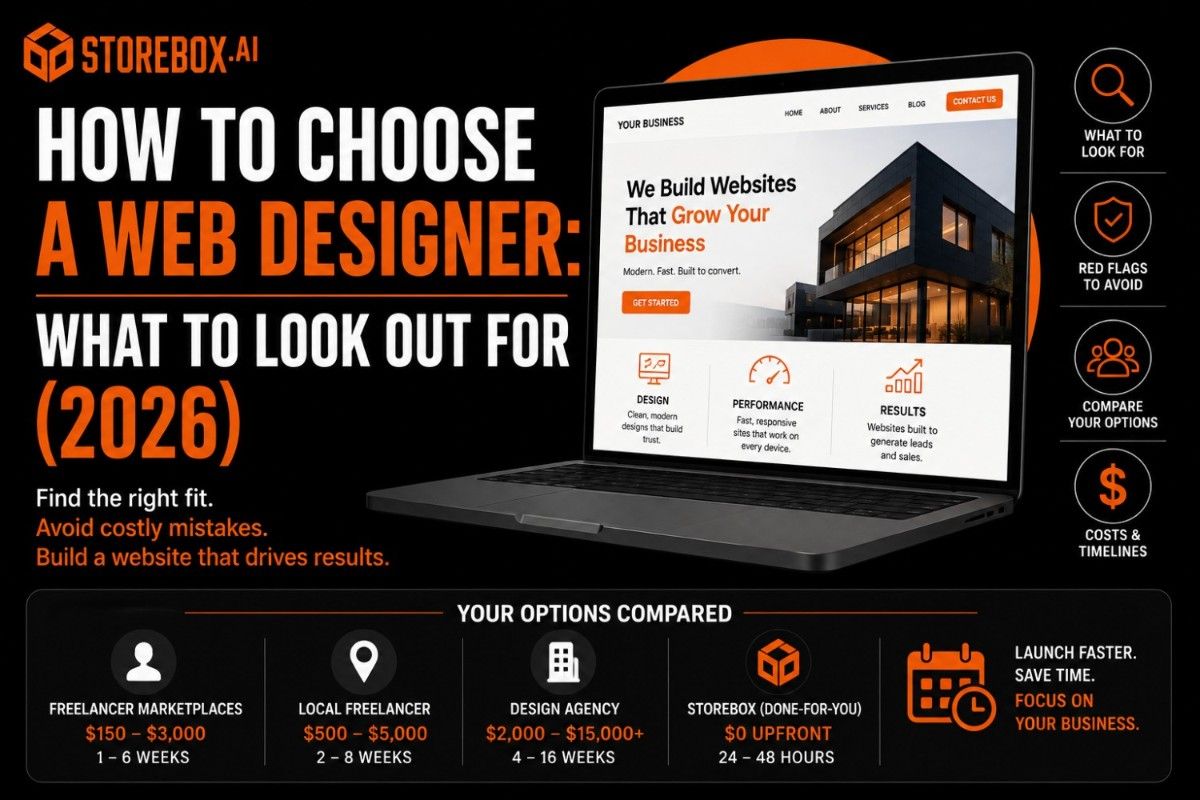
Web Designer Cost Comparison
| Option | Typical cost | Timeline | Who does ongoing updates |
|---|---|---|---|
| Freelance marketplace | $150-$3,000 project fee | 1-6 weeks, variable | You, or pay again per change |
| Local freelancer | $500-$5,000 project fee | 2-8 weeks | You, or pay again per change |
| Small design agency | $2,000-$8,000 upfront | 4-12 weeks | Retainer, often $200-$500/mo |
| Full-service agency | $5,000-$15,000+ upfront | 8-16 weeks | Retainer, often $500-$1,500/mo |
| Storebox (done-for-you) | $0 upfront | 24-48 hours | Included, unlimited, 24-hour turnaround |
How much does it cost to hire a web designer really depends on how much of the ongoing relationship you're counting. A $1,500 freelancer project that needs a $150 fix every time your hours change adds up differently than the sticker price suggests. That ongoing cost, not just the upfront number, is where most budgets go over.
See where the $0-upfront row leads.
No deposit, no vetting, no retainer negotiation. Just a working site in 24-48 hours.
Freelance Web Designer vs Agency: The Traditional Binary
Most people frame this decision as freelancer versus agency, cheaper and riskier against more expensive and more reliable. That framing isn't wrong, but it leaves out how often "more reliable" doesn't hold up in practice either.
The freelancer risk is well documented in small business communities. A recurring pattern shows up often enough to be worth naming directly: a web developer stops responding partway through the project, leaving the site half-built or broken with no clear way to reach them. "My web dev disappeared, site is broken" is close to a verbatim summary of how this gets described when it happens, and it happens often enough that it's not treated as a rare exception.
Agencies solve the disappearing-freelancer problem but introduce a different one. The person who sells you the project is rarely the person who builds it.
One business owner described the broader version of this pattern after a costly agency engagement.
Neither path is automatically the wrong choice. A freelancer vs agency decision comes down to how much you value lower cost against how much you value a formal process, understanding that the formal process has its own version of the same reliability problem.
Also Read
Our Marketing Agency Alternative PageRed Flags and Vetting Questions Before You Pay a Deposit
This is the part worth printing out, or at minimum keeping open in a tab while you're on a call with anyone you're considering.
What to Look For in a Web Designer
- ✓ A portfolio with live, working links, not just screenshots
- ✓ Direct answers about who builds the site, not just who you're talking to now
- ✓ A written scope and timeline before any money changes hands
- ✓ References you can contact directly, not just testimonials posted on their own site
- ✓ Clarity on what happens after launch, who fixes things, and what that costs
Questions to Ask a Web Designer Before Hiring
- Can I see three live sites you've personally built, not just designed?
- Who will be doing the actual work, you or someone else on your team?
- What's included after launch, and what costs extra?
- What's your typical turnaround for a content change once the site is live?
- Can I get the timeline and scope in writing before I pay anything?
Red Flags When Hiring a Web Designer
Radio silence after a deposit
The single most common complaint in this category. If communication slows to nothing right after you pay, it rarely improves from there.
A portfolio of screenshots, not live sites
Screenshots can't be clicked through, and they don't prove the person actually built what's pictured, only that they can take a picture of it.
Vague timelines that keep sliding
"Almost done" without a date attached is a pattern, not a one-time delay. Each slip without explanation makes the next one more likely.
No written scope at all
A verbal agreement about what's included gives either side room to remember it differently later, usually in the direction that costs you more.
Reluctance to say who does the actual work
A deflected or vague answer to this question is often the earliest warning sign, well before any money changes hands.
If you're trying to figure out how to vet a web designer with limited time, or just want the best way to find a web designer without a long process, these five questions and the five red flags above cover most of what separates a smooth project from a stalled one.
The Third Option: Done-for-You
Freelancers and agencies aren't the only two options. A done-for-you website from Storebox skips both: no freelancer to vanish on you, no agency retainer to negotiate, no builder to learn. You describe the business, a real team builds the site, and it stays maintained for a flat monthly rate going forward.
%20(1).png)
No vetting a stranger. No wondering if the deposit just walked off with your money. No retainer negotiation every time you need something changed.
What's specifically included
A custom-built site, not a template
Not a template you're stuck customizing yourself.
SEO and schema markup baked in from day one
Not billed as an add-on later.
Unlimited content updates, 24-hour turnaround
A price change or a new service doesn't sit in someone's inbox for a week.
Your domain stays registered in your name
Not locked to a platform or a developer's account.
No contract
Leaving is a decision, not a negotiation.
The reliability gap is where this option earns its place on the list. A freelancer can vanish between a deposit and a delivery date, and there's nothing you can do about it except start over with someone new. An agency can hand your account to whoever's least busy that quarter. Storebox removes that risk structurally: there's no single person who can go dark on your project, because the build and the maintenance are the product, not a favor someone's doing between other clients.
The cost side tells the same story from a different angle. That ongoing bill, not the upfront number, is usually where the real cost hides.
| Path | Upfront cost | Ongoing cost | Where the real bill hides |
|---|---|---|---|
| Freelancer | ~$1,500 project fee | Pay again per change | Every hours or pricing update needs a paid fix |
| Agency retainer | $2,000-$15,000+ build | $200-$1,500/mo | $2,400-$18,000+ a year in retainer fees alone |
| Storebox | $0 | Starting at $9.99/month | Nowhere. Updates are included, not billed separately |
Flat, predictable, and cheaper than either path once you count what freelancers and agencies cost over twelve months, not just on day one.
Ready to see what this looks like for your business?
A real team builds your site, then keeps it updated. No stranger to vet.
When You Should Still Hire a Web Designer Instead
If your business needs something highly custom, unusual interactions, a specific animation-heavy brand experience, or integrations with internal systems that go well beyond a standard small business site, a specialized designer or development agency is still the right call. Done-for-you services are built for speed and reliability on the kind of site most small businesses need, not for one-off, design-forward projects where the design itself is the product.
If that's your situation, the vetting checklist above still applies. It just means you're heading toward the agency or specialized freelancer side of this decision with clearer eyes than you started with.
Where This Fits Into Your Broader Website Strategy
Finding the right person or service to build your site is one decision. Making sure the result gets you found is another.
After the Site Is Live
Our complete local SEO guide and small business marketing playbook cover what happens after the site is live, and our guide on Google Business Profile optimization covers the companion piece most new sites need alongside them.
Comparing Local Agencies
If you're specifically comparing local agencies before making a decision, our reviewed guides cover real, sourced options in specific markets.
Industry-Specific Detail
For a specific vertical, these guides walk through the same freelancer-versus-done-for-you decision with industry-specific detail.
Where do small business owners find web designers when none of the usual channels feel right? Increasingly, the answer is a done-for-you service rather than another freelancer search or agency consultation. If you've been searching where to find a web designer for small business specifically, rather than a general-purpose freelancer who happens to also build sites, that specialization is worth weighing alongside price.
A properly built website paired with ongoing maintenance tends to outperform a one-time build that nobody touches again.
See what a done-for-you site could look like for your business.