How to Get More Pest Control Customers
You know the feeling. A homeowner three streets over has ants in the kitchen, pulls out their phone, types "pest control near me" — and the first thing they see is an Orkin ad, then a Terminix ad, then a directory. You, the company that actually services that street every quarter, are nowhere on the screen. The good news is that how to get more pest control customers is not a question of out-spending the giants on ads. It's a question of owning the parts of local search they can't buy their way into — and this is a marketing problem you can fix without knocking on a single door. Below is exactly why you lose these customers and the playbook to take them back.
Key insights▼
Why are Orkin and Terminix winning customers in your own backyard?
It usually isn't price, and it definitely isn't the quality of your treatment. You lose because the national brand showed up first at the one moment that decides the whole account: the few minutes a homeowner spends searching, reading reviews, and picking who to call. They win that moment with money and machinery — and both have specific weaknesses you can exploit.
How big is the gap between you and the national brands?
It's enormous on paper, which is exactly why owners feel outgunned. Rollins — the parent company behind Orkin — pulled in $3.388 billion in revenue in 2024, up 10.3% over the prior year (Rollins, Inc.). Add Terminix, Rentokil, and a handful of other national players and the top six companies control roughly 45% of the entire pest control market (SkyQuest).
But here's the number that should change how you think. There are 34,076 pest control businesses in the U.S. (IBISWorld) — which means after the giants take their 45%, more than half the market is split among local companies like yours, customer by customer, in markets the giants can't personally walk. Orkin can't be the neighbor in your town. You can. The brand budget buys them the ad slot; it does not buy them the thing a nervous homeowner is actually shopping for, which is trust they can verify.
Why does the national brand reach the customer before you do?
Two reasons, and they feed each other.
First, paid saturation. A national brand treats every zip code as a media buy. They bid on "pest control near me," "exterminator near me," and "termite inspection [city]" across the country, and they can absorb a higher cost-per-lead because they're optimizing one national funnel. You're optimizing one town. On the auction for the ad slot, you will usually lose — so stop trying to win it head-on.
Second, the decision happens in search results before anyone calls. Even the homeowner who scrolls past the Orkin ad doesn't call them — they keep scrolling to the map, read a few reviews, and pick. Roughly 75% of consumers regularly read online reviews before choosing a local business, and 81% read those reviews on Google (BrightLocal, 2024). If your Google Business Profile is thin or your website still says "family-owned since 2009" with no service-area pages, you lose the comparison you never knew you were in. Your fifteen years on those streets never got a vote.
Be the first local name they trust. When a homeowner searches "pest control near me," they should land on you — not scroll past two national ads to a directory. Get a website that ranks for $10 →
What's ranking now for "how to get more pest control customers" — and why you can beat it?
Here's the honest read. We pulled the search results, and the generic phrase is crowded with software and agency content farms — Briostack, FieldRoutes, PestPac, Scorpion, Jobber — all publishing "10 pest control marketing strategies" posts that are really product pitches for their own software. You won't out-rank them on the generic term, and you shouldn't try.
But the Orkin-and-Terminix angle is wide open. Search "compete with Orkin and Terminix" and almost everything ranking is written to the homeowner — comparison reviews on This Old House and Bob Vila, plus a few "choose local over the national chains" posts published by individual pest control companies. What's missing is the page that does the harder job: content aimed at the owner that turns the giants' weaknesses — no local roots, no neighborhood reviews, rigid corporate plans — into your concrete playbook. The "Orkin vs. Terminix" angle is crowded. The "here's how the local company actually beats them" angle is the gap you walk into.
We're keeping the angle because the data backs the wedge: the giants own the ad auction, but they cannot own a real local address, a year of neighborhood reviews, or the flexibility to fix what your town's homes actually need. That's the ground you fight on.
Stop fighting on their turf. You can't out-bid Orkin on ads — so win on the local search and reviews they can't buy. Claim your $10 site →
How do you get more pest control customers without out-spending the giants?
The fix is to stop competing for the paid ad slot and start owning the three things the homeowner checks before they call: a local website that ranks for your service area, a Google presence the giants can't fake, and a recurring-plan offer that turns a one-time job into years of revenue. Get those three working together and you don't need Orkin's budget.
How do you build a pest control website that ranks for your service area?
Don't settle for a one-page site with a logo and a phone number. Build pages that match the exact searches homeowners run in your towns:
- Make a page per service, per city. "Termite inspection in [your city]," "ant control in [your city]," "rodent removal in [your city]." A page targeting the precise search beats a generic "pest control services" page every time — and it's a search the national brands answer with one bland national page, not a local one.
- Answer the question they're actually asking. Are these ants or termites? Is the treatment safe around kids and pets? How often do I need service? Put those answers on the page and you become the trustworthy local expert before they ever pick up the phone.
- Win the "near me" moment. This matters because 46% of all Google searches have local intent, and 76% of people who search for something nearby visit or contact a business within 24 hours (Red Local Agency). That's the highest-intent traffic there is — and it's local by definition, which means it's yours to win if you show up.
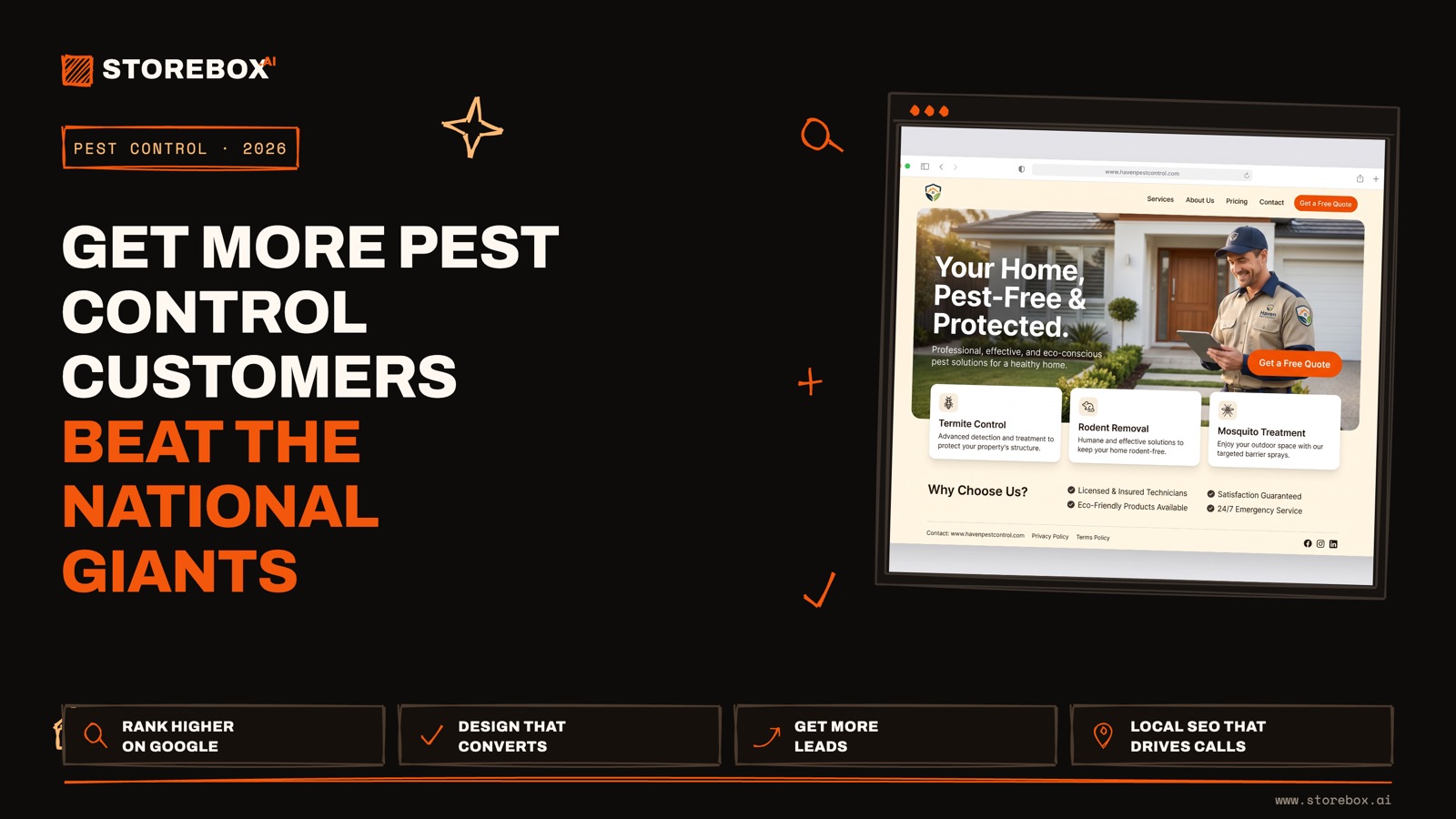
This is exactly the gap a purpose-built site closes. A platform like StoreBox spins up service-and-city pages structured to rank for the searches that matter, so they're live and indexed while the giants are still running national ads — see the 9 website mistakes that cost small businesses leads ↗ for the full list of what to fix. You don't need a developer, and you don't need to touch it again once it starts ringing.
Which pages turn a Google search into a booked recurring plan?
Most local pest control sites are a logo, a number, and a stock photo of a beetle. That doesn't beat a national brand's slick funnel. At minimum you need:
| Page | Job it does |
|---|---|
| Service + city page (per pest, per town) | Ranks for the exact "near me" search the homeowner makes first |
| "Free inspection" booking page | Captures the lead before they bounce back to the Orkin ad |
| Recurring plan / how-it-works page | Sells the quarterly plan — your highest-value, stickiest revenue |
| Pest ID / safe-for-pets FAQ | Answers the real fear and positions you as the guide, not a salesperson |
| Trust stack (local license, insurance, reviews, guarantee) | Answers "are these people legit and local?" — the giants' blind spot |
You don't need to build these by hand — that's the whole point of a platform like StoreBox, which ships these pages as a structured template you fill with your own services and your own service area. (Want to know what a site like that costs first? See what a small business website actually costs ↗.)
All your service-area pages, no developer. Ready to fill with your own towns and go live this week — while the giants run national ads. Build your pest control site for $10 →
How does a local pest control company beat Orkin on Google's map?
Owning the website only works if people see you. The local map results — the three businesses shown with the map — are where the local job is won, and they're the giants' biggest weakness, because a real local address and a wall of neighborhood reviews are things a national brand routing calls to a corporate number simply can't match.
The map pack captures roughly 44% of all clicks on a local search, and businesses inside it get about 93% more actions — calls, clicks, direction requests — than those ranked below it; the #1 spot alone takes about 17.8% of clicks (Red Local Agency). To get there:
- Fix and complete your Google Business Profile. Set the category to "Pest control service," fill every field — service area, hours, every service you offer — and feed it a steady stream of real job photos. A complete, active profile is the single biggest lever on whether you show in the 3-pack.
- Earn reviews relentlessly, with the town in them. Every finished job should end with a review request, and recent, local reviews are both a ranking signal and the thing that calms a nervous homeowner. A national brand can't accumulate a wall of "[your town]" reviews tied to a real local crew.
- Build a page for every city and suburb you serve. A homeowner one town over won't find you if your site only names your home base. One service-area page per city turns "[that town] exterminator" into a search you can actually win.
- Be the local answer, not the national ad. The whole point of reviews matters here: with 81% of review-readers using Google (BrightLocal), the company with the most recent, most local, most credible reviews wins the click — and that company can be you, not Orkin.
StoreBox builds your site, your city pages, and your Google Business Profile structure together so they reinforce each other and you actually land in the 3-pack — the full approach is in local SEO for pest control companies ↗.
Own the map the giants can't fake. Website, city pages, and Google Business Profile, set up together so you rank when it counts. Get your $10 pest control site →
How do you compete with Orkin and Terminix on recurring-plan trust, not price?
You can't out-advertise a billion-dollar brand. You don't have to — because the most valuable customer in this business isn't the one-time job, it's the recurring plan, and that's exactly where local trust wins.
The math is the reason. A homeowner on a quarterly plan with strong retention is worth roughly $4,000 to $6,000 in lifetime value (ResultCalls), and the whole industry runs on it: pest control companies routinely sell for 7 to 10 times EBITDA precisely because that recurring revenue is so durable (CT Acquisitions). Retention is the lever — increasing it by just 5% can lift profits by 25% to 95% (CT Acquisitions). And recurring plans are sold on trust: a homeowner only commits to four visits a year with someone they believe will still answer the phone and treat their home like a neighbor's. That's your whole pitch, and it's the one thing a national call center can't fake. Make the local permanence impossible to miss — a real local address on every page, your license and insurance shown plainly, a written guarantee, and the reviews from homes in their neighborhood. Concede the obvious — yes, Orkin has the brand recognition. But you're the one who'll remember their dog's name on the next visit. That honest, plain-spoken contrast is what converts a one-time call into a years-long plan.
Make "your neighbor, not a call center" your headline. The recurring plan goes to whoever the homeowner trusts. Put that trust on a site that ranks. Launch yours for $10 →
Frequently asked questions
How do I get more pest control customers without a big ad budget?+
How can a small pest control company compete with Orkin and Terminix?+
Why are recurring service plans so important for a pest control business?+
How do I find a good local pest control company near me?+
Is it worth investing in SEO and a website if Orkin already dominates the ads?+
Stop handing your neighbors to the national chains
When a homeowner in your town needs pest control, they reach for their phone before they reach for the phone book. If they can't find you in that moment — or can't tell you apart from a national call center — the brand with the bigger ad budget wins by default. StoreBox builds the local pest control website that ranks for "[your city] exterminator," fills your Google profile, and turns the one-time caller into a recurring plan — so the customers in your town stay yours.
Build your StoreBox site — $10Sources
- Rollins, Inc. — Reports Fourth Quarter and Full Year 2024 Financial Results (2024 revenue $3.388B, +10.3%; parent of Orkin) — https://www.rollins.com/investors/press-releases/detail/402/rollins-inc-reports-fourth-quarter-and-full-year-2024-financial-results
- SkyQuest — Pest Control Services Market (top six companies ≈ 45% combined share) — https://www.skyquestt.com/report/pest-control-services-market
- IBISWorld — Pest Control in the US — Number of Businesses (34,076 U.S. pest control businesses) — https://www.ibisworld.com/united-states/number-of-businesses/pest-control/1495/
- BrightLocal — Local Consumer Review Survey 2024 (75% regularly read reviews; 81% read them on Google) — https://www.brightlocal.com/research/local-consumer-review-survey-2024/
- Red Local Agency — Google Local Pack Statistics (map pack ≈ 44% of clicks; 93% more actions; #1 = 17.8%; 46% local intent; 76% act within 24 hrs) — https://redlocalagency.com/google-local-pack-statistics/
- ResultCalls — 5 Ways to Build Recurring Revenue for Pest Control (quarterly-plan LTV ≈ $4,000–$6,000 at 90% retention) — https://resultcalls.com/blog/5-ways-to-build-recurring-revenue-for-pest-control
- CT Acquisitions — Why Pest Control Sells for 7–10x EBITDA (recurring-revenue multiples; 5% retention lift = 25–95% profit) — https://ctacquisitions.com/answers/why-pest-control-higher-multiples/