How to Get More Pressure Washing Jobs (Year-Round)
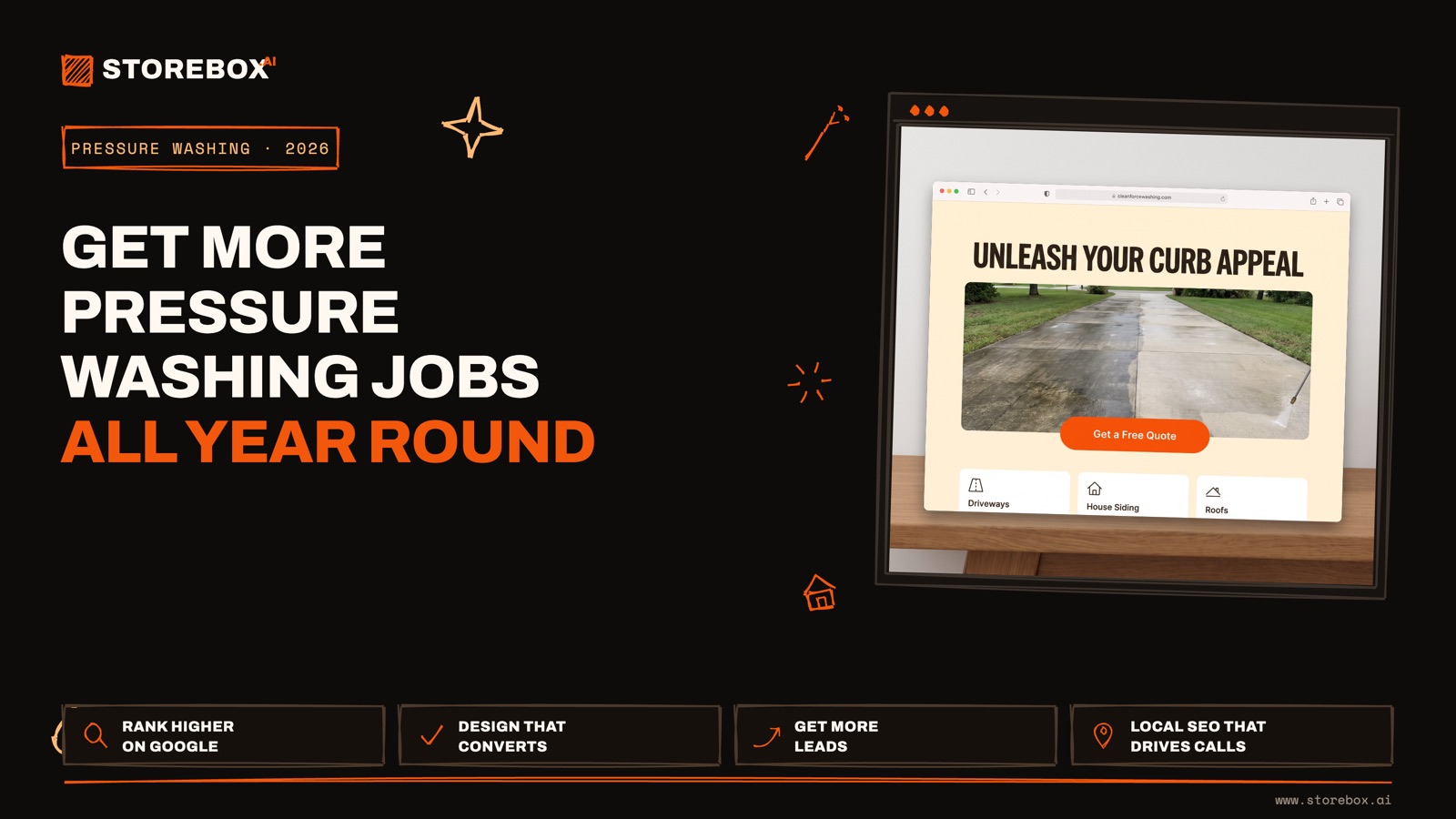
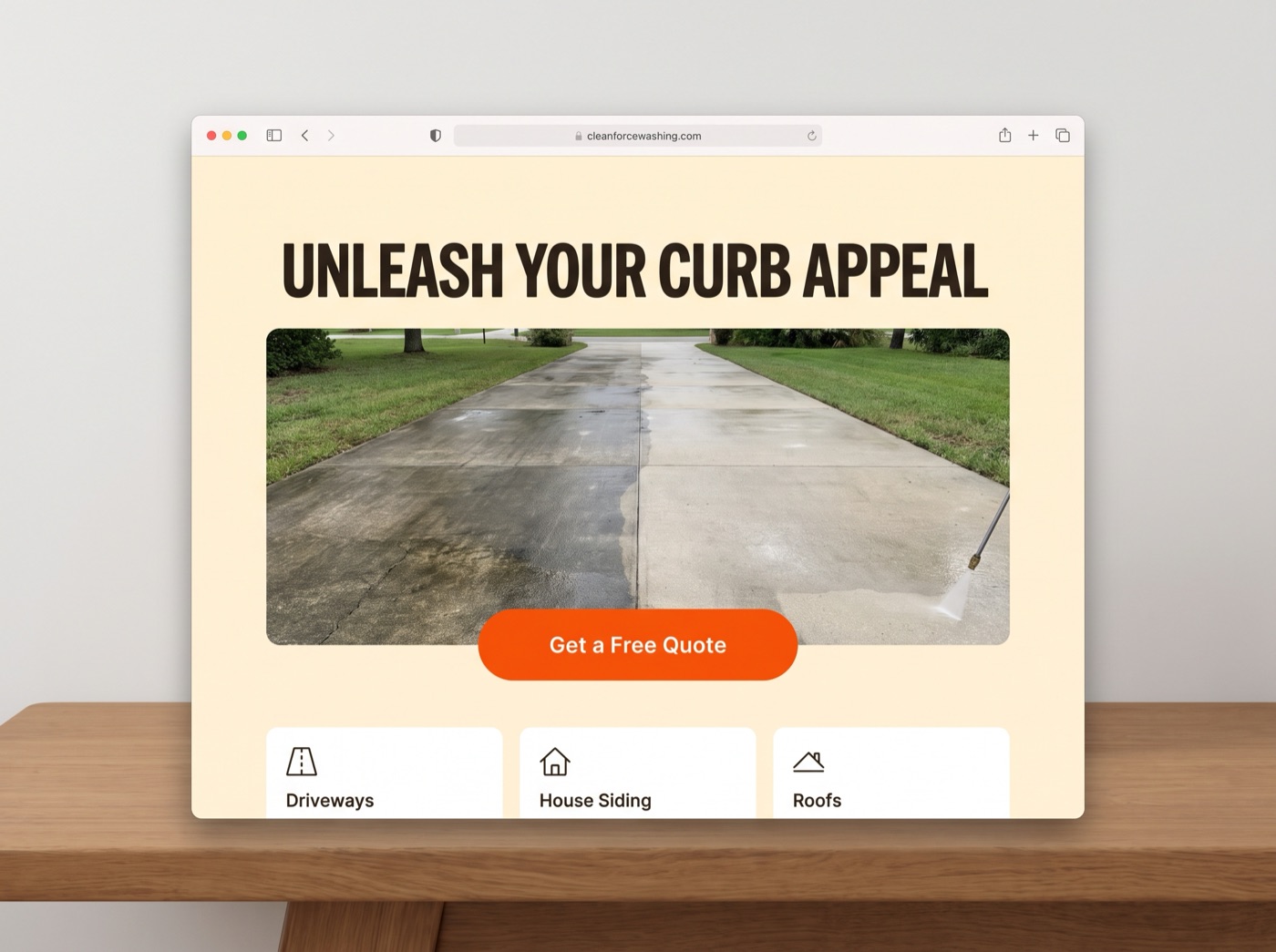
You know how it goes. A neighbor posts in the local Facebook group asking who does driveways, six people tag a guy who quotes $80, and you — the one with insurance, a real machine, and a five-year track record — never even get the call. The whole game has turned into a race to the bottom, and the bottom is a losing place to run a business. The real question isn't how to underbid that guy; it's how to get more pressure washing jobs from customers who pick you on trust and proof instead of price. That's a marketing problem, and it's one you can fix without buying a single new wand tip. Below is exactly why you lose the cheap-price race and the playbook to stop running it.
Key insights▼
Why are you losing pressure washing jobs to the cheapest bid?
It usually isn't your work, and it definitely isn't your equipment. You lose because the customer never had a real reason to pick you over the low quote. When two washers look identical online — same generic phone number, same blurry photos, no reviews to speak of — the only thing left to compare is price. So they pick the cheap one. You didn't lose on quality; you lost because you gave them nothing else to judge you on.
Why won't customers pay more for a better pressure washing job?
Because most of them can't tell you're better — yet. Pressure washing has almost no barrier to entry: a machine, a truck, and a phone, and anyone can call themselves a pro. The U.S. pressure washing services industry runs around $1.2 billion across roughly 32,193 businesses, and the number of those businesses has been growing at a 5.8% compound annual rate (IBISWorld). Translation: every year there are more trucks in your zip code, most of them brand new, most of them competing on the only lever a beginner knows — price.
That flood is exactly why you can't win by being a dollar cheaper. There's always someone hungrier and dumber about their numbers. The way out isn't a lower bid; it's giving the customer something the cheap guy can't fake: proof you'll do it right, reviews from their actual neighbors, and a business they can find again next year.
Where does the customer actually decide who to hire?
Online, before anyone gets a call. Nearly 98% of consumers search online before hiring a home services business (CallRail, 2026), and the search they run is almost always local — "pressure washing near me," "driveway cleaning [their town]." If you don't show up in that search, or if you show up looking exactly like the $80 guy, the decision is made without you. The job was decided on a phone screen, and you weren't on it.
Be the one they find first. When a homeowner searches "pressure washing near me," they should land on you — with photos, reviews, and a booking button — not a list of ten identical phone numbers. Get a website that ranks for $10 →
What's ranking now for "how to get more pressure washing jobs" — and why you can beat it?
Here's the opening. We pulled the search results for this exact query, and almost everything on page one is a software company's listicle — Jobber's "40 ways to grow revenue," Housecall Pro, NiceJob, WorkWave, FieldPromax — plus one Facebook group thread of guys arguing about door hangers. Useful in places, but they're all the same shape: a generic, undated checklist of thirty tactics, written to sell you scheduling software, that never commits to which moves actually move the needle for a solo or small crew.
What's missing is the page that does the harder job: a straight, owner-to-owner playbook that says stop competing on price, here's the small handful of things that get you found locally and let you charge what the work is worth. The "31 random tactics" angle is crowded. The "here's how to escape the price race specifically" angle — tied to local search, reviews, and recurring work — is wide open. That's the gap you walk into, and it's also the smarter way to actually run your marketing.
One focused playbook beats thirty random tips. You don't need forty tactics — you need to get found, prove your work, and lock in repeat customers. Claim your $10 site →
How do you get more pressure washing customers without dropping your price?
The fix is to stop being one more interchangeable truck and start being the obvious local choice — the washer the town already finds, already trusts, and already books before they bother getting a second quote. That comes down to three things: getting found when people search locally, winning on proof instead of price, and turning one-off jobs into recurring revenue so you're not starting from zero every spring.
How do you get found for "pressure washing near me" in your town?
Most of your competitors are invisible the moment a customer types a city name. Showing up for the local search is the single highest-leverage thing you can do, because that's where the job is decided. The local map results — the three businesses Google shows with the little map — capture the lion's share of local clicks, and the businesses in that 3-pack earn about 126% more traffic and 93% more user actions (calls, clicks, direction requests) than businesses ranked 4 through 10 (Search Engine Land). To land there:
- Claim and complete your Google Business Profile. Set the category to "Pressure washing service," fill every field — service area, hours, services — and feed it a steady stream of real before/after job photos. A complete, active profile is the biggest single lever on whether you show in the 3-pack.
- Build a page for every city and suburb you serve. A customer one town over won't find you if your site only names your home base. One service-area page per city turns "[that town] driveway cleaning" into a search you can actually win.
- Match the page to the search. "House washing in [your city]," "driveway pressure washing in [your city]," "commercial pressure washing in [your city]." A page targeting the exact thing someone types beats a generic "services" page every time.
This is exactly the gap a purpose-built site closes. A platform like StoreBox spins up the city-and-service pages structured to rank for local searches and wires them to your Google Business Profile so they reinforce each other — see the 9 website mistakes that cost small businesses leads ↗ for the full list of what to fix. You don't need a developer, and you don't touch it again until the phone rings.
Own "near me" before the cheap guy does. Website, city pages, and Google Business Profile, set up together so you rank when it counts. Get your $10 pressure washing site →
How do reviews and before/after photos win the job over a lower price?
This is how you beat price without lowering it. Customers don't buy clean — they buy certainty that you'll deliver clean and won't damage anything. Two things give them that certainty, and the low bidder rarely has either: a wall of recent local reviews, and undeniable before/after proof.
The numbers back it up. Roughly 75% of consumers regularly read online reviews before choosing a local business, and 81% of them read those reviews on Google (BrightLocal, 2024). Worse for the no-review competitor: 71% of consumers won't even consider a business rated below three stars (BrightLocal, 2024). A thin or empty profile isn't neutral — it actively loses you the job. So:
- Ask for a review at the end of every single job, while the driveway is still glistening and the customer is happy. Text them the direct Google link before you pull out of the drive.
- Shoot the before/after on every job. A muddy patio next to a spotless one sells harder than any sentence you can write. Put the best ones on your site and your profile.
- Get the town name into the reviews. "Did our whole house in [town] — looks brand new." Recent, local, specific reviews are both a ranking signal and the exact thing that calms a nervous homeowner comparing you to a stranger.
You don't have to chase any of this by hand. A platform like StoreBox builds the before/after gallery and the review prompts into your site so the proof stacks up automatically — and if you want to know what that costs first, here's what a small business website actually costs ↗.
Let your proof do the closing. A wall of local reviews and before/after shots beats a lower price every time. Put it on a site that shows it off. Build yours for $10 →
How do you book recurring and commercial pressure washing work?
This is where you escape the seasonal price grind for good. A one-off residential job averages somewhere around $311, with most landing in the $250–$450 range (HomeAdvisor). That's fine money — but you have to win it over and over, every spring, against every new truck. Recurring and commercial work flips that. A property manager, an HOA, a restaurant group, a fleet yard — these are clients who need the same surfaces cleaned on a schedule, who don't shop the price every time, and who pay on terms.
To land them, you have to look like a business that can handle a contract, not a side hustle:
- Build a commercial services page that names the work — storefronts, parking lots, dumpster pads, fleet washing, HOA common areas — and the search "commercial pressure washing in [your city]" starts finding you.
- Show commercial proof. A gallery of a cleaned parking garage or a restaurant patio tells a facilities manager you've done their kind of job before.
- Make it effortless to start a relationship — a clear quote-request form, a real address, your license and insurance shown plainly. Commercial buyers screen out anyone who looks fly-by-night, which is most of your competition.
- Pitch the schedule, not the single clean. Offer quarterly or monthly service. Recurring contracts smooth your cash flow and pull you out of the spring-only scramble entirely.
StoreBox builds your residential and commercial pages, your galleries, and your local SEO together so the same site that books a homeowner's driveway also closes the property manager's quarterly contract — the full approach is in local SEO for pressure washing businesses ↗.
Stop starting from zero every spring. Recurring and commercial work means clients who book again — not bid wars. Launch your $10 site →
Frequently asked questions
How do I get my first pressure washing customers when I'm just starting out?+
Is pressure washing marketing actually worth it for a small operation?+
How do I get pressure washing leads without paying for Angi, Thumbtack, or lead resellers?+
How do I find a good pressure washing company near me?+
Should I lower my price to compete with cheaper pressure washers?+
Stop racing to the bottom on price
When someone in your town needs a driveway, a deck, or a storefront cleaned, they reach for their phone first. If they can't find you — or you look exactly like the $80 guy with no reviews and no photos — the job goes to whoever's cheapest by default, and your better work never gets a say. StoreBox builds the local pressure washing website that ranks for "[your city] pressure washing," stacks up your reviews and before/after proof, and books recurring work — so you win on trust, not the lowest bid.
Build your StoreBox site — $10Sources
- IBISWorld — Pressure Washing Services in the US — Industry Analysis (~$1.2B revenue; ~32,193 businesses; 5.8% CAGR business growth) — https://www.ibisworld.com/united-states/industry/pressure-washing-services/6538/
- CallRail — 31 Home Services Marketing Statistics (2026) (98% of consumers search online before hiring a home services business) — https://www.callrail.com/blog/home-services-marketing-statistics
- Search Engine Land — What Is the Google Local Pack? (3-pack: 126% more traffic, 93% more actions vs. positions 4–10) — https://searchengineland.com/guide/google-local-pack
- BrightLocal — Local Consumer Review Survey 2024 (75% regularly read reviews; 81% read on Google; 71% won't consider a business under 3 stars) — https://www.brightlocal.com/research/local-consumer-review-survey-2024/
- HomeAdvisor — How Much Does Pressure Washing Cost? [2025 Data] (avg ~$311/job; typical $250–$450 range) — https://www.homeadvisor.com/cost/painting/powerwash-exterior-surfaces/