How to Handle Price Objections Early
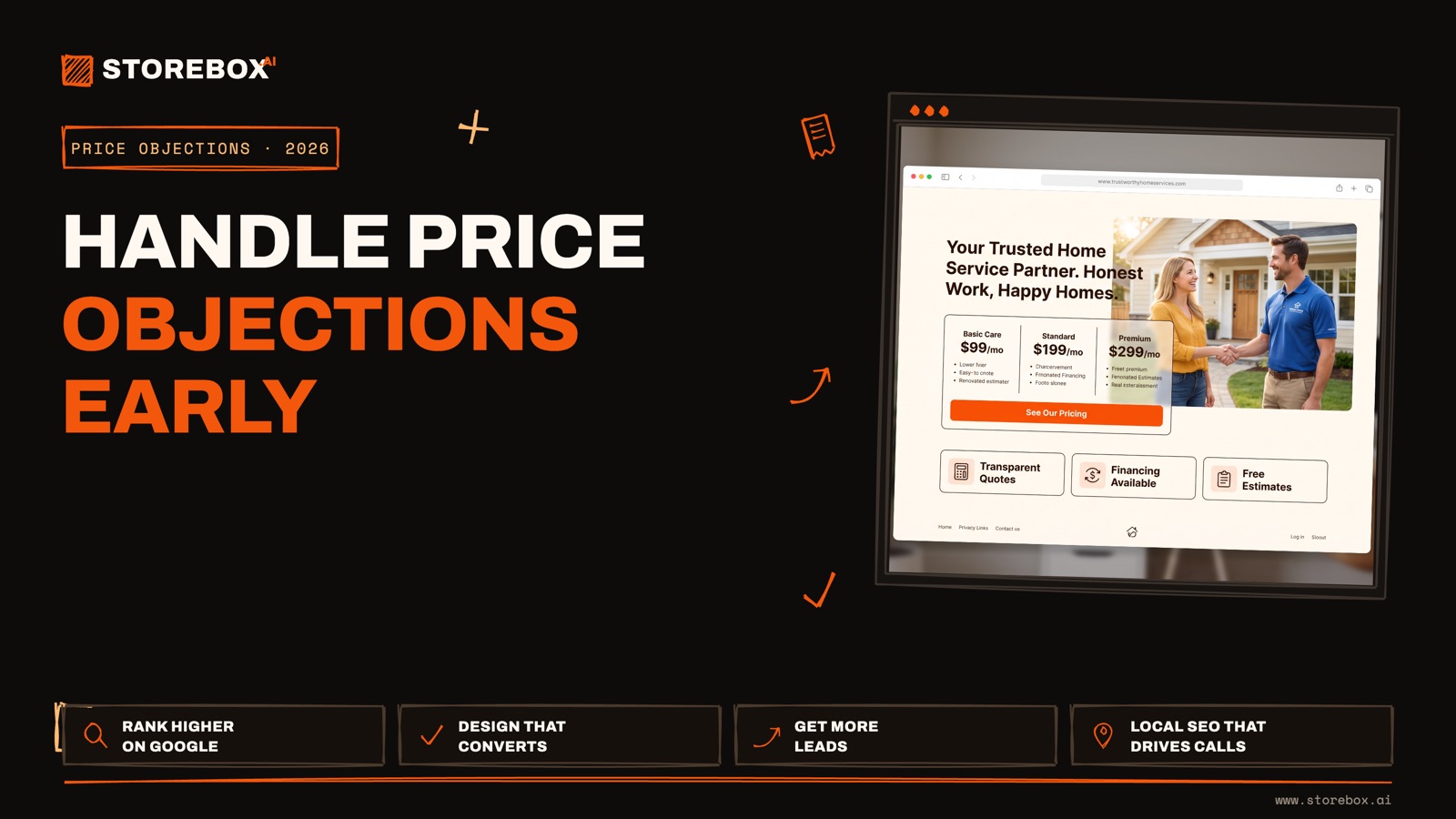
Most advice on how to handle price objections assumes the objection lands in a live conversation, where a slick rebuttal can save the sale. For home-services contractors, that advice is half a step too late. By the time a homeowner says your number is too high, they've usually already decided — based on a quote with no context, against a competitor whose price they also didn't understand. The real fix isn't a better comeback. It's removing the shock before it ever reaches you, by putting pricing and the reasons behind it on your website where the homeowner is already looking. Below is why the objection happens and the system that defuses it.
Key insights▼
Why do customers think you're too expensive (when you're not)?
It usually isn't your price. It's that the price showed up with no story attached — a number on a quote, next to nothing that explains what it buys.
StoreBox analyzed thousands of contractor and homeowner discussions across the trades, and one pattern dominates everything else: nothing goes viral like price-shock. A post asking why a "tiny bathroom remodel costs as much as a car" drew roughly 3,961 engagements. "Is this an unreasonable quote for a 50-gallon water heater?" pulled about 2,490. A "$146,000 Renewal by Andersen window quote" hit 2,149. A "$9,000 HVAC quote pushed me into DIY" gathered 815. Sort the entire corpus by engagement and the sticker-shock posts sit at the top, every trade, over and over.
Here's what StoreBox's analysis makes obvious once you read enough of them: homeowners aren't cheap — they're scared of being ripped off. A price with no context reads as a rip-off, full stop. They don't know if $9,000 for an HVAC system is a fair market rate or a markup aimed at a sucker, because nobody told them what's in it. So they assume the worst, post the number online, and a thousand strangers pile on to confirm the fear. That dynamic is exactly what shows up at your door as "that seems high."
The fear isn't irrational, either — these are big, infrequent purchases most people make blind. A full bathroom remodel runs roughly $25,000 to $80,000 at the high end, with the national average around $12,000 (HomeAdvisor). A new HVAC system averages about $11,590 to $14,100 (Angi). Even a "simple" water heater swap spans $600 to $3,500 depending on the unit (Thumbtack). When a number that large arrives naked — no scope, no inclusions, no comparison — the homeowner has no choice but to judge it against the only thing they have: the fear in their gut.
Stop the shock before it reaches you. When the number lives on your site with the reasons beside it, "that seems high" turns into "that makes sense." Get a website that explains your pricing for $10 →
What's ranking for "how to handle price objections" — and why you can beat it?
Here's the opening. We pulled the search results for "how to handle price objections," and the entire first page is generic B2B sales-training content — Richardson, HubSpot, Sandler, Kixie, and a stack of "27 rebuttals" listicles. All of it teaches the same move: don't lead with price, build value first, then handle the objection live with a clever line. It's written for software reps and account executives closing deals over Zoom.
None of it is written for a home-services contractor whose customer already left, already posted the quote online, and already decided you're expensive before you ever spoke. The generic advice treats the objection as a conversation to win. For the trades, the objection is a trust failure that happened upstream, on a website that showed a homeowner nothing. That's the gap. The sharpened angle — handling price objections before they happen, with pricing transparency on your website — is wide open, because the agencies writing the top results have never quoted a roof or replaced a furnace. We're pivoting the whole piece to it, and saying so plainly.
Win the objection before it's spoken. The sales-training crowd fixes it in the room; you can fix it on the page, where the homeowner actually decides. Claim your $10 site →
How do you handle price objections with transparency instead of discounting?
The fix is to stop defending your number after the fact and start framing it before the homeowner ever asks. That means three things working together on your website: pricing ranges so the number isn't a surprise, the context that explains what it buys, and the trust signals that make the price feel earned instead of inflated.
How do you present pricing to customers so the number builds trust?
Knowing how to present pricing to customers is mostly about timing and framing — and the best place to do both is your website, before the quote conversation even starts. The homeowner wants the number; refusing to give one reads as something to hide. So give a range, and surround it with context:
- Publish honest price ranges, per service. Not a single misleading "starting at" — a real band, like "most water heater replacements run $1,200–$2,800 depending on tank size and code upgrades." A range pre-loads the homeowner so your actual quote lands inside an expectation you set, not against a fear they invented.
- Show what's included — and what cheap quotes leave out. The permit. The haul-away. The warranty. The code-required upgrades the lowball bid quietly skips. This is where you reframe "expensive" as "complete," without ever saying the word.
- Explain why you cost what you cost. Licensed crews, pulled permits, manufacturer-certified installs, a warranty you'll actually honor in year three. The number stops being arbitrary the moment the homeowner can see what's behind it.
The payoff is measurable. In a survey of homeowners, 78% said they're more likely to call a contractor that shows pricing on its website — up from 66% two years earlier — and among millennials that figure hit 85% (Roofing Contractor / ROOFLE / Owens Corning, 2025). Transparency isn't just a trust play; it's a lead-gen play. This is exactly the structure a purpose-built site gives you — StoreBox builds service pages with the price ranges, inclusions, and "why we cost this" context already laid out, so the framing does its job before the phone rings. See the 9 website mistakes that cost small businesses leads ↗ for the full list of what to fix.
Give the number a reason. A price with context converts; a price alone gets posted online with a question mark. Put yours where it works. Build your pricing pages for $10 →
Why does hiding your price guarantee the objection instead of avoiding it?
Because silence doesn't remove the fear — it feeds it. When a homeowner can't find a price, they don't assume "fair." They assume "expensive, and hiding it."
The behavior is well documented. The single biggest reason online shoppers abandon a purchase is unexpected extra costs, cited by 39% of those who bail, and another 14% leave because they couldn't see the total cost up front (Baymard Institute). A home-services quote is the same psychology at higher stakes: a number that appears late, with surprises attached, sends people running. And it compounds — homeowners shop around. Research shows the typical homeowner gets only one or two estimates before deciding, with most experts pushing for three (McKinley Construction Management). If your number is the one that arrived without context while a competitor's came with a clear breakdown, you lose — even if you were cheaper.
Transparency flips it. A landmark study found 94% of consumers say they'd stay loyal to a brand that's completely transparent, 73% would pay more for it, and 40% would switch brands to get it (Label Insight, 2016). People don't punish a fair price they understand. They punish a number that shows up naked and makes them feel like the mark.
Hiding the price doesn't hide the cost — it hides the trust. Show the number with its context and the objection never forms. Get a transparent pricing site for $10 →
How do you talk about price with customers when your quote is the highest?
First, accept that you sometimes will be the highest — and that's fine, because the goal was never to be cheapest. Knowing how to talk about price with customers in that spot is about making the gap make sense before they compare. Research consistently shows most customers will pay more when they perceive added value; they're not hunting for the lowest number, they're hunting for the safest spend. Your job is to make "safe" and "your bid" the same thing, on the page, before they line your quote up against a lowball.
That means putting the contrast in writing where they'll read it cold:
| What the homeowner sees | What it tells them |
|---|---|
| A real price range per service | You're not hiding anything — the number's already in the open |
| A line-item of what's included | Your bid is complete; the cheaper one is probably missing the permit and the warranty |
| Your license, insurance, and warranty, shown plainly | You'll still be reachable when something needs fixing — the lowball crew won't |
| Before/after photos and recent local reviews | Real homeowners trusted this price and were glad they did |
When all of that lives on your site, the high quote stops looking like a markup and starts looking like the reason to choose you. You don't need to build it by hand — that's the point of a platform like StoreBox, which ships these as a structured template you fill with your own services, your own numbers, and your own jobs. (Want to know what a site like that costs first? See what a small business website actually costs ↗.)
Be the highest and the obvious choice. Show the value in writing and the price difference explains itself. Build your value case for $10 →
How does pricing transparency on your website actually win the job on Google?
Repositioning only works if homeowners see it — and increasingly, the page that explains your pricing is also the page that ranks. Homeowners search "[service] cost [city]" and "how much does a [job] cost" constantly, and right now the answers come from national cost-aggregator sites that know nothing about your market. A clear, local pricing page is a search opportunity hiding in plain sight, and it doubles as your objection-killer.
Online research now runs the whole decision: 91% of homeowners rely on online reviews before picking a contractor (ACHR News), and the same homeowner who reads your reviews is reading your pricing in the same session. So build the two together:
- Make a pricing page per core service. "Water heater replacement cost in [your city]," "AC installation pricing in [your city]." You capture the cost search and set the homeowner's expectation before they ever fill out a form.
- Pair every price range with proof. Reviews, license and warranty, and photos on the same page that shows the number. The price and the trust signal reinforce each other instead of living on separate pages no one connects.
- Answer the cost questions on the page. "Why does it cost this much? What's included? What makes a cheap quote risky?" You become the trustworthy local expert before a competitor becomes the cheaper-looking stranger.
StoreBox builds your service pages, your pricing context, and your review and trust structure together so they reinforce each other and rank for the cost searches your customers actually run — the full approach is in local SEO for home-services contractors ↗.
Own the cost search in your town. When your pricing page ranks, you set the expectation before anyone else gets a word in. Get your $10 contractor site →
Frequently asked questions
What's the best way to handle a price objection on a home-services job?+
Should I put my prices on my website, or will that scare customers off?+
Why are contractor quotes so expensive, and how do I know a quote is fair?+
How do I present pricing to customers without getting undercut by lowballers?+
Does being the most expensive contractor cost me jobs?+
Stop defending your price after the fact
When a homeowner gets a quote with no context, they don't assume it's fair — they assume it's a rip-off, post the number online, and walk before you ever get to explain. The objection was never really about the price. It was about the silence around it. StoreBox builds the contractor website that shows your pricing, explains what it includes, and proves why you're worth it — so the number builds trust instead of sticker-shock, and the objection dies before it reaches you.
Build your StoreBox site — $10Sources
- StoreBox — Analysis of contractor and homeowner discussions across the trades (price-shock posts dominate engagement; figures directional) — internal research
- Roofing Contractor / ROOFLE Technologies / Owens Corning — 2025 Homeowner Roofing Survey: Tracking the Journey (78% more likely to call a contractor that shows pricing online; 85% of millennials; up from 66% in 2023) — https://www.roofingcontractor.com/articles/100649-2025-homeowner-roofing-survey-tracking-the-journey
- Baymard Institute — Cart Abandonment Rate Statistics (39% abandon over unexpected extra costs; 14% because they couldn't see the total up front) — https://baymard.com/lists/cart-abandonment-rate
- Label Insight — Transparency ROI Study (2016) (94% loyal to a transparent brand; 73% would pay more; 40% would switch) — https://www.prnewswire.com/news-releases/study-nearly-three-fourths-of-consumers-would-pay-more-for-products-that-offer-complete-transparency-300318901.html
- ACHR News — 91% of Homeowners Rely on Online Reviews Before Picking Contractors — https://www.achrnews.com/articles/155206-91-of-homeowners-rely-on-online-reviews-before-picking-contractors
- HomeAdvisor — Bathroom Remodel Cost (national average ~$12,000; high-end $25,000–$80,000) — https://www.homeadvisor.com/cost/bathrooms/remodel-a-bathroom/
- Angi — New Heating and Cooling System Cost (HVAC ~$11,590–$14,100) — https://www.angi.com/articles/insider-s-price-guide-new-heating-and-cooling-system.htm
- Thumbtack — Water Heater Installation & Replacement Cost ($600–$3,500) — https://www.thumbtack.com/p/water-heater-installation-replacement-cost
- McKinley Construction Management — Why You Should Still Get Three Contractor Quotes (most homeowners get only one or two estimates) — https://www.mckinleyconstructionmanagement.com/why-you-should-still-get-three-contractor-quotes/