Key Insights
How SEO and inbound marketing work together for small businesses in 2026.
Expand key insights
- Organic search delivers roughly 11 times more website traffic than organic social media on average, which makes search the strongest distribution channel for inbound content by a wide margin.
- Inbound marketing without SEO tends to produce content nobody finds, while SEO without an inbound plan tends to produce traffic that never turns into a lead.
- The expensive head terms in this space belong to software companies and large agencies, but cost and comparison questions carry far less competition and closer buying intent.
- Small businesses rarely need an enterprise inbound platform. Free tools cover most of the measurement, and the real work is publishing useful pages on a consistent schedule.
- The consideration stage of the funnel, where people compare options and prices, is the stage most small business websites skip entirely.
- AI assistants now answer many of the questions inbound content used to answer, so pages written as clear, self-contained answers get cited more often than long general guides.
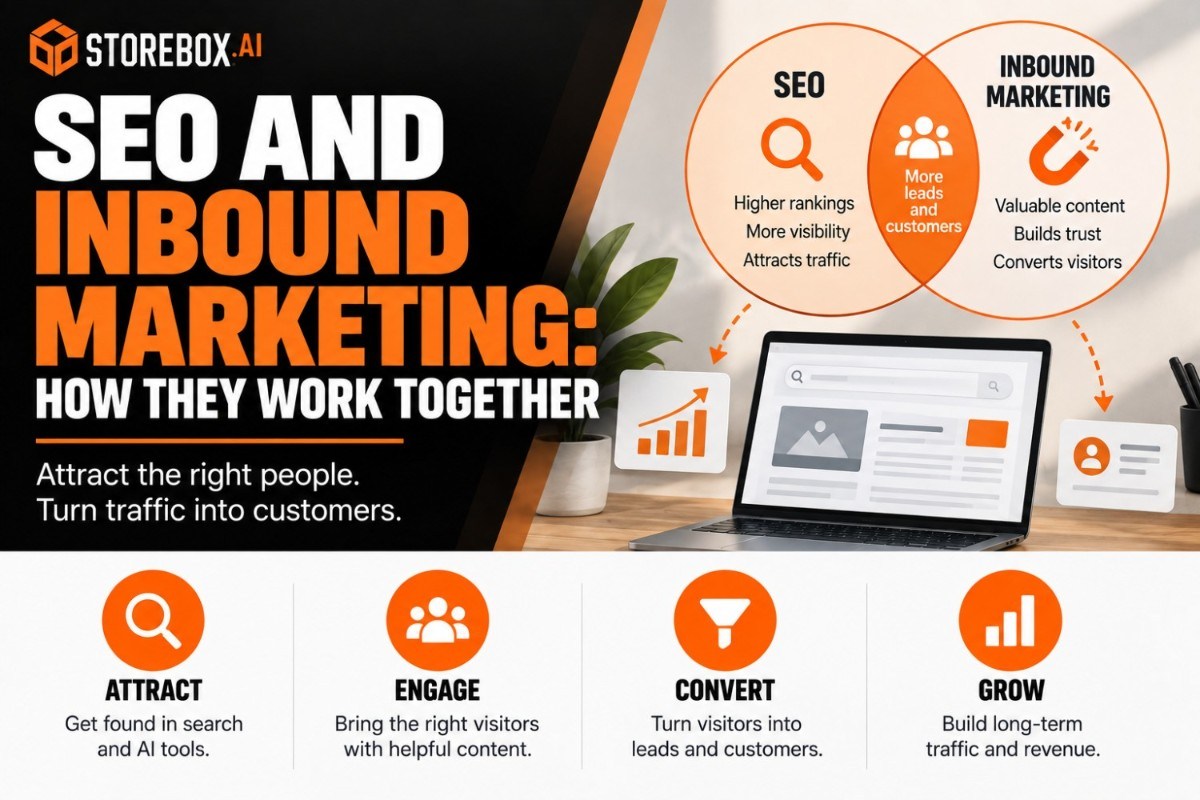
SEO and inbound marketing get talked about as two separate disciplines, often by two separate vendors trying to sell two separate retainers. For a small business, splitting SEO and inbound marketing apart creates more cost and less result. SEO and inbound marketing share the same goal: be the business a customer finds when they go looking, instead of paying to interrupt them when they aren't. The difference is scope. Inbound marketing is the whole approach of earning attention with useful content, and SEO is the part that makes sure the content shows up when someone types a question into Google or asks an AI assistant.
That relationship matters more in 2026 than it did a few years ago. Search results now include AI Overviews, map packs, and answer boxes that pull from well-structured pages, and the businesses that treat SEO and inbound marketing as one system tend to be the ones those features cite. This guide covers how the two connect, which tools a small business needs (and which it can skip), real examples, how the funnel maps to search intent, what inbound costs, and where to start without buying an enterprise platform.
SEO and Inbound Marketing at a Glance
| Question | Short answer |
|---|---|
| What is inbound marketing? | Attracting customers with content and experiences they go looking for, instead of interrupting them with ads, cold calls, or unsolicited email. |
| Where does SEO fit into inbound marketing? | SEO is the discovery layer. It gets inbound content found by people who are already searching for an answer or a provider. |
| How much website traffic comes from organic search? | 53 percent of trackable website traffic, compared with about 15 percent from paid search and 5 percent from organic social, according to BrightEdge research across thousands of domains. |
| Is inbound cheaper than outbound marketing? | Content marketing generates over three times as many leads as outbound marketing and costs 62 percent less, according to Demand Metric. |
| What does enterprise inbound software cost? | HubSpot Marketing Hub Enterprise costs $3,600 a month and includes five seats, before any add-ons. |
| What should a small business start with? | A website with pages built around searches customers already run, a complete Google Business Profile, and a steady habit of collecting reviews. |
What Is Inbound Marketing, Briefly
Inbound marketing means creating content and experiences that people seek out on their own, then turning that attention into a relationship and eventually a sale. The term was popularized by HubSpot, whose founders built both a methodology and a software company around it, which is why so much of the definitional content online comes from HubSpot itself.
The easiest way to understand it is by contrast. Outbound marketing, sometimes called traditional marketing, pushes a message toward people who didn't ask for it: cold calls, direct mail, TV spots, display ads, purchased email lists. Inbound pulls people toward a business because they were already searching for what it offers.
Inbound: Pulls People In
A plumber's page answering "why is my water heater making a popping noise" is inbound. The reader was already looking.
Outbound: Pushes a Message Out
A flyer on every door in the neighborhood is outbound. Both can work, but they carry very different cost structures, covered with numbers below.
SEO and Inbound Marketing: How They Connect
Inbound content only works if people see it, and search is where most of them will. BrightEdge found organic search responsible for 53 percent of trackable website traffic, while organic social media contributes just 5 percent, about one eleventh as much. That single comparison explains why SEO carries so much of the weight inside an inbound strategy. A business can publish excellent content and share it on social media every week, but if the pages aren't built to rank, most potential readers will never reach them.
For B2B businesses the concentration is even stronger. More than 75 percent of B2B website traffic comes from organic and paid search combined, and social media delivers less than 1 percent of revenue on average in the same research.
How the Two Pieces Divide the Work
-
Inbound decides what to create. What questions customers ask, what worries slow down a purchase, what a first-time buyer needs to understand before calling.
-
SEO decides how that content gets found. Which exact phrases people search, how pages are structured, how fast they load, whether they carry schema markup, and whether other sites link to them.
-
Inbound handles what happens after the click. A clear next step, a form or booking link, a follow-up email, a reason to come back.
-
SEO measures whether any of it is reaching people. Rankings, impressions, and clicks from Google Search Console show which pages earn attention and which ones need rework.
SEO vs Inbound Marketing: What's the Difference?
SEO is a set of techniques for earning visibility in search engines. Inbound marketing is a broader strategy that uses search, email, social, reviews, and content together to attract and convert customers. Every inbound strategy needs SEO to scale, but SEO can exist without inbound thinking, which is how businesses end up with pages that rank for a keyword and then fail to convert a single visitor because nobody planned what the reader should do next.
Inbound Marketing Tools a Small Business Needs
Inbound marketing tools range from free Google products to enterprise platforms costing thousands of dollars a month. For context, HubSpot Marketing Hub Enterprise costs $3,600 a month with five seats and 10,000 marketing contacts included. That price makes sense for a marketing department running multi-channel campaigns. It rarely makes sense for a salon, a contractor, or a five-person accounting firm.
| Job to be done | Small business option | Enterprise option |
|---|---|---|
| Website and content publishing | A managed site or simple CMS | Custom CMS with a development team |
| Search performance | Google Search Console (free) | Paid SEO suites and rank trackers |
| Traffic and conversion analytics | Google Analytics (free) | Multi-touch attribution platforms |
| Local visibility | Google Business Profile (free) | Listing management software across hundreds of locations |
| Contacts and follow-up | A free or starter-tier CRM and email tool | Full marketing automation with lead scoring |
The pattern across that table is consistent. The free tier of almost every category covers what a small business needs to start, and paid tools earn their cost only once there's enough traffic and enough leads to manage. Buying the tool before the content exists is one of the most common ways small businesses overspend on inbound. Our guide to optimizing a Google Business Profile covers the most valuable free tool on the list.
Inbound Marketing Examples That Fit a Small Business
Most published inbound marketing examples come from software companies with content teams. These are closer to what works for a local or service business:
A Pricing or Cost Page
A page answering "how much does [your service] cost in [your city]" captures people close to a decision. Many businesses avoid publishing prices, which leaves the search to competitors or directories.
Service-Area Pages
One page per city or neighborhood served, each with specific local detail, gives search engines a reason to show the business for location-based searches.
A Review Request After Every Job
Reviews feed both Google rankings and the trust decision a new customer makes, and asking the same day works far better than asking weeks later.
An FAQ Built From Real Phone Calls
The questions a front desk hears every week are the questions people type into search engines and AI assistants.
A Comparison Page
"Repair vs replace," "DIY vs hiring a pro," or "us vs the national chain" pages meet people in the middle of a decision.
Useful Posts on Facebook and Local Groups
Social works best as a way to point existing followers toward content that lives on the website.
Our trade-specific guides show these tactics applied in practice, including plumbing lead generation, painting leads, and Facebook marketing for local business.
Service pages, area pages, and FAQ answers, built for you.
Storebox sites come structured for search and AI citation from day one.
Get My Free Website Draft →The Inbound Marketing Funnel, Mapped to Search Intent
The inbound marketing funnel usually gets drawn as awareness, consideration, and decision. The more useful way to plan it is by the kind of search a person runs at each point:
-
1. Awareness Searches Are Questions About a Problem
"Why is my AC blowing warm air" or "signs of a roof leak." The person may not know they need a professional yet. Helpful explainer content wins here.
-
2. Consideration Searches Compare Options and Prices
"Repair vs replace AC unit," "how much does a new roof cost," "best type of flooring for a kitchen." This stage is where people start forming a shortlist, and the one most sites skip.
-
3. Decision Searches Name a Provider or a Location
"AC repair near me," "[business name] reviews," "roofer in [city]." Service pages, reviews, and a complete Google Business Profile carry this stage.
Most small business websites cover only the decision stage, a homepage and a services list, and sometimes a scattering of awareness blog posts. The consideration stage gets skipped, even though it's where buyers compare costs and approaches, and it often has the least competition. The keyword research behind this article shows the same pattern for inbound marketing itself: the broad definitional question draws heavy competition from software companies, while "how much does inbound marketing cost" and "inbound marketing for small business" face a small fraction of that difficulty.
What Inbound Marketing Costs
Inbound marketing costs vary more by who does the work than by which tactics are used. There are three realistic routes:
Route 1
Do It Yourself
The tools can be close to free, but the real cost is time: writing pages, maintaining the website, requesting reviews, and checking Search Console. Owners who try this often stall after a few months because client work always wins the week.
Route 2
Hire a Consultant or Agency
A consultant can set strategy and train someone in-house, while an agency usually handles execution on a monthly retainer. Our breakdown of marketing agency pricing covers typical retainer ranges.
Route 3
Use a Managed Service
A service that bundles the website and SEO suits businesses that want the fundamentals handled without paying for a full marketing department.
Whichever route a business picks, the economics favor inbound over time. Demand Metric found content marketing generates over three times as many leads as outbound marketing while costing 62 percent less.
3x
more leads than outbound
62%
lower cost than outbound
The catch is timing. Outbound can produce calls next week, while inbound and SEO usually take a few months to show meaningful movement, as covered in our guide on how long local SEO takes to show results. Businesses that judge inbound after thirty days tend to quit right before it starts paying off.
The website itself is part of the cost too, and it's where many small businesses underinvest or overpay. Our guide to small business website cost covers realistic numbers for every build route.
Also Read
Done-for-You vs DIY WebsiteInbound Marketing for Small Business: Where to Start
Inbound marketing for small business looks nothing like the enterprise version, and trying to copy the enterprise version is where most owners get stuck. A small business doesn't need lead scoring, multi-touch attribution, or a content calendar with forty posts a quarter. It needs a handful of fundamentals done consistently for a long time.
In order of impact, those fundamentals look like this:
A business that does those five things every month for a year will usually outperform a competitor who bought an expensive platform and published three blog posts. Our local SEO checklist and complete local SEO guide turn this into a step-by-step plan.
%20(1).png)
How Storebox handles SEO and website marketing for you:
- ✓Websites built and managed for you, with a clear page for every service and area you serve.
- ✓SEO and AEO built in from day one, including schema markup on every page.
- ✓Answer-style content that search engines and AI tools can pull and cite.
- ✓Ongoing updates handled by our team, so the fundamentals keep running without an agency retainer.
- ✓Plans starting at $9.99 a month.
Frequently Asked Questions
What's the difference between SEO and inbound marketing?
How much does inbound marketing cost for a small business?
What tools do I need for inbound marketing?
Is inbound marketing better than outbound marketing for small business?
What's a simple inbound marketing checklist to get started?
Do I need an inbound marketing consultant?
Sources
Want SEO and inbound handled as one system, without the enterprise price tag?
Start With a Free Website Draft →