Storebox Team·Jul 24, 2026·Updated Oct 8, 2026·17 min read
Key Insights
Squarespace ecommerce alternatives compared for 2026: real pricing, Reddit reviews, and where Squarespace Commerce's template model runs into trouble.
Expand key insights
Squarespace's ecommerce templates are genuinely strong for a small, curated catalog, but store owners consistently describe the category and subcategory system as an afterthought bolted onto a website builder rather than a real ecommerce platform.
A recurring, specific complaint is that Squarespace shop pages display every product at once with no way to build a proper landing page: featured items, lifestyle photography, then subcategory navigation. Store owners describe this as defeating the entire purpose of having categories in the first place.
Squarespace Commerce pricing runs $28 to $52 a month with no transaction fees on paid plans, but the app store and third-party integration ecosystem is noticeably thinner than Shopify's, meaning fewer ready-made ways to extend functionality Squarespace doesn't build in natively.
Inventory depth and product variant handling are more basic than dedicated ecommerce platforms, which becomes a real constraint once a catalog grows past a simple, curated product line.
Squarespace's on-page SEO tools are solid for a general website, but schema and structured-data control for ecommerce specifically is more limited than platforms built ecommerce-first.
A done-for-you ecommerce alternative removes the exact gap Squarespace store owners describe: the design stays polished, but the category structure, inventory depth, and app ecosystem are handled properly instead of worked around.
Why People Look for Squarespace Ecommerce Alternatives
Squarespace built its reputation on design, and that reputation is well earned. But a growing number of store owners researching Squarespace ecommerce alternatives describe two consistent, specific gaps: category and inventory structure, and support quality that varies sharply from one account to the next.
Squarespace
WHAT STORE OWNERS ARE LEAVING
The clearest pattern behind the switch splits two ways. First, category and inventory structure: Squarespace shop pages display every product at once with no way to build a proper landing page, featured items, lifestyle photography, then subcategory navigation, which store owners describe as defeating the purpose of having categories in the first place. Second, support quality: store owners report very different outcomes for similar issues, from resolution within hours to being passed between agents for weeks, with no phone support channel available either way.
Key Features
● Design templates that require little to no customization to look professional
● Integrated booking, scheduling, and content tools alongside commerce
● No transaction fees on paid Commerce plans
● Simpler builder experience than managing a self-hosted platform
Does anyone else feel like the offerings through Squarespace are terrible? We wanted to try a merch section out on our existing site. I thought it would be pretty easy but I thought wrong. I tried so many options but the minute you enter the shop EVERY product is displayed. Kind of defeats the purpose of having categories and sub categories if the landing page displays everything. Am I missing something or what? In a perfect world, I would like the landing page for shop to be, featured products, some lifestyle photos and then the nav bar for the subcategories. Is this even achievable?
Squarespace just isn't good for e-commerce at all and its quite frustrating that they advertise it as such because they're really ignoring where its strengths really lie.
💬 Reply➦ Share
Support quality is a separate, less discussed reason. Multiple recent discussions describe it as inconsistent, not uniformly bad.
"We left SquareSpace a few weeks after paying for a year because of it." — a store owner describing a support experience, r/squarespace
"I have personally never encountered any issues with Squarespace support." — an agency owner managing more than 30 live client sites, r/squarespace
Pros
✓ Templates require little to no customization to look professional
✓ No transaction fees on paid Commerce plans, predictable flat pricing
Cons
✗ Category and inventory depth are noticeably more limited than dedicated ecommerce platforms
✗ Support response times vary significantly, with no phone support channel
Neither pattern means Squarespace is a bad platform. The design praise is genuine, and it stays genuine throughout this guide. The category structure, the shop landing page, and support consistency are what store owners run into trouble with once they try to sell more than a simple, curated line of products, and it is the most common reason a squarespace online store alternative search happens in the first place.
This is one part of a broader pattern covered in small business website management: a platform's design strength does not automatically transfer to its ecommerce depth, and the two are worth evaluating separately before committing.
Is Squarespace Good for Ecommerce? Pricing, Cost, and Limitations
Is Squarespace good for ecommerce?
Yes, for a specific kind of store: a small, visually driven catalog where design polish matters more than deep inventory tools. It becomes a less comfortable fit once a store needs real category structure, product variants at scale, or a wider third-party app ecosystem.
Squarespace Commerce Pricing
Squarespace commerce pricing runs $28 to $52 a month depending on tier, with no transaction fees on paid plans. That places it in a similar range to other design-forward builders, and squarespace ecommerce cost stays predictable since there is no revenue-based tier escalation the way BigCommerce charges.
$28–$52
per month, by tier
No transaction fees
on paid Commerce plans
Flat, no revenue tiers
unlike BigCommerce's escalating plans
Templates vs. App Store: Where the Trade-off Shows Up
Squarespace commerce templates are a genuine strength: they look professional with little to no customization required, which is not true of every platform on this list. The limitation shows up specifically in the squarespace commerce app store, which has a noticeably thinner catalog of third-party integrations than Shopify's, meaning fewer ready-made ways to bolt on functionality Squarespace does not build in natively.
Strength: Templates
Look professional out of the box, with little to no customization needed. Not every platform on this list can say that.
Limitation: App Store
A noticeably thinner catalog of third-party integrations than Shopify's, meaning fewer ready-made ways to bolt on missing functionality.
SEO Tools: What's Solid, What's Limited
Squarespace commerce seo tools are solid for general on-page basics, meta titles, descriptions, clean URLs, but structured data and schema control specifically for product listings is more limited than platforms built ecommerce-first. Weighing squarespace ecommerce pros and cons honestly: the design and template quality are genuine advantages, while category structure, inventory depth, and app ecosystem depth are the recurring squarespace commerce limitations that show up in real store owner discussions.
Predictable pricing, real ecommerce depth, done for you
Shopify
$39+ (often $89–$189 real cost)
Deep, ecommerce-first
Huge app ecosystem, native tax and conversion tools
Growing catalogs needing real category structure
WooCommerce
$10–$50 hosting + plugins
Deep, fully customizable
Unlimited products, full design control
Cost-sensitive merchants comfortable with WordPress
BigCommerce
$39+ (revenue-tiered)
Deep, native brand/category pages
Native category and brand page handling
Large, multi-brand catalogs
Wix eCommerce
$17–$35
Basic, similar to Squarespace
AI-assisted site builder, built-in marketing tools
Beginner-friendly, similarly small catalogs
Etsy (marketplace)
$0 + per-listing and transaction fees
Handled by Etsy's template
Built-in shopper traffic, no storefront to build
Built-in buyer traffic over brand control
Ecwid
Free–$15+
Basic, embed-focused
Embeds into an existing site, no migration needed
Adding a store to an existing site
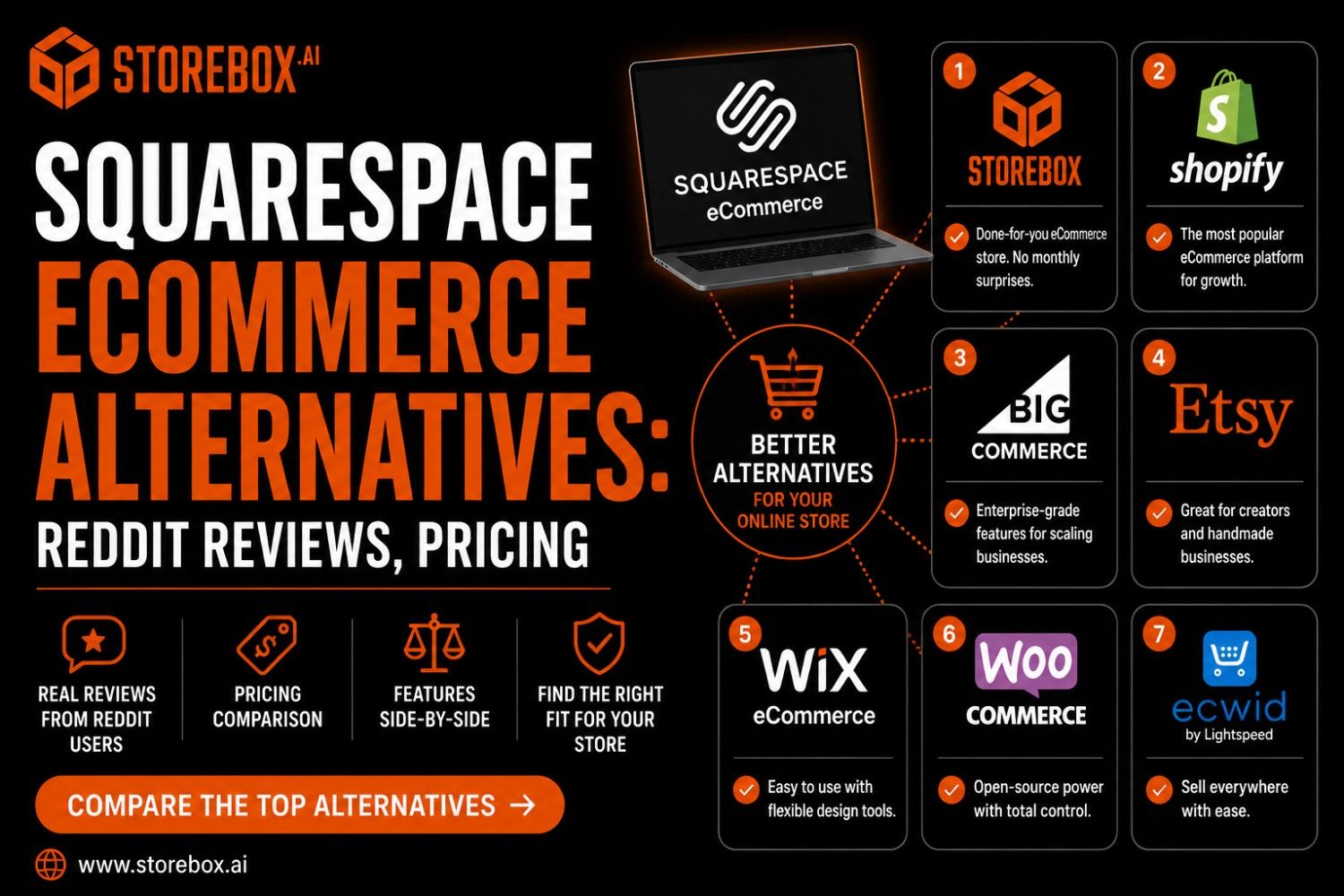
Top 7 Squarespace Ecommerce Alternatives: Features, Pricing, Pros, and Cons
Best Overall Value
1
Storebox
DONE-FOR-YOU
Storebox vs Squarespace
Storebox is a done-for-you managed ecommerce store with product listings, real category structure, and checkout built for you. It handles the exact gaps Squarespace store owners describe, category pages, inventory depth, and app-level functionality, without you needing to work around template limits. Built-in SEO (schema markup, meta tags, sitemap), email marketing, and review collection are included as standard.
Key Features
● Real category and subcategory structure, not a single flat product list
● Store built from your photos, price list, or a voice note, live in 24 hours
● 0% commission on every sale, card processing only
● SEO, email marketing, and review collection all included, zero paid apps
● Free migration from Squarespace in 24 to 48 hours
Storebox vs Squarespace: Quick Take
Choose Storebox if
You want ecommerce-specific functionality (category structure, SEO, promotions) done for you instead of working around template limits.
Choose Squarespace if
You want a simple, design-first site with a small catalog and don't need deep ecommerce functionality.
Pros
✓ Directly solves the category and inventory-depth gap named across Squarespace store owner discussions
✓ No app store to search through for missing functionality
✓ Unlimited content updates with 24-hour turnaround, free migration in 24-48 hours
Cons
✗ Less hands-on template customization than a fully self-built Squarespace site, since the build is managed for you
Best for: Store owners who like Squarespace's design sensibility but have run into its category, inventory, or app ecosystem limits, and want a done-for-you Squarespace ecommerce alternative rather than another self-managed builder.
Shopify is a dedicated ecommerce platform, and squarespace ecommerce vs shopify is the highest-intent comparison in this category. Shopify wins clearly on category structure, inventory depth, and app ecosystem size. Squarespace wins on out-of-the-box visual polish for a small catalog with minimal customization effort.
Key Features
● Real category and collection structure built for browsing at scale
● Massive app ecosystem for nearly any missing feature
● One-page checkout and Shop Pay for faster repeat purchases
"Ecwid was very limited with its beginner plans." — a Reddit user describing their switch to Shopify after outgrowing a simpler platform, illustrating the same category-and-scale pattern Squarespace store owners describe
Shopify vs Squarespace: Quick Take
Choose Shopify if
You need deeper inventory tools, more ecommerce apps, and stronger checkout customization.
Choose Squarespace if
Design polish matters more than ecommerce depth and your catalog is small.
Pros
✓ Real category and collection browsing, the specific gap Squarespace store owners describe
✓ Far larger app ecosystem than Squarespace's
Cons
✗ Themes typically need more setup effort to look as polished as a default Squarespace template
Best for: Store owners who have outgrown Squarespace's category and inventory limits and need a platform built ecommerce-first. For a deeper look, see our full Shopify alternatives guide.
WooCommerce is a free, open-source WordPress plugin, and squarespace ecommerce vs woocommerce is one of the closer comparisons in this list on cost, but not on design effort. WooCommerce offers unlimited category depth and full design control. Squarespace requires far less setup work to look professional.
Key Features
● Unlimited products and unlimited category depth
● Full design control through WordPress themes
● Large plugin ecosystem for nearly any feature
"I also hate that every additional thing is another plug-in that costs more." — a store owner on the trade-off between WooCommerce's low starting cost and its ongoing plugin stack, r/woocommerce
WooCommerce vs Squarespace: Quick Take
Choose WooCommerce if
You want full catalog and design control and don't mind managing plugins and hosting.
Choose Squarespace if
You want zero technical maintenance even if it means less catalog depth.
Pros
✓ No product or category limit, no core platform fee
✓ Full control over category and subcategory structure
Cons
✗ Security patching and plugin compatibility management falls on the store owner
Best for: Store owners comfortable with WordPress who want unlimited category and product structure without Squarespace's template constraints.
BigCommerce is a fully hosted ecommerce platform, and squarespace ecommerce vs bigcommerce is a direct trade of design ease for catalog depth. BigCommerce handles native category and brand pages, which is precisely the structural gap Squarespace store owners describe running into.
Key Features
● Native category and brand page handling
● No transaction fees
● More built-in marketing tools than Squarespace's default coupon system
"Shopify has no native way to create brand or category pages." — a merchant who tested both platforms for marketplace-style stores, on BigCommerce's specific structural advantage, r/ecommerce
BigCommerce vs Squarespace: Quick Take
Choose BigCommerce if
You need native category and brand page handling for a larger catalog.
Choose Squarespace if
Your catalog is small and visual polish matters more than inventory depth.
Pros
✓ Native category and brand pages solve the exact gap named in Squarespace store owner discussions
Cons
✗ Revenue-tier pricing means costs can rise automatically as sales grow
Best for: Store owners whose catalog has outgrown Squarespace's flat product listing and need genuine multi-category structure. See our dedicated BigCommerce alternatives guide for more.
Wix eCommerce is a drag-and-drop store builder, and it sits closest to Squarespace on this whole list: similar catalog depth, similar beginner-friendly builder model, different visual design language and template aesthetic.
Key Features
● Drag-and-drop store builder
● AI-assisted site generation
● Built-in basic SEO and marketing tools
Wix eCommerce vs Squarespace: Quick Take
Choose Wix if
You want a similarly beginner-friendly builder with different design language and more built-in marketing tools.
Choose Squarespace if
You specifically prefer Squarespace's template aesthetic and are comfortable with its category limits.
Pros
✓ Built-in marketing tools (email, coupons, loyalty) more developed than Squarespace's defaults
Cons
✗ Similar catalog depth limits to Squarespace, just structured differently
Best for: Store owners who want a similarly beginner-friendly builder with a different visual style and slightly more built-in marketing functionality. See our dedicated Wix ecommerce alternatives guide for more.
6
Etsy
MARKETPLACE
Etsy vs Squarespace
Etsy is a built-in marketplace listing and checkout, with no separate storefront needed. Squarespace commerce vs Etsy is a question of platform ownership versus built-in shopper traffic: Squarespace gives you a fully branded site, Etsy gives you an existing audience.
Key Features
● Built-in shopper traffic from Etsy's own marketplace search
● No separate storefront or hosting to build or maintain
● No monthly platform fee, pay per listing and per sale
Etsy vs Squarespace: Quick Take
Choose Etsy if
You want built-in marketplace traffic instead of building your own audience from scratch.
Choose Squarespace if
You want your own branded store rather than a marketplace listing template.
Pros
✓ Built-in shopper traffic a standalone Squarespace store doesn't have on its own
Cons
✗ No control over branding or buyer experience beyond Etsy's template, per-transaction fees on every sale
Best for: Sellers who value Etsy's built-in buyer traffic and are comfortable trading brand control and transaction fees for that audience.
Ecwid is an embeddable shopping cart that adds ecommerce to a website you already have. Against Squarespace, it's a question of adding a store to an existing site versus rebuilding on an all-in-one design-and-commerce platform.
Key Features
● Embeds into an existing site through a code snippet
● No full platform migration required
● Free plan available for a small catalog
Ecwid vs Squarespace: Quick Take
Choose Ecwid if
You already have a website and just want to add a cart, without a full site rebuild.
Choose Squarespace if
You want an all-in-one design-forward site and store built together from the start.
Pros
✓ Fastest option if you already have a site and just need checkout capability
Cons
✗ Not a full website platform: no CMS or custom page design of its own
Best for: Store owners who already have a site they're happy with and want to avoid a full Squarespace migration entirely, just adding commerce functionality on top.
Squarespace ecommerce vs shopify reddit threads and general squarespace ecommerce review discussions surface the same pattern repeatedly: the design praise is genuine, but the ecommerce-specific complaints are just as consistent.
The shop landing page displays every product at once with no way to feature items, add lifestyle photography, or route shoppers into subcategories first, which the original poster describes as defeating the purpose of having categories at all.
"Squarespace just isn't good for e-commerce at all"
A pointed reply noting the platform is quite frustrating to sell on specifically because Squarespace advertises itself as an ecommerce solution while, in this commenter's view, not building toward where its actual strengths lie.
💬 Reply➦ Share
▲44▼
Posted in r/ecommerce
Design praise, ecommerce caution, in the same threads
A recurring pattern across these discussions: nobody disputes that Squarespace templates look professional out of the box. The caution is specifically about category structure, inventory depth, and app ecosystem once a catalog needs to grow past a simple, curated line.
💬 Reply➦ Share
Post 3 is a simulated community summary distilling a broader discussion pattern, not a single verbatim thread. Posts 1 and 2 quote a real r/squarespace thread and reply.
None of this means Squarespace is a poor platform. It means the design strength that makes it a strong general website builder does not automatically extend to deep ecommerce functionality, and store owners planning to grow past a small, curated catalog are worth evaluating that gap honestly before committing.
Done-for-You Squarespace Alternative: Why Storebox Leads This List
A done for you squarespace ecommerce alternative addresses the pattern named consistently throughout this guide: the design should never need to suffer, but the category structure, inventory depth, and app-level functionality need to actually work for ecommerce, not just look good on a website.
Storebox is a squarespace online store alternative built with:
🗂️
Real category and subcategory structure, not a single flat product list
Featured products, lifestyle photography, and a proper subcategory navigation, the exact landing page structure Squarespace store owners describe wanting but not finding a way to build.
🎨
Professional store design without needing to build it yourself
Keeps the design polish Squarespace is known for, without needing to work around its template constraints to get there.
🔍
SEO built in, not sold as an app-store add-on
Schema markup, meta tags, and sitemap configuration are part of every Storebox build from day one, addressing the deeper structured-data gap Squarespace's ecommerce SEO tools leave open.
📣
Conversion features included by default
Email marketing and review collection come standard, no need to search a thin app store for functionality that should be included.
🔄
Unlimited content updates with 24-hour turnaround
New products, category changes, seasonal promotions. All included in the monthly price, handled for you, live within 24 hours.
This is the direct answer for a store owner who loves Squarespace's design sensibility but has run into its category, inventory, or app ecosystem limits. See how Storebox builds ecommerce stores for the full feature breakdown, and small business website management for how this fits into a broader online presence.
What is included at every plan, no add-on apps required.
Real category and subcategory structure, not a flat product list
0% commission on every sale
Built-in SEO: schema markup, meta tags, sitemap
Email marketing and review collection included
No app store to search for missing functionality
Unlimited content updates with 24-hour turnaround
Starter
$9.99/mo
Store, schema, SEO, unlimited 24-hour edits
Popular
Growth
$19.99/mo
Everything in Starter plus review automation, lead routing, growth optimization
Pro
$49.99/mo
Everything in Growth plus multi-location pages, advanced analytics
No contract. Free migration from Squarespace, Shopify, or any other platform in 24 to 48 hours.
We build a free ecommerce store draft from your business name and product type in under five minutes. No signup. No card.
What are the best Squarespace ecommerce alternatives?
The best Squarespace ecommerce alternatives depend on what's driving the switch. Storebox is the top choice for store owners who love Squarespace's design sensibility but have hit its category, inventory, or app ecosystem limits, since it is a done-for-you squarespace online store alternative starting at $9.99 a month. Shopify and BigCommerce suit growing catalogs needing real category and brand page structure. WooCommerce fits store owners wanting unlimited catalog depth and full design control. Wix suits a similarly beginner-friendly builder with a different design language. Etsy suits sellers who value built-in marketplace traffic over brand control. Ecwid suits store owners who already have a site and just want to add a cart.
Is Squarespace good for ecommerce?
Yes, for a specific type of store: a small, visually driven catalog where design polish matters more than deep inventory tools. It becomes a less comfortable fit once a store needs real category and subcategory structure, product variants at scale, or a wider third-party app ecosystem. Store owners commonly describe the shop landing page displaying every product at once with no way to build a proper featured-and-category layout, which is a specific, recurring limitation rather than a vague complaint.
How much does Squarespace Commerce cost?
Squarespace commerce pricing runs $28 to $52 a month depending on tier, with no transaction fees on paid plans. Unlike BigCommerce, there is no revenue-based tier escalation, so squarespace ecommerce cost stays predictable as sales grow. The cost concern with Squarespace is less about the sticker price and more about needing to add workarounds, or switch platforms entirely, once a catalog outgrows its category and inventory tools.
What are the limitations of Squarespace Commerce?
The most specific squarespace commerce limitations named by store owners are the shop landing page displaying every product with no featured-item or category-first layout, more basic inventory and product variant handling than dedicated ecommerce platforms, a thinner app store than Shopify's for extending functionality, and more limited schema and structured-data control for ecommerce SEO specifically. None of these affect the platform's general website design quality, which remains a genuine strength.
What is the difference between Squarespace and Shopify for ecommerce?
Squarespace ecommerce vs Shopify comes down to design effort versus ecommerce depth. Squarespace requires little to no customization to look professional, while Shopify offers real category and collection structure, deeper inventory tools, and a far larger app ecosystem. Store owners with a small, curated catalog often prefer Squarespace's out-of-the-box polish, while those needing to organize a growing catalog into real categories typically move to Shopify or a done-for-you alternative.
What is a done-for-you Squarespace ecommerce alternative?
A done-for-you Squarespace ecommerce alternative is a managed service that builds, hosts, and maintains your online store for a flat monthly fee, keeping the design quality Squarespace is known for while properly handling category structure, inventory depth, and SEO instead of leaving them as template workarounds. Storebox provides this starting at $9.99 a month, with free migration from Squarespace completed in 24 to 48 hours.
See what your store could look like on Storebox.
Get a free draft in five minutes. No signup. No card.


%20(1).png)