Key Insights
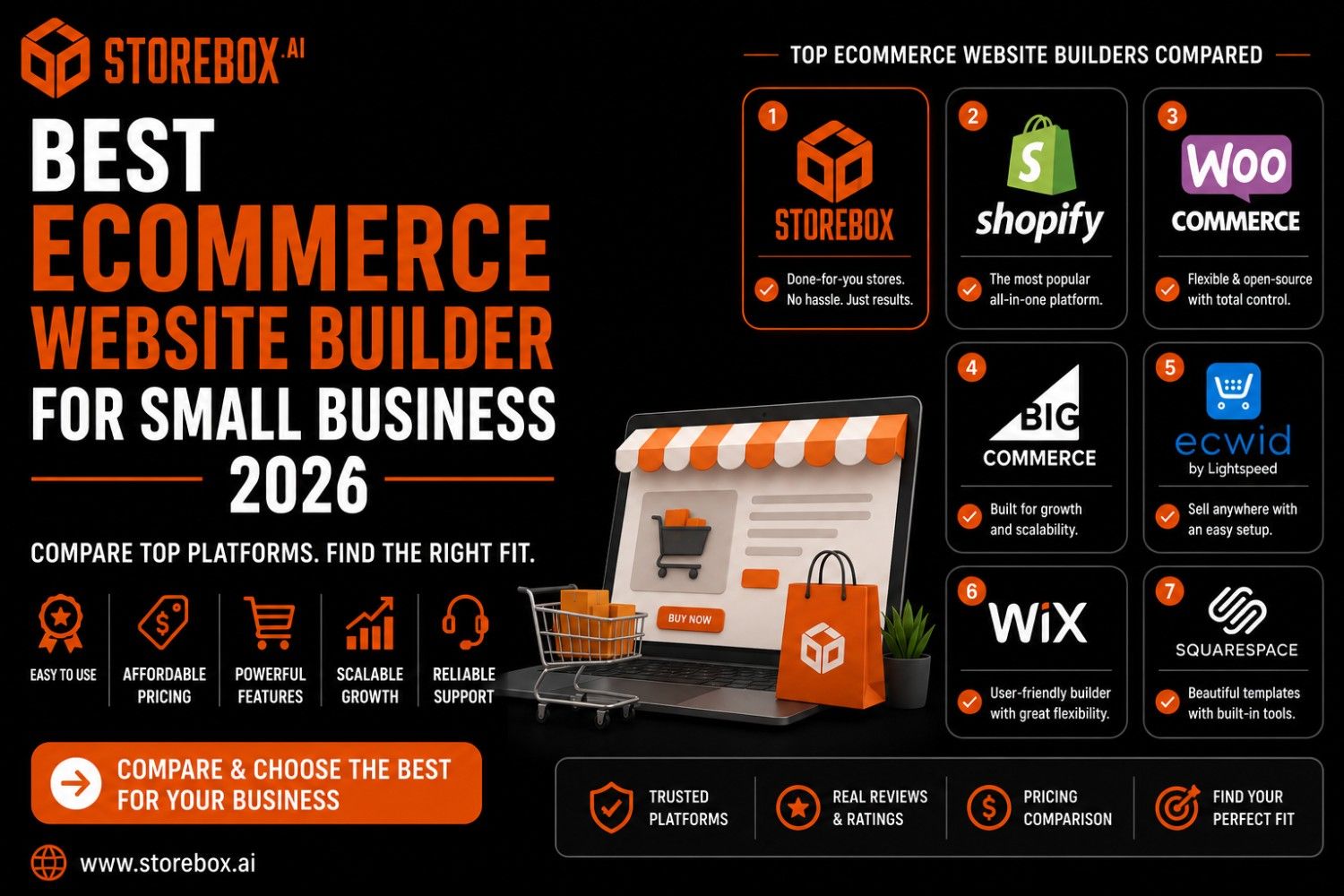
The best ecommerce website builder for small business in 2026: Shopify, WooCommerce, BigCommerce, Wix, Squarespace, Ecwid, and Storebox, compared with real Reddit reviews.
Expand key insights
- There is no single best ecommerce platform. There is only the best one for your specific catalog, budget, and how much time you want to spend managing it. A family craft store and a dropshipping operation need different tools, even if both call themselves "small business."
- Shopify's biggest complaint isn't the software. It's that the platform gets more expensive as your store succeeds. More than one store owner has described this as being penalized for growth, since Shopify's fees and app costs scale with sales volume.
- WooCommerce is genuinely free to install, but "free" quietly becomes a part-time job. Security, plugin updates, and support all fall on you or whoever you hire, and Reddit threads on this are full of people who found that out the hard way.
- Chargebacks and payment disputes hit different platforms differently. At least one Shopify user has flagged that disputed orders tend to resolve in the customer's favor almost automatically, which matters if you sell anything a scammer might target.
- The cheapest platform on paper is rarely the cheapest platform in practice. Once you count hosting, plugins, apps, and your own hours, a $0 starting price can end up costing more than a flat $10 to $50 a month plan that includes everything.
- A done-for-you ecommerce platform skips the whole debate. Instead of picking a builder and becoming its unpaid IT department, you describe your business and someone else handles the build, the security, and the updates.
Table of Contents
- How to Choose an Ecommerce Platform
- Best Ecommerce Platform Comparison Chart
- 7 Best Ecommerce Platforms Compared
- Storebox vs Shopify vs WooCommerce and Wix
- Cheapest Platform, Dropshipping, Etsy, and Solopreneurs
- What Else Reddit Says: The Middle-Ground Takes
- Why Storebox Is the Best Small Business Ecommerce Builder
- Frequently Asked Questions
Somewhere right now, a small business owner is at their kitchen table at 11pm with six browser tabs open, trying to figure out if WooCommerce is actually cheaper than Shopify or if that's just something people say on Reddit. If that's you, you're not wrong to be confused. The honest answer: it depends, and most articles won't tell you what it depends on.
This one will. We've built detailed, Reddit-sourced comparisons for every major ecommerce platform, and this page pulls all seven into one ranked list, with pros, cons, and real user complaints for each.
How to Choose an Ecommerce Platform for Your Small Business
Before comparing platforms, answer three questions honestly.
How technical are you, really? Not how technical you'd like to become this year. WooCommerce rewards people who don't mind fiddling with plugins and the occasional broken update. Shopify and Wix reward people who want to click a button and move on with their day.
What does your catalog actually look like? Five handmade products is a different problem than 500 SKUs with variants. A platform perfect for one is genuinely painful for the other, which is where most "best ecommerce platform" roundups fall apart: they compare features instead of catalog fit.
Who's going to fix it when something breaks? This is the question nobody asks upfront and everybody asks three months in. If the answer is "me, eventually, after googling it," factor that time into the price. If the answer is "nobody, because I don't have a developer," you've just ruled out a few options.
One small business owner on Reddit summed up the actual decision better than most marketing pages do, a pattern we've also covered in our small business marketing playbook.
That's not a knock on Shopify specifically. It's the honest trade-off underneath almost every ecommerce platform comparison: easier usually means pricier, and cheaper usually means more of your own time.
Skip the whole debate.
Describe your business, we build and maintain the store. From $19.99/mo, flat.
Best Ecommerce Platform Comparison Chart
| Platform | Starting cost | Real cost with apps | Technical effort | Best for |
|---|---|---|---|---|
| Storebox | $19.99/mo flat | Same, no add-ons needed | 0, done for you | Ecommerce owners who want to sell, not troubleshoot IT issues |
| Shopify | $39/mo | $89–$189/mo | Low to moderate | Ease of use, large app ecosystem |
| WooCommerce | Free + hosting | $30–$150/mo | High | Full control, technical comfort |
| BigCommerce | $39/mo | Rises with revenue | Moderate | Larger, complex catalogs |
| Wix | $17/mo | $17–$35/mo | Low | Small, simple catalogs |
| Squarespace | $28/mo | $28–$52/mo | Low | Design-first, small stores |
| Ecwid | Free–$15/mo | Free–$99/mo | Low | Small stores |
7 Best Ecommerce Platforms for Small Business: Features, Pricing, Pros, and Cons


Read through all 7 and still not sure?
We'll build a free store draft from your business name and product type. No signup. No card.
Storebox vs Shopify vs WooCommerce, and Storebox vs Shopify vs Wix
Storebox vs Shopify vs WooCommerce
Shopify vs BigCommerce vs WooCommerce is the classic three-way search, but it leaves out the option most people haven't heard of yet. Here's what changes when you swap BigCommerce for Storebox.
| Factor | Storebox | Shopify | WooCommerce |
|---|---|---|---|
| Starting cost | $19.99/mo flat | $39/mo | Free + hosting |
| Real cost once running | Same, no add-ons | $89–$189/mo | $30–$150/mo |
| Who manages security and updates | Storebox | Shopify | You or your developer |
| Pricing changes as you grow? | No | Yes, apps and fees scale | No platform fee, but time cost scales |
| Technical effort required | Minimal | Low to moderate | High |
Shopify wins on ease of use against WooCommerce alone. WooCommerce wins on sticker price against Shopify alone. With Storebox in the mix, both advantages shrink: flat pricing beats Shopify's growth-tied fees, and zero maintenance beats WooCommerce's plugin upkeep.
Storebox vs Shopify vs Wix
Shopify vs WooCommerce vs Wix is the smaller-store version of this search, usually decided on Wix's simplicity versus Shopify's depth. Swap in Storebox for WooCommerce and the calculation changes.
| Factor | Storebox | Shopify | Wix |
|---|---|---|---|
| Starting cost | $19.99/mo flat | $39/mo | $17/mo |
| Real cost once running | Same, no add-ons | $89–$189/mo | $17–$35/mo |
| Catalog complexity ceiling | High, built to scale | High | Low, slows past a small catalog |
| Design and SEO included | Yes, by default | Requires apps | Basic tools included |
| Who builds and maintains it | Storebox | You, with support available | You |
Wix is easiest to set up yourself. Shopify handles a bigger catalog once you outgrow Wix. Storebox skips the "set it up yourself" step entirely while still matching Shopify's catalog capacity, at a lower and more predictable monthly cost than either.
For the best ecommerce platform for beginners specifically, Wix and Shopify both get recommended for this reason: neither requires understanding hosting, plugins, or code before launch. A done-for-you platform removes that requirement altogether, worth knowing before you spend a weekend learning a builder you might not need.
Skip the setup-it-yourself step entirely.
Same catalog capacity as Shopify, lower and more predictable pricing than either. From $19.99/mo.
Cheapest Ecommerce Platform, Dropshipping, Etsy Sellers, and Solopreneurs
Cheapest Ecommerce Platform: What "Cheap" Actually Means
The cheapest ecommerce platform on the pricing page is almost never the cheapest once you're actually running a store. WooCommerce and Ecwid both advertise free tiers, genuinely free for a very small, simple catalog. The most affordable ecommerce platform for anyone selling more than a handful of products is usually the one that includes what you need by default, not the one with the lowest sticker price and the longest add-on list.
A best free ecommerce platform search usually leads to the same handful of names: WooCommerce, Ecwid's free tier, and Square Online. All three work for testing an idea. None of them stay free once a store needs tax handling, real marketing tools, or more than a small product count. For the full math on free versus paid, see our breakdown of free vs affordable website builders.
Best Ecommerce Platform for Dropshipping, Etsy Sellers, and Solopreneurs
If you're running a specific kind of small business, the "best" answer narrows fast.
Dropshipping
Needs solid supplier integrations and automated fulfillment. WooCommerce and Shopify both support this through plugins or apps, though each adds setup time and monthly cost on top of the base plan.
Etsy and Handmade Sellers
Really a question about traffic. Etsy hands you an audience. Your own store hands you the customer relationship, minus the 6.5% cut Etsy takes per sale. Keep the Etsy shop for discovery, and build your own site once you have repeat customers worth owning the relationship with.
Solopreneurs
The calculation is mostly about time. The best platform is whichever one requires the least ongoing babysitting, since there's no second person to hand the plugin updates to. Our ecommerce platform overview breaks down what a done-for-you setup looks like.
What Else Reddit Says: The Middle-Ground Takes
A few more Reddit comments capture the honest middle ground better than any marketing page does.
Distilled from r/web_design discussion threads on choosing an ecommerce platform.
We're including that exchange because it's a useful reminder: someone on the internet will always recommend the platform only they can operate. Read every "best platform" claim, including ours, with that in mind.
Search best ecommerce website builder reddit or best ecommerce platform reddit yourself and you'll find the same names repeating: Shopify, WooCommerce, Wix, and increasingly done-for-you options that barely existed as a category a few years back. Whatever "best ecommerce platform 2026" list you find, cross-check it against a real thread first. Marketing copy doesn't mention chargeback risk. Reddit does.
Why Storebox Is the Best Small Business Ecommerce Website Builder
A done-for-you ecommerce platform is exactly what it sounds like: you describe the business, someone else builds and maintains the store. Every platform above requires you to become at least a little bit of a website administrator. Storebox runs on a different premise: you run the business, we run the store.
Flat monthly pricing, not tiers that climb as you succeed
No revenue thresholds, no automatic upgrades, no surprise bill the year your store finally takes off.
No plugin stack, no security patches, no app subscriptions to manage
The "who fixes it when it breaks" question has one answer: we do.
SEO, schema markup, and conversion tools included from day one
Not a separate app, plugin, or upgrade tier. Part of every build from the start.
Fraud-aware checkout out of the box
The chargeback and stolen-card risk described above is handled at the platform level, not left for you to configure.
Free migration from any of the platforms above in 24 to 48 hours
Whichever platform you're on now, the switch is handled for you, not a weekend project.
If the list above made your stomach sink a little because you recognized your own store in one of those complaints, that's usually the sign it's worth a look.
%20(1).png)
What is included, no plugins, apps, or add-ons required.
Flat monthly rate, no revenue-tier upgrades, ever
No plugin stack or app subscriptions to manage
Built-in SEO: schema markup, meta tags, sitemap
Fraud-aware checkout out of the box
Email marketing and review collection included
Unlimited content updates with 24-hour turnaround
Starter
Website only (no ecommerce store), schema, SEO, unlimited 24-hour edits
Growth
Full ecommerce store, plus review automation, lead routing, growth optimization
Pro
Everything in Growth plus multi-location pages, advanced analytics
No contract. We'll build a free draft of your store from your business name in under five minutes, no card required. Every plan includes website maintenance so nothing sits broken while you're busy running the business.
What is the best ecommerce platform for a small business?
What is the best ecommerce website builder for a small business on a tight budget?
What is the cheapest ecommerce platform in 2026?
How do I choose an ecommerce platform for my small business?
What is the best ecommerce platform for dropshipping?
Is there a done-for-you ecommerce platform?
You run the business. We run the store.
Get a free draft in five minutes. No signup. No card.